
Secondary claim guide
Nexus Letter for AFib Secondary to PTSD
Medically reviewed by the Patriot Path Medical Team
Licensed MD reviewers • Last updated:
VA can service connect AFib secondary to PTSD under 38 CFR 3.310 when medical evidence links them, by causation or aggravation. One veteran study found a modest association, not proof; a study of women veterans found no significant link. DC 7010 pays 10 or 30 percent for ECG-confirmed AFib needing interventions or control, and a grant can leave your combined rating unchanged.
Three more things belong up front. This page does not claim a proven cause, because the research does not show one, and VA does not ask for proof: it asks whether the evidence for and against is in approximate balance. Board decisions on this pairing include grants, denials and remands, and each is "binding only with regard to the specific case decided" under 38 CFR 20.1303. And you may not need to buy a letter: in one 2025 Board decision (A25105908) the veteran won through his prescribed medications with no private letter in the file.
An illustrative example
A veteran is service connected for PTSD at 70 percent, and that is his only rating. For a year he has had spells of a pounding, irregular heartbeat. A two-week monitor records paroxysmal atrial fibrillation, his cardiologist starts a daily pill to control it, and he needs one cardioversion that year. Suppose a reasoned opinion links the AFib to his PTSD and VA grants service connection.
On those facts DC 7010's 10 percent row fits: one treatment intervention in the year, and daily oral medication to control. With PTSD at 70 and AFib at 10 as his only two ratings, Table I of 38 CFR 4.25 gives 73, which rounds to 70, so his combined rating does not change. The grant still puts the AFib on the record as service connected under 38 CFR 3.310. If he later needs five or more interventions in a year, the question becomes the rating, and 70 combined with 30 is 79, which rounds to 80.
We put this example together from the rating rules to show the arithmetic. It is not a client and not a case result, and it predicts nothing for any claim.
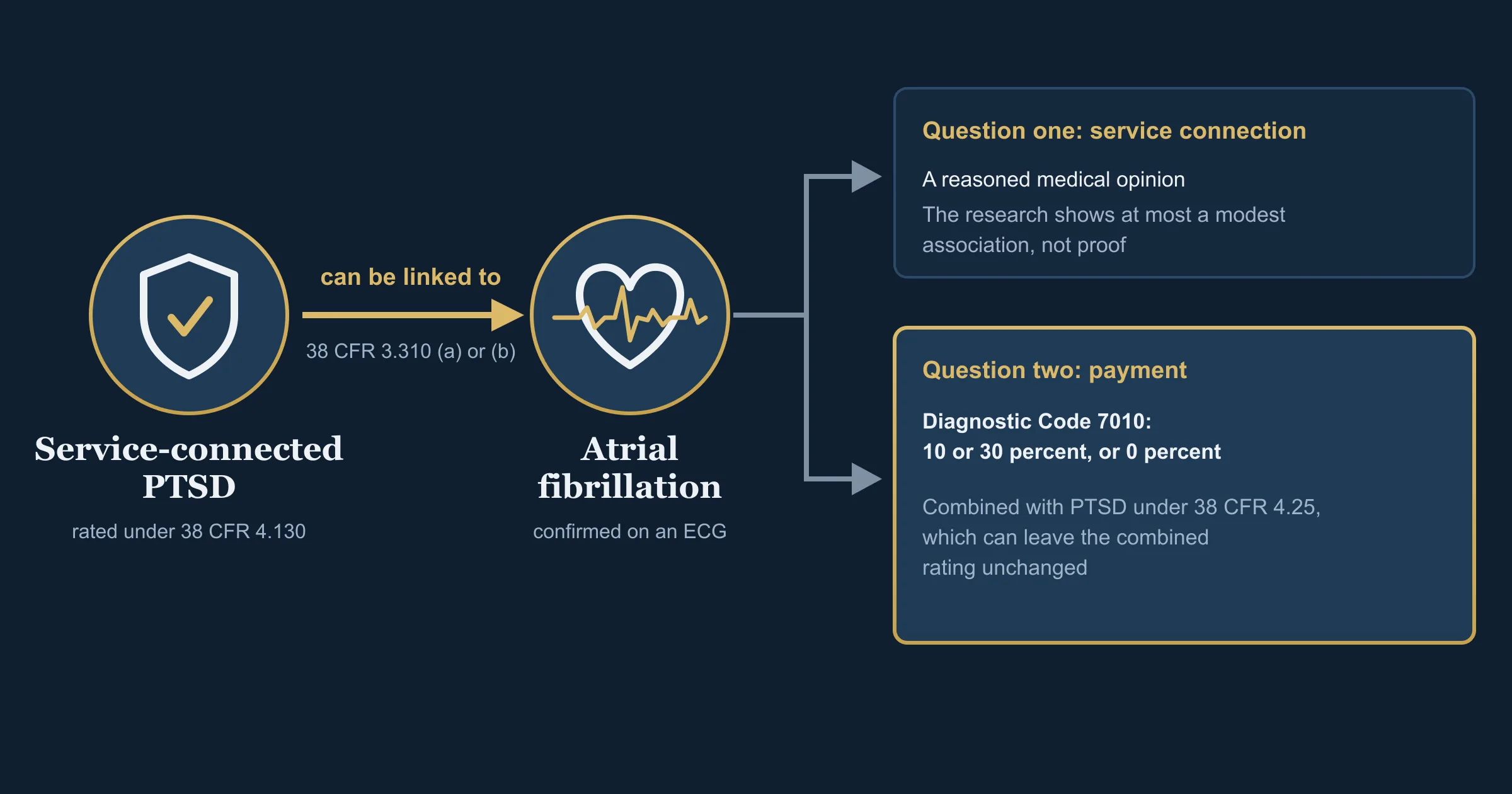
Is There a Real Link Between PTSD and AFib?
The honest answer is a small one in some studies and none in another. No study we found shows PTSD to be a cause of atrial fibrillation. The largest veteran study found an association that is modest after adjustment, and the low end of its confidence range sits at or close to no effect. Each finding below is labelled for what it measured and in whom.
The largest veteran study: a modest association
Rosman and colleagues (Journal of the American Heart Association, 2019) followed 988,090 veterans who first used VA health care between October 2001 and November 2014 and had no atrial fibrillation at the start. Their mean age was about 30, 87.8 percent were men, and mean follow-up was 4.8 years, with 2,491 new AFib diagnoses. Before adjustment, a PTSD diagnosis went with a hazard ratio of 1.31 (95 percent confidence interval 1.19 to 1.43). After adjusting for age, sex, race and ethnicity, hypertension, coronary disease, heart attack, diabetes, sleep apnea, obesity, alcohol and drug abuse, smoking and depression, it was 1.13 (1.02 to 1.24), about 13 percent higher. Adding each veteran's use of health care brought it to 1.11 (1.00 to 1.23) (PMID 31564191).
The same study, for proportion
In Rosman's final model, hypertension carried a hazard ratio of 2.41, alcohol abuse 1.81 and obstructive sleep apnea 1.69, each larger than PTSD's 1.13. The PTSD group also carried more of those risks: alcohol abuse was recorded in 25.81 percent of veterans with PTSD against 4.53 percent without, sleep apnea in 15.55 against 6.60 percent, and hypertension in 19.43 against 10.11 percent. SSRI or SNRI antidepressants were recorded in 81.37 against 18.88 percent, and the authors did not adjust for them. They wrote that residual confounding "cannot be ruled out" and that the findings "require validation in more diverse populations".
Women veterans: no significant link
Ebrahimi and colleagues (EClinicalMedicine, 2026) matched 101,448 women veterans with PTSD to the same number without, 202,896 in all, mean age 39.1, and followed them about 6 years. New atrial fibrillation or flutter occurred in 840 women with PTSD and 699 without: hazard ratio 1.07 (0.97 to 1.18), p = 0.16, not statistically significant, although PTSD was linked to several other heart and vascular outcomes in the same study. The paper's summary panel lists atrial fibrillation among its significant findings; its Table 2, results and discussion say it was not, and we follow the table. A null result does not show there is no link, because the range runs up to 1.18 (PMID 42751178).
Stress disorders as a group, not PTSD alone
Song and colleagues (BMJ, 2019) compared 136,637 Swedes with any stress-related disorder (PTSD, acute stress reaction, adjustment disorder and other stress reactions) with 171,314 of their unaffected full siblings. Beyond the first year after diagnosis, the outcome the paper calls "arrhythmia" was about 12 percent higher (hazard ratio 1.12, 1.04 to 1.21). The paper's text reports no figure for atrial fibrillation itself, the exposure is not PTSD alone, the people were not veterans, and the authors had no data on alcohol consumption or smoking and did not adjust for sleep apnea. The sibling design does control for shared family background (PMID 30971390).
Genes: no shared signal for AFib
A 2025 genetic study (Lukas and colleagues, Translational Psychiatry) found no clear genetic correlation between PTSD and atrial fibrillation (rg 0.03, p = 0.16), while PTSD did share genetic signal with coronary disease, hypertension and heart failure (rg 0.21 to 0.32). A genetic correlation is not a causal test, so this does not rule a link out; it is one more result that does not point toward one (PMID 39755697).
Mental health conditions more broadly
A Swedish study of 3,815,546 parents (Mo and colleagues, European Journal of Preventive Cardiology, 2025) found any psychiatric disorder linked to a 28 percent higher AFib rate (adjusted hazard ratio 1.28, 1.27 to 1.29; 1.32 in a sibling analysis), with stress-related disorders among the subtypes linked; the abstract gives no figure for them (PMID 41392705). Two pooled analyses (meta-analyses) of cohort studies disagree with each other. One from 2022 found anxiety (1.10, 1.02 to 1.19), depression (1.25, 1.12 to 1.39) and work stress (1.18, 1.05 to 1.32) linked to new AFib (PMID 35618103). One from 2020 found none of anxiety, anger, depression or work stress significant (anxiety 1.10, 0.97 to 1.24; depression 1.15, 0.98 to 1.35) (PMID 32311930). Neither included PTSD as an exposure.
Sleep: insomnia and AFib, measured in veterans
In 1,063,723 post-9/11 veterans followed a mean 9.6 years (Gaffey and colleagues, Journal of the American Heart Association, 2023), an insomnia diagnosis went with an adjusted AFib hazard ratio of 1.32 (1.21 to 1.43), and 1.38 when veterans with sleep apnea were excluded. In the same model, a combined variable for generalized anxiety, major depression or PTSD was 1.13 (1.05 to 1.21); that is a composite, not PTSD alone (PMID 37791503).
Mechanism: physiology and reviews, not outcome evidence
A meta-analysis of heart-rate variability found lower resting parasympathetic measures and a higher resting heart rate in people with PTSD than in healthy controls (Schneider, 2020, PMID 32854795); that is physiology, not AFib outcomes. A brief narrative review (Fu, 2022) found that the causal links between PTSD, autonomic dysfunction and cardiovascular risk "remain unknown" (PMID 34844132). A narrative review that is not about PTSD describes the autonomic nervous system as both a trigger and a substrate for AFib (Malik, 2024, PMID 39084720). These describe a plausible pathway. None shows that the pathway produces AFib in veterans with PTSD.
What this means for a claim
Put together, the evidence is one positive and one null veteran cohort that measured PTSD and AFib directly, a broader Swedish signal for stress disorders as a group, no shared genetic signal, no randomized or causal evidence, and a plausible but unproven mechanism. That is a small, inconsistent association.
It is enough to make the question a fair one for a physician to weigh in one veteran's file. It is not enough to answer the question for him. Both veteran cohorts studied younger veterans (mean ages about 30 and 39), and whether the result holds for older veterans is not known. An opinion that says the science settles it overstates the science, and a VA examiner can say so.
How VA Decides AFib Secondary to PTSD
Two routes run through 38 CFR 3.310, and one standard of proof runs through both.
Route one: the PTSD caused the AFib
38 CFR 3.310(a): "disability which is proximately due to or the result of a service-connected disease or injury shall be service connected. When service connection is thus established for a secondary condition, the secondary condition shall be considered a part of the original condition."
VA's manual states the causation test as but-for. The secondary disability must be shown to be "the result of, or would not have occurred but for, an SC disability" (M21-1 Part V, Subpart ii, Chapter 2, Section D, Block 1.b). The same block adds that "the primary disability need not be SC, or even diagnosed, at the time the secondary disability is incurred." So AFib that began before VA granted the PTSD is not excluded for that reason.
Route two: the PTSD made AFib worse
38 CFR 3.310(b) covers "Any increase in severity of a nonservice-connected disease or injury that is proximately due to or the result of a service-connected disease or injury, and not due to the natural progress of the nonservice-connected disease". It then sets a gate: VA "will not concede" aggravation "unless the baseline level of severity of the nonservice-connected disease or injury is established by medical evidence created before the onset of aggravation or by the earliest medical evidence created at any time between the onset of aggravation and the receipt of medical evidence establishing the current level of severity of the nonservice-connected disease or injury."
VA's manual applies a broader test than that natural-progress wording. In a note at Block 1.a it says that, in accordance with Spicer v. McDonough, VA "will apply the broader but-for standard and will no longer consider natural progress of the NSC disability when deciding a claim based on aggravation of an NSC disability by an SC disability." Another note in the same block says permanent worsening "is not required". That is VA's stated practice in its manual, not new regulation text.
The baseline still matters, in both directions. Block 1.c lets the baseline rest on medical evidence or on "any other credible evidence, including lay evidence", with a note that lay evidence on its own may not be enough. Block 1.g keeps the deduction: "The evaluation assigned will reflect the difference between the current and baseline levels of severity." And Block 1.f cuts against the veteran: "Do not assume a baseline of 0 percent when a baseline cannot be established by the available evidence", and when no baseline can be established after development, the aggravation claim "must be denied." Block 1.h allows a grant at 0 percent when the worsening does not reach a higher rating level.
The standard: approximate balance, not proof
38 CFR 3.102 defines reasonable doubt as "one which exists because of an approximate balance of positive and negative evidence which does not satisfactorily prove or disprove the claim", and directs that "such doubt will be resolved in favor of the claimant." It also says the doubt must be "within the range of probability as distinguished from pure speculation or remote possibility."
The phrase "at least as likely as not" is not in 3.102; we counted it in the section text and it appears zero times. It is how VA medical opinions conventionally express that balance, and Board remand orders ask examiners for it in those words, for example "at least as likely as not (50 percent or greater probability)" in 18149468 (non-precedential, 38 CFR 20.1303). The words alone carry nothing. The Board decisions below weigh the reasons behind them.
What a VA examiner has to answer
For aggravation, VA's manual lists what the examiner's report must separately address: the current severity of the AFib; an opinion whether any increase "would not have occurred but for" the service-connected disability, or the condition "would have been less severe but for" it, "including where the SC disability has interfered with or impeded treatment"; and "an adequate analysis with medical considerations supporting the opinion" (Block 1.e).
In the decisions we read, VA opinions that skipped part of that were sent back. In 22001161 (2022) the Board wrote that "the May 2020 examiner neglected to address the Veteran's service-connected posttraumatic stress disorder (PTSD)" and directed that "The examiner must provide separate findings and rationales relating to causation and aggravation." In A25047908, A25041291 and A25043387 (2025) the Board remanded because the VA opinion did not address aggravation. All are non-precedential under 38 CFR 20.1303.
Getting VA to order an examination at all
VA does not order an examination on every secondary claim. M21-1 Part IV, Subpart i, Chapter 1, Section B, Block 1.e requires lay or medical evidence of a current disability or symptoms, evidence of a service-connected primary disability, and an "indication that the claimed secondary condition may be associated with the primary disability or may have been aggravated by the primary disability." It says "the threshold for ordering an examination is low", but that "A generalized statement merely asserting a conclusion that a condition is secondary to an SC disability is not sufficient".
Two Board files sit on either side of it. In 18149468 (2018) a veteran wrote that his doctor had told him his AFib may be secondary to his PTSD; the Board noted that "There is no medical opinion of record which addresses this theory of entitlement" and remanded for one, including a baseline if aggravation was found. In 1800688 (2018) the PTSD theory rested on the veteran's and his representative's assertions, with nothing medical behind it, and the Board found "a VA examination is not necessary to decide the claim." Both are non-precedential under 38 CFR 20.1303.
Palpitations or AFib: The 38 CFR 4.14 Overlap Question
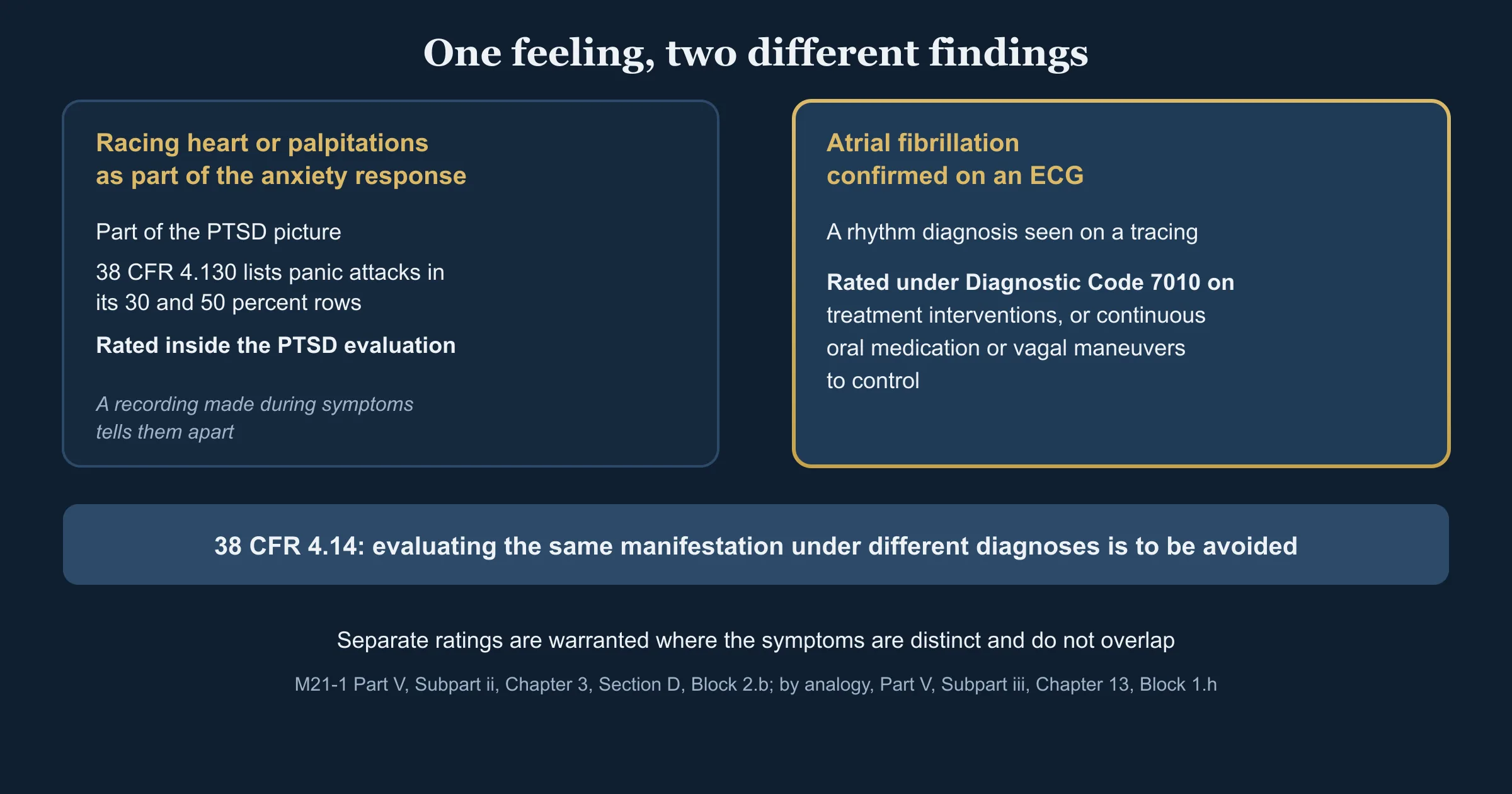
A racing heart can be part of PTSD itself. Atrial fibrillation is a rhythm disorder seen on a tracing. VA rates the first inside the PTSD evaluation and, if it is service connected, the second under the heart schedule. The rule that keeps the two apart is the pyramiding rule.
The evaluation of the same disability under various diagnoses is to be avoided.38 CFR 4.14, first sentence
Both the use of manifestations not resulting from service-connected disease or injury in establishing the service-connected evaluation, and the evaluation of the same manifestation under different diagnoses are to be avoided.38 CFR 4.14, last sentence
Between those sentences, 4.14 names tachycardia and nervousness among the manifestations that can arise from more than one cause, some service connected and some not. A fast heartbeat is in the regulation's own text.
The mental-disorder formula already counts part of this. 38 CFR 4.130 lists "panic attacks (weekly or less often)" in its 30 percent row and "panic attacks more than once a week" in its 50 percent row. When a pounding heart is part of the panic or anxiety the PTSD evaluation already accounts for, 4.14 bars evaluating that same manifestation again under a heart code.
DC 7010 sits right on the edge. Its Note (1) lists sinus tachycardia, as well as atrial fibrillation and atrial flutter, among its examples of supraventricular tachycardia. So the rhythm on the tracing matters: a fast but regular sinus rhythm during anxiety and atrial fibrillation are different findings, even when both feel like a racing heart.
ECG-confirmed atrial fibrillation rated on DC 7010's own criteria (treatment interventions, or continuous oral medication or vagal maneuvers to control) is measured on different things than the PTSD evaluation. VA's manual states the test for separate ratings: "To warrant separate evaluations, symptoms considered must be distinct and not overlap" (M21-1 Part V, Subpart iii, Chapter 13, Block 1.h). That block's worked example is PTSD with anxiety against fibromyalgia, not a heart condition, so applying it to a racing heart is reasoning by analogy. A note at Part V, Subpart ii, Chapter 3, Section D, Block 2.b, citing Esteban v. Brown, adds: "Separate evaluations are warranted where none of the symptomatology for any one condition duplicates or overlaps another."
We found no M21-1 topic and no Board decision that rules on PTSD-versus-AFib overlap specifically. The test is applied to each veteran's symptoms. Separate evaluations are not automatic, and they are not barred either.
Where the overlap has shown up in Board files
In 18147996 (2018) the Board granted sinus tachycardia, not atrial fibrillation, as secondary to PTSD with anxiety and depression; the word fibrillation does not appear in the decision. A VA physician had called the veteran's generalized anxiety disorder "the more likely cause of his intermittent sinus tachycardia, along with his deconditioning." The Board decided service connection only and set no percentage for the tachycardia, and it did not discuss 4.14.
In A25060522 (2025) a private opinion relied in part on PTSD that "causes him nightmares and heart pounding at night", a symptom that also sits inside the psychiatric picture; the Board did not discuss overlap. In 0727311 (2007) an examiner's opinion about PTSD and "symptoms of palpitations" was read by the Board as aggravation of the atrial fibrillation. These are facts in decided cases, not rulings on 4.14, and each decision is non-precedential under 38 CFR 20.1303.
Why a recording during symptoms settles the question
A 2009 systematic review in JAMA found that history and examination are not accurate enough to exclude a significant arrhythmia in most patients with palpitations, and that prolonged ECG monitoring matching symptoms to the rhythm is needed to make the diagnosis for most patients with recurrent palpitations. A known panic disorder made an arrhythmia less likely (likelihood ratio 0.26), but the confidence interval reached 1.01, so it rules nothing out (PMID 19920238).
The 2023 ACC/AHA/ACCP/HRS atrial fibrillation guideline, in its full text, says an initial AF diagnosis should be made by a clinician using "visual interpretation of the electrocardiographic signals" (PMID 38033089). One Taiwanese insurance study linked panic disorder to later AF diagnoses (adjusted hazard ratio 1.73, 1.26 to 2.37), on 48 cases; it was not about PTSD, and its abstract describes matching on enrollment time, age, sex and comorbidities, not on how often patients saw doctors (PMID 23107841).
Describe your symptoms to every clinician and examiner exactly as they happen. Whether a racing heart is anxiety, sinus tachycardia or atrial fibrillation is answered by the tracing, not by how the symptom is worded.
What AFib Secondary to PTSD Can Pay
VA rates atrial fibrillation under DC 7010, supraventricular tachycardia, in 38 CFR 4.104. The current text came from a final rule published at 86 FR 54089 on September 30, 2021, effective November 14, 2021. Any description of DC 7010 in terms of episodes per year, Holter monitoring or lone atrial fibrillation is quoting the earlier text. For a claim pending when the text changed, the Board in A26001783 (2026) considered both versions, to "rate based on whichever is most favorable to the Veteran" (non-precedential, 38 CFR 20.1303).
DC 7010, Supraventricular tachycardia, 38 CFR 4.104 (rows as printed)
| Row text | Rating |
|---|---|
| Confirmed by ECG, with five or more treatment interventions per year | 30 percent |
| Confirmed by ECG, with one to four treatment interventions per year; or, confirmed by ECG with either continuous use of oral medications to control or use of vagal maneuvers to control | 10 percent |
DC 7010 prints no 0 percent row and no row above 30 percent.
Note (1): Examples of supraventricular tachycardia include, but are not limited to: Atrial fibrillation, atrial flutter, sinus tachycardia, sinoatrial nodal reentrant tachycardia, atrioventricular nodal reentrant tachycardia, atrioventricular reentrant tachycardia, atrial tachycardia, junctional tachycardia, and multifocal atrial tachycardia.38 CFR 4.104, DC 7010
Note (2): For the purposes of this diagnostic code, a treatment intervention occurs whenever a symptomatic patient requires intravenous pharmacologic adjustment, cardioversion, and/or ablation for symptom relief.38 CFR 4.104, DC 7010
Below the 10 percent row, 38 CFR 4.31 supplies the number: "In every instance where the schedule does not provide a zero percent evaluation for a diagnostic code, a zero percent evaluation shall be assigned when the requirements for a compensable evaluation are not met." ECG-confirmed AFib with no treatment intervention in the year and no continuous oral medication or vagal maneuvers to control it is rated 0 percent. That is still a grant of service connection.
Note (2) is narrow. The 2021 rule's discussion explains why VA declined to add emergency room visits as such: "ER visits do not necessarily require intravenous pharmacologic adjustment, cardioversion, or ablation to block or control the condition and any associated disability. When they do, the proposed evaluation criteria can accommodate this situation." The same discussion records that VA added oral medications and vagal maneuvers at commenters' request.
The heart's METs-based General Rating Formula is not the route for DC 7010. In A26009895 (2026) the Board wrote that "the General Formula only applies '[u]nless otherwise directed' and here, Diagnostic Code 7010 specifies other rating criteria. The General Formula is therefore not applicable" (non-precedential, 38 CFR 20.1303).
Blood thinners: an open question
The 10 percent row turns in part on "continuous use of oral medications to control". Whether an anticoagulant taken only to prevent stroke meets that wording is unresolved. The words anticoagulant and blood thinner appear nowhere in 4.104, in the 2021 final rule, or in the M21-1 articles we read, and no Board decision we read construes the point; the two 10 percent decisions we read do not name the medication.
The 2023 ACC/AHA/ACCP/HRS guideline, in its full text, says that for AF above a stated stroke-risk level "anticoagulation is recommended to prevent stroke and systemic thromboembolism" (PMID 38033089). DC 7010's row says only "to control", and nothing we read says whether VA treats stroke prevention as use "to control". VA's manual has a continuous-medication rule for aspirin (M21-1 Part V, Subpart iii, Chapter 5, Block 2.c), written for the 10 percent continuous-medication criterion of the General Rating Formula. That rule requires that a medical professional advised the veteran to use aspirin "to reduce disability from the SC cardiovascular disorder or to prevent additional disability from that disorder". It does not mention DC 7010 or anticoagulants. We make no promise either way.
One evaluation for the rhythm codes
38 CFR 4.104: "For DCs 7009, 7010, 7011, and 7015, a single evaluation will be assigned under the diagnostic code that reflects the predominant disability picture." VA's manual gives the reason: "The impairment and disability resulting from one or more types of arrhythmia, evaluated under 38 CFR 4.104, DCs 7009-7011 and 7015, are essentially indistinguishable. Consequently, assignment of multiple evaluations under any of these DCs would be in violation of 38 CFR 4.14" (M21-1 Part V, Subpart iii, Chapter 5, Block 2.e).
The 2021 rule's preamble, which is commentary and not regulation text, calls "predominant disability picture" a term of art that "generally describes the disability that allows for the highest compensable evaluation." So AFib together with a slow rhythm needing a pacemaker, for example, gets one evaluation across those codes, not two.
Other heart disease alongside the AFib is a different rule
The single-evaluation sentence covers the four rhythm codes only. Heart disease rated under the General Rating Formula is handled differently, and that formula's Note (3) lists "arrhythmia, palpitations" among the heart failure symptoms it counts. For AFib alongside, say, coronary disease, VA's manual sets a case-by-case test: "consider whether the criteria for evaluating the disability and/or the symptoms of the disability are separate and distinct and apply 38 CFR 4.14 and any other condition-specific guidance." It continues: "When the evaluation criteria are separate and distinct, the symptoms do not overlap, and no specific prohibition applies, separate evaluations are warranted" (M21-1 Part V, Subpart iii, Chapter 5, Block 2.f).
How an AFib rating adds to a PTSD rating
Ratings are not added. 38 CFR 4.25(a) combines them through Table I, largest first, and converts the result "to the nearest number divisible by 10, and combined values ending in 5 will be adjusted upward." Under 4.25(b) that conversion "will be done only once per rating decision, will follow the combining of all disabilities, and will be the last procedure in determining the combined degree of disability."
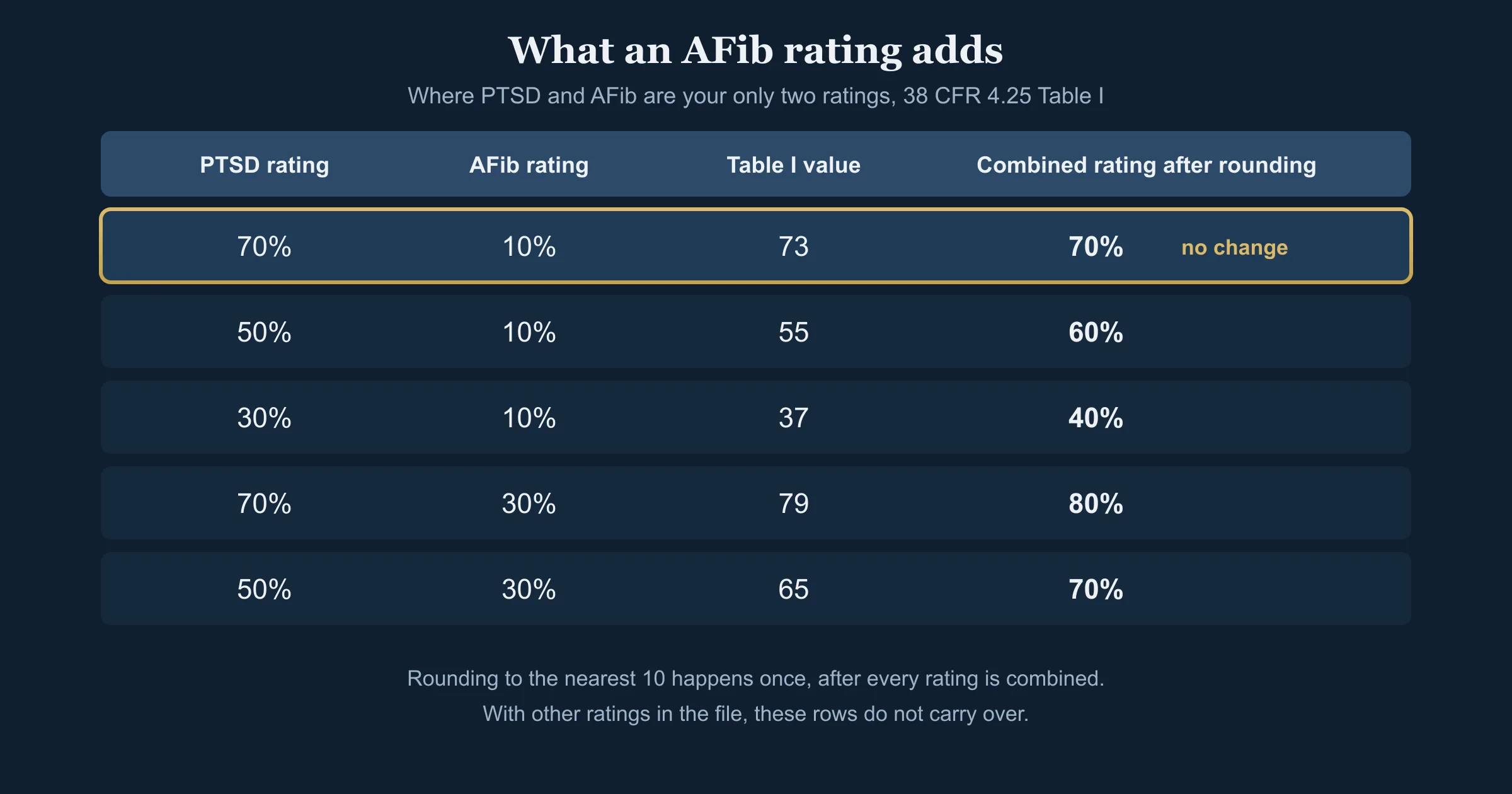
The table below is scoped to a file where PTSD and AFib are the only two ratings. Read both directions: for a veteran at 70 percent for PTSD, a 10 percent AFib rating may change nothing in the combined number; at 30 or 50 percent it does, and a 30 percent AFib rating moves 70 to 80. With other ratings in the file, every rating is combined in order of severity using unrounded values, and the rounding comes once at the end, so these rows do not carry over.
Combined value under 38 CFR 4.25 Table I, where PTSD and AFib are your only two ratings
| PTSD rating | AFib rating | Table I value | Combined rating after rounding |
|---|---|---|---|
| 70 percent | 10 percent | 73 | 70 percent (no change) |
| 50 percent | 10 percent | 55 | 60 percent |
| 30 percent | 10 percent | 37 | 40 percent |
| 70 percent | 30 percent | 79 | 80 percent |
| 50 percent | 30 percent | 65 | 70 percent |
Cells read from Table I in 38 CFR 4.25 as published in the eCFR issue of August 27, 2026. 55 and 65 end in 5 and are adjusted upward under 4.25(a).
The combined percentage is not the only thing a rating can reach. In A26009895 (2026) the Board kept the AFib at 10 percent and granted a total rating based on individual unemployability, finding that "the Veteran's service-connected atrial fibrillation, by itself, has rendered him unemployable" on a treating VA physician's opinion. That veteran's service-connected disabilities combined to 90 percent, including PTSD at 50 and sleep apnea at 50, and the Board also granted special monthly compensation under subsection (s) because he was "unemployable solely due to his service-connected atrial fibrillation and the remainder of his service-connected disabilities are ratable at 60 percent or more." That decision is non-precedential under 38 CFR 20.1303; it shows that a 10 percent row does not by itself decide everything a veteran receives.
The full DC 7010 and DC 7011 walk-through, with the rating estimator, is on our arrhythmia and AFib page.
What Board Decisions on AFib and PTSD Show
We read 54 Board decision files for this page and rely on 24 of them, each read at its ORDER block and the analysis behind it. The 22 below decided an AFib question; two more (1214416 and 18147996) appear elsewhere on this page, each for the narrow point it supports. On the AFib-and-PTSD question itself, 19 decisions: 6 granted service connection, on the different bases each entry sets out, 5 denied it and 8 sent it back for a new or better opinion. That is a convenience sample, drawn from one page of one Board search plus web searches, so those counts are not grant rates and predict nothing.
Under 38 CFR 20.1303, "previously issued Board decisions will be considered binding only with regard to the specific case decided." The rule goes on: "each case presented to the Board will be decided on the basis of the individual facts of the case in light of applicable procedure and substantive law." Each entry below is described only for the issue it decided.
Service connection granted
Citation Nr A26026116 (decided March 24, 2026)
Granted: service connection for atrial fibrillation as secondary to service-connected PTSD, and obstructive sleep apnea as secondary to PTSD, in the same decision.
An October 2025 private opinion cited literature on proposed pathways ("chronic inflammation, persistent sympathetic nervous system activation, and unhealthy lifestyle factors like poor diet or smoking") and concluded the AFib "fits the sequence of causation by PTSD" (the Board's summary of the opinion; the decision does not quote the clinician). The Board gave it probative weight because it was "based on a review of the claims file and consideration of the Veteran's statements." No VA opinion addressed the secondary theory, and the Board found a remand for one was not warranted.
Why it matters. A private opinion carried this claim, but it was uncontradicted: the Board did not weigh it against a negative VA opinion, because none existed on that theory.
Non-precedential: binds only this case (38 CFR 20.1303).
Citation Nr A25060522 (decided July 15, 2025)
Granted, on a mixed basis: service connection for paroxysmal atrial fibrillation "to include as secondary to" service-connected PTSD.
Two private opinions supported onset in service and aggravation by PTSD. The Board gave "No weight" to a July 2022 VA examination because it "is inconsistent with the evidence of record which shows a diagnosis of atrial fibrillation." The grant rested on an in-service injury and a nexus "as well as evidence that the Veteran's atrial fibrillation is aggravated by his PTSD." The decision has no baseline discussion.
Why it matters. Not a PTSD-only grant: the basis mixes direct service connection and aggravation, and the VA examination lost on its own error about the diagnosis.
Non-precedential: binds only this case (38 CFR 20.1303).
Citation Nr A25105908 (decided December 9, 2025)
Granted, through a medication route with no private letter: service connection for atrial fibrillation, and for chronic heart failure caused by the AFib.
The veteran attributed his AFib to "the combination of Cymbalta and Adderall at high dosages he was prescribed for his service-connected TBI and PTSD disabilities." A September 2021 VA examiner gave a negative opinion but "noted that Adderall therapy was a possible etiology" (the Board's recital), and, in the Board's summary of the treatment notes, a treating cardiologist thought the medications "may have contributed". The Board found the AFib "is caused by his service-connected TBI and PTSD disability", applying Spicer v. McDonough and Walsh v. Wilkie: "medication for or treatment of the primary service-connected disability may also serve as an intermediate step for secondary service connection purposes."
Why it matters. The link ran through treatment prescribed for service-connected TBI and PTSD. The Board relied on a VA examiner's remark and a treating cardiologist's note, together with the veteran's wife's testimony about medical journal articles. No private nexus letter was in the file.
Non-precedential: binds only this case (38 CFR 20.1303).
Citation Nr 1329648 (decided September 16, 2013)
Granted: service connection for "cardiac arrhythmia, secondary to service-connected PTSD". The order does not name atrial fibrillation; the recited diagnoses included paroxysmal atrial fibrillation among other rhythm problems. No percentage was assigned for the arrhythmia.
A May 2013 VA opinion was negative. A June 2013 private cardiologist found the arrhythmias "much more likely to be related to the Veteran's PTSD than to his very mild mitral valve prolapse" (the Board's recital). The Board found that "the May 2013 VA medical opinion and June 2013 private medical opinion are each probative" and that the evidence was "in equipoise", and granted on the benefit of the doubt.
Why it matters. A reasoned private opinion produced a tie with a reasoned VA opinion, and the tie went to the veteran.
Non-precedential: binds only this case (38 CFR 20.1303).
Citation Nr 18143609 (decided October 19, 2018)
Granted: service connection for bradycardia and atrial fibrillation, "to include as a result of exposure to herbicide agents, and to include as secondary to posttraumatic stress disorder (PTSD) with alcohol abuse".
The finding of fact ties the AFib to herbicide exposure "and/or" to the service-connected "PTSD with alcohol abuse". The deciding opinion came from a VA cardiac electrophysiologist the Board itself requested, not a private letter. The decision cites neither Allen v. Principi nor 38 CFR 3.301; the alcohol abuse was already part of the service-connected psychiatric disability.
Why it matters. Not a PTSD-alone grant, and not an alcohol-route precedent.
Non-precedential: binds only this case (38 CFR 20.1303).
Citation Nr 0727311 (decided August 31, 2007)
Granted: service connection for atrial fibrillation, on the Board's finding that it "is aggravated by the service-connected PTSD."
A 2003 VA examiner's opinion, as the Board recited it, concerned whether PTSD "may exacerbate the veteran's symptoms of palpitations"; the Board read it as an opinion that the AFib was aggravated, and found that a VA nurse practitioner's contrary addendum "does not, however, counteract the opinion of the VA doctor in October 2003." The Board applied the version of 3.310 in force before October 10, 2006, which had no baseline requirement.
Why it matters. An older grant under an older rule. The Board's reading was broader than the opinion's words, and today's 3.310(b) requires a baseline.
Non-precedential: binds only this case (38 CFR 20.1303).
Service connection denied, or not decided
Citation Nr 26002462 (decided February 23, 2026)
Denied: service connection for a heart disability, including atrial fibrillation and atrial flutter, secondary to PTSD.
A February 2024 VA examiner reasoned, in the Board's summary, that "Although studies have suggested the possibility of a 'relationship,' again there is no established known pathophysiology to definitely state there is a direct cause/effect relationship." The examiner cited a Heart Rhythm Society press release, which we did not open. The Board found that opinion "to be of high probative value", called the appellant's articles "general", and noted the record "contains no positive nexus opinion from a medical professional that can be combined with this treatise evidence."
Why it matters. With no physician opinion on the other side, an examiner who called the research a possibility carried the decision. That is the opinion a private letter has to engage and out-reason.
Non-precedential: binds only this case (38 CFR 20.1303).
Citation Nr 1506592 (decided February 12, 2015)
Denied: service connection for a cardiovascular disorder, including paroxysmal atrial fibrillation, including as secondary to PTSD.
A September 2013 private letter stated the physician's belief that PTSD stress "resulted in his bout of atrial fibrillation"; the Board found he "provided absolutely no rationale for this conclusion." It gave the greater weight to an August 2013 VA examination, made in person, that addressed causation and aggravation. A positive VA psychologist's aggravation opinion carried no significant weight because "he is not shown to be a medical doctor and therefore is not qualified to opine of matters of etiology for heart disorders." Internet articles were of "negligible probative value".
Why it matters. A conclusion without reasons, and an opinion from outside the right field, both lost to a reasoned examination.
Non-precedential: binds only this case (38 CFR 20.1303).
Citation Nr 18153054 (decided November 27, 2018)
Reopened, then denied: service connection for atrial fibrillation as secondary to PTSD.
A Mayo Clinic Q&A article was enough to reopen the claim. On the merits the Board found that the article "included no reasoning regarding why or how such a link might exist, whether it is a causal link or only correlative", and found a May 2014 VA examination more probative.
Why it matters. An article can reopen a claim and still fail to carry it.
Non-precedential: binds only this case (38 CFR 20.1303).
Citation Nr 1322370 (decided July 12, 2013)
Denied: service connection for atrial fibrillation with bradycardia, status-post pacemaker insertion, claimed as secondary to PTSD.
A VA examiner addressed causation and then, after a remand, aggravation; the Board relied on a competent examiner who, "after reviewing the complete evidence of record, as well as the pertinent medical literature, concluded that there was no relationship". There was no private opinion.
Why it matters. A complete VA opinion on causation and aggravation, with nothing on the other side, decided it. The decision predates the 2019 veteran study.
Non-precedential: binds only this case (38 CFR 20.1303).
Citation Nr 1800688 (decided January 5, 2018)
Denied: service connection for atrial fibrillation, to include as secondary to PTSD and herbicide exposure.
The PTSD theory rested on assertion alone: the representative argued it in November 2017, and the Board wrote that the veteran "merely stated service connection for atrial fibrillation should be granted as due to service-connected PTSD". The Board found "There is no medical evidence to support that the Veteran has a diagnosis of ischemic heart disease or that his atrial fibrillation is related to PTSD", and held that no VA examination was needed. It also noted that the herbicide presumptions cover ischemic heart disease and, in its words, "exclude atrial fibrillation and sick sinus syndrome."
Why it matters. Argument with no medical indication behind it did not earn an examination.
Non-precedential: binds only this case (38 CFR 20.1303).
Citation Nr A26018829 (decided March 3, 2026)
Not decided on PTSD: atrial fibrillation was denied on a direct theory only.
The Board wrote that the PTSD theory had not been raised "during the present appeal period and therefore it will not be addressed in this decision", that evidence submitted after the hearing on that link "will not be considered", and encouraged a supplemental claim for that theory.
Why it matters. Under the appeals system's docket rules, a PTSD theory raised for the first time at the Board hearing was set aside, not decided.
Non-precedential: binds only this case (38 CFR 20.1303).
Sent back for a VA opinion, or a better one
Citation Nr A25047908 (decided May 29, 2025)
Remanded: service connection for atrial fibrillation, to include as secondary to PTSD.
The Board found a January 2024 private opinion of "little if any probative value" because, beyond citing an association in research, it "did not adequately explain the relevance of this information to the specific facts pertaining to the Veteran's condition". It found the VA opinion "also inadequate, primarily because the examiner did not discuss aggravation", and asked: "would the atrial fibrillation have been less severe but for the PTSD, either because there is causal link or because the service-connected disability results in the inability to treat atrial fibrillation."
Why it matters. Literature without the veteran's facts failed, and so did a VA opinion that stopped at causation.
Non-precedential: binds only this case (38 CFR 20.1303).
Citation Nr A26029498 (decided April 1, 2026)
Remanded: service connection for a heart condition and for sleep apnea.
The Board found December 2025 private opinions "insufficient for grants at this time, particularly given the absence of any discussion of this Veteran's medical history". They did not discuss evidence of sick sinus syndrome, "for which a pacemaker was placed", and gave "no discussion of the timing of onset". The remand also asks whether, if PTSD caused obesity, the obesity was a substantial factor in and a but-for cause of the heart condition.
Why it matters. Opinions that skipped the veteran's own diagnoses and timeline were not enough for a grant.
Non-precedential: binds only this case (38 CFR 20.1303).
Citation Nr A25041291 (decided May 6, 2025)
Remanded: service connection for atrial fibrillation, to include as secondary to PTSD with panic disorder.
The VA opinion "does not separately address the theory of entitlement to secondary service connection based on aggravation"; a May 2022 private opinion gave no rationale. VA treatment records showed a provider aiming to taper alprazolam because of the AFib, and the Board directed the examiner to address it, advising that "aggravation under 38 C.F.R. § 3.310(b) does not require that there be 'permanent' worsening".
Why it matters. Treatment records can raise a medication question the opinion then has to answer.
Non-precedential: binds only this case (38 CFR 20.1303).
Citation Nr A25043387 (decided May 14, 2025)
Remanded: service connection for a heart disability, to include atrial fibrillation, to include as secondary to PTSD.
The Board found the VA opinions inadequate because the examiner "did not address whether the Veteran's sleep apnea and atrial fibrillation were aggravated by his service-connected PTSD", and asked about PTSD "to include medications taken for such condition, or sleep apnea". The record included a 2011 report in which the veteran attributed AFib to Zoloft.
Why it matters. Medication and sleep apnea were both on the table as routes the new opinion had to address.
Non-precedential: binds only this case (38 CFR 20.1303).
Citation Nr 22001161 (decided January 10, 2022)
Remanded: service connection for a heart disability, including paroxysmal atrial fibrillation, on herbicide and secondary theories.
The May 2020 examiner "neglected to address the Veteran's service-connected posttraumatic stress disorder (PTSD)." The Board required separate causation and aggravation opinions for each heart diagnosis.
Why it matters. An opinion silent on the PTSD theory is not an opinion on it.
Non-precedential: binds only this case (38 CFR 20.1303).
Citation Nr 18149468 (decided November 9, 2018)
Remanded: service connection for atrial fibrillation, including as secondary to a service-connected disability.
The veteran wrote that his doctor had told him his AFib may be secondary to his PTSD, and "There is no medical opinion of record which addresses this theory of entitlement." The Board ordered one, and wrote: "If aggravation is found, the examiner should address the baseline manifestations prior to aggravation and the increased manifestations due to the service-connected PTSD."
Why it matters. Once the veteran reported his doctor's remark, the Board sent the claim back for an opinion that addressed the PTSD theory.
Non-precedential: binds only this case (38 CFR 20.1303).
Citation Nr 1323790 (decided July 25, 2013)
Remanded: the same appeal later denied in 1506592.
The Board asked whether paroxysmal atrial fibrillation was "caused by or is aggravated (chronically worsened beyond the natural progression of the disease) by his service-connected PTSD", and for the baseline before aggravation. That natural-progression wording predates the manual's Spicer note.
Why it matters. The full 3.310 question, causation, aggravation and baseline, asked in one remand.
Non-precedential: binds only this case (38 CFR 20.1303).
Citation Nr 25010275 (decided August 8, 2025)
Remanded: service connection for atrial fibrillation and non-ischemic cardiomyopathy, on herbicide and PTSD theories.
A May 2025 VA addendum, in the Board's summary, treated AFib and PTSD as "separate entities entirely". The Board found the April, May and June 2025 opinions "lacking" on the direct, secondary and toxic-exposure theories (its secondary criticism centered on the PTSD and diabetes link), and the new directive asks again whether PTSD caused or aggravated the AFib.
Why it matters. An appeal docketed in 2009 was still open in 2025.
Non-precedential: binds only this case (38 CFR 20.1303).
The percentage: decisions on what AFib is rated
Citation Nr A26009895 (decided February 3, 2026)
Denied: a rating above 10 percent for atrial fibrillation. Granted in the same decision: a total rating based on individual unemployability and special monthly compensation under subsection (s), the latter because the AFib alone made him unemployable and his other service-connected disabilities were ratable at 60 percent or more.
The Board held the General Formula "not applicable" because DC 7010 "specifies other rating criteria", so METs findings did not lift the rating. It found the AFib "by itself, has rendered him unemployable" on a treating VA physician's opinion. The AFib "required continuous medication for control"; no drug is named.
Why it matters. A 10 percent AFib rating did not cap what this veteran received, in a file whose service-connected disabilities combined to 90 percent.
Non-precedential: binds only this case (38 CFR 20.1303).
Citation Nr A26001783 (decided January 8, 2026)
Denied: an initial rating above 10 percent for atrial fibrillation (granted under the PACT Act, not a PTSD route).
The Board recited both the earlier DC 7010 criteria and the amended ones, and three VA examinations found the veteran "required continuous oral medication for control of his atrial fibrillation"; no drug is named, and the Board found the AFib had not manifested with five or more treatment interventions per year.
Why it matters. Daily medication alone sat at 10 percent; the 30 percent row needs five or more interventions a year.
Non-precedential: binds only this case (38 CFR 20.1303).
Across these files, the Board weighed each opinion's reasons, the record behind it, the qualifications of whoever gave it, and what stood on the other side. Private opinions carried claims (A26026116, where no VA opinion addressed the theory; A25060522, on a mixed basis) and failed (1506592, A25047908); VA evidence carried grants (A25105908, 18143609) as well as denials (26002462, 1322370). No decision we read names the 2019 veteran study.
Other Routes: Medication, Alcohol, Sleep Apnea and Blood Pressure
A secondary claim can also run through something the PTSD led to: a medication prescribed for it, drinking, sleep apnea, high blood pressure or weight. Each step in that chain needs its own medical support, and each is a separate question.
Through medication prescribed for PTSD
In A25105908 (2025) the Board granted AFib through medications prescribed for service-connected TBI and PTSD, citing Spicer and Walsh: "medication for or treatment of the primary service-connected disability may also serve as an intermediate step for secondary service connection purposes." Other files raised the same kind of question without deciding it: a provider tapering alprazolam because of the AFib (A25041291), and a veteran's 2011 report blaming Zoloft (A25043387). All are non-precedential under 38 CFR 20.1303.
None of this means any named drug causes AFib. It means a treating medication can be the mechanism an opinion has to explain, using the dates the drug was started and changed and what the treating doctors wrote at the time.
Through alcohol use
The direct route is closed. 38 CFR 3.301(a): "Direct service connection may be granted only when a disability or cause of death was incurred or aggravated in line of duty, and not the result of the veteran's own willful misconduct or, for claims filed after October 31, 1990, the result of his or her abuse of alcohol or drugs."
The secondary route is open in VA's manual under Allen v. Principi, 237 F.3d 1368 (Fed. Cir. 2001): "where there is sufficient medical evidence establishing that the alcohol or drug abuse disability is secondary to, or is a symptom of SC disability, and where the alcohol or drug abuse disability is not due to willful misconduct, then a Veteran may establish SC for the alcohol or drug abuse disability on a secondary basis" (M21-1 Part X, Subpart iv, Chapter 1, Section D, Block 1.h). Block 1.d adds: "Establish SC under 38 CFR 3.310(a) for any diseases or disabilities resulting from alcohol abuse, if alcohol abuse is determined to be secondary to an SC disability." The same Block 1.h opens with the post-1990 prohibition and then sets out the Allen exception, so the manual itself holds both.
Medically, each link has group-level evidence of a different kind, and neither study tested the chain. Seal and colleagues (2011) found that among Iraq and Afghanistan veterans in VA care with alcohol or drug use disorders, 55 to 75 percent also had PTSD or depression diagnoses (PMID 21277712). In a randomized trial in 140 drinkers with AFib in Australia, AFib recurred over 6 months in 37 of the 70 assigned to abstain against 51 of the 70 assigned to keep their usual drinking (hazard ratio 0.55, 0.36 to 0.84); that measured recurrence, not new AFib, and not veterans (Voskoboinik, 2020, PMID 31893513).
No AFib decision we read applied Allen v. Principi, and 18143609 is not one. This route is legally open and medically demanding: an opinion has to support each link, PTSD to the drinking and the drinking to the AFib, and the same drinking is an alternative explanation with a larger hazard ratio than PTSD's in the 2019 veteran study (1.81 against 1.13).
Through sleep apnea
In A26026116 (2026) the Board granted obstructive sleep apnea and atrial fibrillation in the same decision, each as secondary to PTSD (non-precedential, 38 CFR 20.1303). The AFib grant rested on PTSD itself; the decision did not decide AFib through the sleep apnea. A 2026 meta-analysis of 21 cohort studies (611,898 people) linked sleep-disordered breathing to about a two-thirds higher rate of new AFib (relative risk 1.67, 1.41 to 1.97) (PMID 42859517). A 2017 meta-analysis put sleep apnea prevalence in PTSD at 75.7 percent at an apnea-hypopnea index of 5 or more, but with a confidence interval from 44.1 to 92.5 percent, too wide to treat as a fixed rate (PMID 28735910).
The 2023 AF guideline calls the role of treating sleep apnea to keep a normal rhythm uncertain. A chained claim, PTSD to sleep apnea to AFib, needs a reasoned opinion at each step.
Through high blood pressure
In the 2019 veteran study's final model, hypertension carried a hazard ratio of 2.41, against 1.13 for PTSD. In 1214416 (2012) the Board granted paroxysmal AFib as secondary to service-connected hypertension on an uncontradicted VA opinion that the hypertension "appears to have caused [his] mildly dilated left side of heart and this is triggering the paroxysmal atrial fibrillation." That veteran's hypertension was service connected as secondary to diabetes, not PTSD. The decision shows only that AFib can be granted secondary to service-connected hypertension; the PTSD-to-hypertension link has to be shown in its own right (non-precedential, 38 CFR 20.1303).
Through weight
In A26029498 (2026) the Board's remand asked whether, if the PTSD caused obesity, the obesity was a substantial factor in, and a but-for cause of, the heart condition (non-precedential, 38 CFR 20.1303). In the 2019 veteran study, obesity carried a hazard ratio of 1.23.
No presumption covers this pairing
The cardiovascular paragraph of 3.310, paragraph (c), is about amputation: heart disease "developing in a veteran who has a service-connected amputation of one lower extremity at or above the knee or service-connected amputations of both lower extremities at or above the ankles". The herbicide list in 3.309(e) names ischemic heart disease, and its Note 2 says the term excludes "any other condition that does not qualify within the generally accepted medical definition of Ischemic heart disease." In 18143609 the Board wrote that "atrial fibrillation is not a condition which is presumptively associated with herbicide exposure" (non-precedential, 38 CFR 20.1303). The former prisoner of war list in 3.309(c) reaches "arrhythmia" only as a complication of atherosclerotic heart disease or hypertensive vascular disease.
When the theory is raised matters
In A26018829 (2026) a PTSD theory raised for the first time at the Board hearing was not decided, and evidence on it submitted after the hearing was not considered; the Board pointed the veteran to a supplemental claim. Raise the secondary theory, and file its medical evidence, where the claim or docket allows it (non-precedential, 38 CFR 20.1303).
The blood pressure link has its own guide: hypertension secondary to PTSD.
So does the sleep apnea link: sleep apnea secondary to PTSD.
What a Nexus Opinion for AFib Secondary to PTSD Has to Cover
No document wins by using the right phrase. These are the pieces whose absence the Board pointed to in the decisions above, and the evidence an honest opinion has to engage. Each decision named below is non-precedential under 38 CFR 20.1303.
- A confirmed rhythm diagnosisAtrial fibrillation or flutter recorded on an ECG, Holter or event monitor, as distinct from palpitations or a fast sinus rhythm during anxiety. Both DC 7010 rows require ECG confirmation, and in A25060522 a VA examination that denied a diagnosis the record showed got no weight.
- A timelineWhen the PTSD began, when the AFib was first recorded, and how episodes line up with symptom flares, sleep, alcohol or medication changes. In A26029498 the Board faulted private opinions that gave "no discussion of the timing of onset".
- The research at its actual sizeThe 2019 veteran cohort's adjusted 1.13 and the 2026 null result in women veterans, both in younger veterans, and the 2025 genetic finding, each answered rather than skipped. In A25047908 a private opinion that cited research without applying it to the veteran's facts had "little if any probative value"; in 26002462 a VA examiner who called the research a possibility went unanswered.
- This veteran's other risk factorsAlcohol use, sleep apnea, hypertension, weight, stimulant or drug use, thyroid disease, structural heart disease and age, and how each is or is not tied to the PTSD. In A26029498 the private opinions said nothing about the veteran's sick sinus syndrome and pacemaker; in 1329648 the private cardiologist explained why he weighed PTSD above a mild mitral valve prolapse.
- Causation and aggravation, answered separatelyWhether the PTSD caused the AFib, and separately whether it made existing AFib worse, with the baseline drawn from the earliest records. The manual lists what an aggravation opinion must address (Block 1.e), and 22001161 required "separate findings and rationales relating to causation and aggravation."
- The route, and every link in itIf the theory runs through a medication, drinking, sleep apnea, blood pressure or weight, each step needs its own reasoning. The medication route won in A25105908 on a VA examiner's remark and a treating cardiologist's note, together with the veteran's wife's testimony about medical journal articles.
- The record actually reviewed, by someone qualifiedIn A26026116 the Board weighted the private opinion because it rested on the claims file and the veteran's statements. In 1506592 the Board found it "unclear what, if anything, the physician knew" of the veteran's history, and gave a psychologist's heart opinion no significant weight because he was not shown to be a medical doctor.
The conclusion is conventionally written as a probability, "at least as likely as not", because that is the form VA examiners and Board remand orders use for the approximate balance in 38 CFR 3.102. The reasons are what the Board weighs.
What we cannot do
We cannot put an AFib diagnosis into records that lack one, and we cannot make the research say more than it does. A physician on our team will not sign an opinion your file does not support. No one can tell you in advance what VA will decide. We write medical evidence; filing claims and representing veterans are not part of our work.
The elements VA looks for in any medical opinion are in our guide to what a nexus letter must include.
Is There an AFib Claim Here, and Does It Need a Letter?
Check your file
Tick each statement your records support today. The first two decide whether an AFib-secondary-to-PTSD claim exists at all. The rest carry no points; each names something a rater or a physician will look for in the file.
Tick only what your records show right now. Nothing here adds up to a score.
When You May Not Need a Letter, and When We Cannot Help
We write nexus letters. Here is where buying one does not make sense, or cannot work.
- There is no recorded AFib diagnosis yetPalpitations or a racing heart without a recorded rhythm is not a diagnosis of atrial fibrillation, and no letter can supply one. A clinician who can record the rhythm during symptoms comes first.
- PTSD is not service connected and no PTSD claim is pendingA secondary claim runs through a service-connected PTSD. 38 CFR 3.304(f) sets what PTSD itself needs: a diagnosis, a medical link between current symptoms and an in-service stressor, and credible supporting evidence that the stressor occurred. For a PTSD diagnosed in service, combat, fear of hostile military or terrorist activity, or a prisoner-of-war stressor, 3.304(f) says the veteran's lay testimony alone may establish the stressor, subject to the conditions it sets. That claim comes first.
- Your records may already hold the linkIn A25105908 (2025) the Board relied on a VA examiner's own remark and a treating cardiologist's note, combined with the veteran's wife's testimony about medical journal articles on PTSD and heart disease, and no private letter was filed. If a treating doctor has already written that your PTSD or its treatment may have contributed, that is evidence VA weighs (non-precedential, 38 CFR 20.1303).
- The open question is the rating, not the linkWhere AFib is already service connected, what moves the rating is ECG confirmation and dated records of interventions, medication and vagal maneuvers. Those come from your cardiology records, not from a letter.
- The combined rating may not moveAt 70 percent for PTSD, where these are your only two ratings, a 10 percent AFib grant combines to 73 and rounds back to 70. A later 30 percent AFib rating would combine to 79 and round to 80. The grant still puts the AFib on the record. Whether that is worth paying for now is your call, and we will say so plainly on the consultation.
- The racing heart is the anxietyIf every recording made during your symptoms shows a regular sinus rhythm and no recording has ever shown atrial fibrillation, there is no atrial fibrillation diagnosis to claim. Where that racing heart is part of the anxiety the PTSD evaluation already counts, 38 CFR 4.14 bars evaluating it again under a heart code. In 18147996 the Board did grant service connection for sinus tachycardia as secondary to PTSD with anxiety and depression and set no percentage for it; that is a different claim from the one on this page (non-precedential, 38 CFR 20.1303).
Frequently Asked Questions
Can AFib be service connected secondary to PTSD?
Yes, it can be, under 38 CFR 3.310(a) if the PTSD caused it or 3.310(b) if the PTSD made existing AFib worse, which needs a baseline. VA asks for an approximate balance of evidence under 38 CFR 3.102, not proof. Board decisions on this pairing include grants, denials and remands, each "binding only with regard to the specific case decided" under 38 CFR 20.1303; the grants we read each rested on medical evidence in the veteran's own file: a private opinion, a VA opinion, or treatment records.
Does PTSD cause atrial fibrillation?
No study we found shows that it does. In 988,090 younger veterans, PTSD went with an adjusted hazard ratio of 1.13 (1.02 to 1.24) for new AFib, a modest association. A 2026 study of 202,896 women veterans found no significant link (1.07, 0.97 to 1.18), and a 2025 genetic study found no shared genetic signal. The evidence makes the question fair for a physician to weigh in one veteran's file, not settled.
What is the VA rating for AFib secondary to PTSD?
AFib is rated under DC 7010: 30 percent when confirmed by ECG with five or more treatment interventions per year, and 10 percent when confirmed by ECG with one to four interventions per year, or with either continuous use of oral medications to control or use of vagal maneuvers to control. An intervention is IV medication adjustment, cardioversion or ablation for symptom relief. Below 10 percent, 38 CFR 4.31 assigns 0 percent.
Will an AFib rating raise my combined rating if my PTSD is rated 70 percent?
It may not. Where PTSD at 70 and AFib at 10 are your only two ratings, 38 CFR 4.25 Table I gives 73, which rounds to 70. A 30 percent AFib rating gives 79, which rounds to 80. At 50 percent for PTSD, a 10 percent AFib rating gives 55, which rounds up to 60. With other ratings in the file the arithmetic changes, because rounding happens once at the end.
Can I be rated for both PTSD and AFib, or is that pyramiding?
38 CFR 4.14 bars evaluating the same manifestation under different diagnoses, and it names tachycardia in its text. A racing heart that is part of the anxiety response belongs to the PTSD evaluation. ECG-confirmed AFib rated on DC 7010's own criteria is measured on different things, and VA's manual allows separate evaluations where the symptoms are distinct and do not overlap. We found no rule or Board decision on this exact pairing; it is decided case by case.
Does a blood thinner count as medication to control AFib for the 10 percent rating?
Unresolved. DC 7010's 10 percent row includes "continuous use of oral medications to control". Neither 38 CFR 4.104, the 2021 final rule nor the M21-1 articles we read mention anticoagulants, and no Board decision we read decides the point. The 2023 AF guideline describes anticoagulation as stroke prevention. We make no promise either way.
Can my PTSD medication be the link to my AFib?
It can be the route. In A25105908 (2025, non-precedential under 38 CFR 20.1303) the Board granted AFib through medications prescribed for service-connected TBI and PTSD, holding that treatment of the primary condition can be an intermediate step. That does not mean any named drug causes AFib; an opinion has to explain the mechanism from the dates and the treating records.
Do I need a nexus letter for AFib secondary to PTSD?
Not always. If a treating doctor or VA examiner has already linked your AFib to PTSD or its treatment, the record may carry it. A letter does real work when a VA opinion says the AFib is unrelated or skipped aggravation, or when alcohol use, sleep apnea or high blood pressure in the record has to be weighed. With no recorded AFib diagnosis, or no service-connected or pending PTSD, a letter cannot help yet.
How much does a nexus letter for AFib secondary to PTSD cost?
Our pricing page lists the fee for a physician-authored nexus letter. The first consultation is free. If you go ahead, the fee is paid before a licensed clinician reviews your records, and if an honest opinion cannot be supported you are refunded before drafting starts. The section on when you may not need a letter is worth reading first.
Related guides
- Arrhythmia and AFib VA ratingsThe full DC 7010 and DC 7011 walk-through, the rating estimator, and AFib secondary to sleep apnea.
- PTSD and VA disabilityHow VA rates PTSD under the mental-disorder formula, the claim every secondary condition here depends on.
- Hypertension secondary to PTSDThe blood pressure link, which has to be shown in its own right before AFib can be argued through it.
- Sleep apnea secondary to PTSDThe sleep apnea link, one step of a chained route that needs its own opinion.
- What is a nexus letterWhat a medical opinion is and where it fits in a VA claim.
- What a nexus letter must includeThe elements a rater looks for in any medical opinion.
Bring the Rhythm Reports and the Rating Decision
For a free consultation, have your PTSD rating decision, any ECG, Holter or event monitor reports, your cardiology notes and medication list, and any VA heart examination at hand, so you can tell us what they say. You will get a straight answer on whether a physician's opinion can add anything. If the open question is the diagnosis or the rating rather than the link, we will say so. If you go ahead, the fee comes first, a licensed clinician then reviews the full file, and if an honest opinion cannot be supported you get your money back before drafting begins.
Citations & References
- 38 CFR 4.104, Schedule of ratings, cardiovascular system, including DC 7010 and the single-evaluation rule for DCs 7009, 7010, 7011 and 7015 (eCFR, issue date 2026-08-27) https://www.ecfr.gov/current/title-38/section-4.104
- 38 CFR 4.14, Avoidance of pyramiding (eCFR, issue date 2026-08-27) https://www.ecfr.gov/current/title-38/section-4.14
- 38 CFR 4.130, General Rating Formula for Mental Disorders (eCFR, issue date 2026-08-27) https://www.ecfr.gov/current/title-38/section-4.130
- 38 CFR 4.25, Combined ratings table (eCFR, issue date 2026-08-27) https://www.ecfr.gov/current/title-38/section-4.25
- 38 CFR 4.31, Zero percent evaluations (eCFR, issue date 2026-08-27) https://www.ecfr.gov/current/title-38/section-4.31
- 38 CFR 3.310, secondary service connection, aggravation and the amputation rule, paragraphs (a) to (c) (eCFR, issue date 2026-08-27) https://www.ecfr.gov/current/title-38/section-3.310
- 38 CFR 3.102, Reasonable doubt (eCFR, issue date 2026-08-27) https://www.ecfr.gov/current/title-38/section-3.102
- 38 CFR 3.301, Line of duty and misconduct, paragraphs (a), (c)(2) and (d) (eCFR, issue date 2026-08-27) https://www.ecfr.gov/current/title-38/section-3.301
- 38 CFR 3.304(f), posttraumatic stress disorder (eCFR, issue date 2026-08-27) https://www.ecfr.gov/current/title-38/section-3.304
- 38 CFR 3.309, presumptive diseases, paragraphs (c) and (e) (eCFR, issue date 2026-08-27) https://www.ecfr.gov/current/title-38/section-3.309
- 38 CFR 20.1303, Nonprecedential nature of Board decisions (eCFR, issue date 2026-08-27) https://www.ecfr.gov/current/title-38/section-20.1303
- Schedule for Rating Disabilities: The Cardiovascular System, final rule, 86 FR 54089 (September 30, 2021), effective November 14, 2021 (Federal Register full text) https://www.federalregister.gov/documents/2021/09/30/2021-19998/schedule-for-rating-disabilities-the-cardiovascular-system
- M21-1, Part V, Subpart iii, Chapter 5, Cardiovascular System Conditions, Blocks 2.c, 2.e and 2.f (VA KnowVA, article 554400000014520) https://www.knowva.ebenefits.va.gov/system/templates/selfservice/va_ssnew/help/customer/locale/en-US/portal/554400000001018/content/554400000014520/M21-1-Part-V-Subpart-iii-Chapter-5-Cardiovascular-System-Conditions
- M21-1, Part V, Subpart iii, Chapter 13, Mental Disorders, Block 1.h (VA KnowVA, article 554400000180520) https://www.knowva.ebenefits.va.gov/system/templates/selfservice/va_ssnew/help/customer/locale/en-US/portal/554400000001018/content/554400000180520/M21-1-Part-V-Subpart-iii-Chapter-13-Mental-Disorders
- M21-1, Part V, Subpart ii, Chapter 3, Section D, Block 2.b, separating findings and pyramiding, with the Esteban note (VA KnowVA, article 554400000180489) https://www.knowva.ebenefits.va.gov/system/templates/selfservice/va_ssnew/help/customer/locale/en-US/portal/554400000001018/content/554400000180489/M21-1-Part-V-Subpart-ii-Chapter-3-Section-D-Evaluating-Disabilities
- M21-1, Part V, Subpart ii, Chapter 2, Section D, Blocks 1.a to 1.h, causation, aggravation and the baseline for secondary claims (VA KnowVA, article 554400000180484) https://www.knowva.ebenefits.va.gov/system/templates/selfservice/va_ssnew/help/customer/locale/en-US/portal/554400000001018/content/554400000180484/M21-1-Part-V-Subpart-ii-Chapter-2-Section-D-Secondary-Service-Connection-SC-and-Aggravation-of-Non-Service-Connected-NSC-Disabilities
- M21-1, Part IV, Subpart i, Chapter 1, Section B, Evidentiary Standards for Finding an Examination or Opinion Necessary, Block 1.e (VA KnowVA, article 554400000180495) https://www.knowva.ebenefits.va.gov/system/templates/selfservice/va_ssnew/help/customer/locale/en-US/portal/554400000001018/content/554400000180495/M21-1-Part-IV-Subpart-i-Chapter-1-Section-B-Evidentiary-Standards-for-Finding-an-Examination-or-Opinion-Necessary
- M21-1, Part X, Subpart iv, Chapter 1, Section D, Disability or Death from Use of Alcohol, Drugs, or Tobacco Products, Blocks 1.d and 1.h (VA KnowVA, article 554400000177988) https://www.knowva.ebenefits.va.gov/system/templates/selfservice/va_ssnew/help/customer/locale/en-US/portal/554400000001018/content/554400000177988/M21-1-Part-X-Subpart-iv-Chapter-1-Section-D-Disability-or-Death-from-Use-of-Alcohol-Drugs-or-Tobacco-Products
- Rosman, et al. Posttraumatic Stress Disorder and Risk for Early Incident Atrial Fibrillation: A Prospective Cohort Study of 1.1 Million Young Adults. J Am Heart Assoc. 2019 (PubMed) https://pubmed.ncbi.nlm.nih.gov/31564191/
- Ebrahimi, et al. Impact of posttraumatic stress disorder on incident cardiovascular outcomes in women veterans: a retrospective longitudinal study. EClinicalMedicine. 2026 (PubMed) https://pubmed.ncbi.nlm.nih.gov/42751178/
- Song, et al. Stress related disorders and risk of cardiovascular disease: population based, sibling controlled cohort study. BMJ. 2019 (PubMed) https://pubmed.ncbi.nlm.nih.gov/30971390/
- Lukas, et al. A genetic exploration of the relationship between posttraumatic stress disorder and cardiovascular diseases. Transl Psychiatry. 2025 (PubMed) https://pubmed.ncbi.nlm.nih.gov/39755697/
- Mo, et al. Psychiatric disorders and the risk of atrial fibrillation: a Swedish population-based cohort study. Eur J Prev Cardiol. 2025 (PubMed) https://pubmed.ncbi.nlm.nih.gov/41392705/
- Wu, et al. Psychological factors and risk of atrial fibrillation: A meta-analysis and systematic review. Int J Cardiol. 2022 (PubMed) https://pubmed.ncbi.nlm.nih.gov/35618103/
- Fu, et al. Relationship between psychological factors and atrial fibrillation: A meta-analysis and systematic review. Medicine (Baltimore). 2020 (PubMed) https://pubmed.ncbi.nlm.nih.gov/32311930/
- Gaffey, et al. Insomnia and Early Incident Atrial Fibrillation: A 16-Year Cohort Study of Younger Men and Women Veterans. J Am Heart Assoc. 2023 (PubMed) https://pubmed.ncbi.nlm.nih.gov/37791503/
- Schneider, et al. Psychol Med. 2020;50(12):1937-48 (meta-analysis of heart-rate variability in PTSD; PubMed) https://pubmed.ncbi.nlm.nih.gov/32854795/
- Fu (2022). Auton Neurosci. 2022;237:102923 (brief narrative review of PTSD, autonomic function and cardiovascular risk; PubMed) https://pubmed.ncbi.nlm.nih.gov/34844132/
- Malik (2024). Card Electrophysiol Clin. 2024;16(3):271-80 (narrative review of the autonomic nervous system and atrial fibrillation; PubMed) https://pubmed.ncbi.nlm.nih.gov/39084720/
- Thavendiranathan P, et al. Does this patient with palpitations have a cardiac arrhythmia? JAMA. 2009 (PubMed) https://pubmed.ncbi.nlm.nih.gov/19920238/
- Cheng YF, et al. Association between panic disorder and risk of atrial fibrillation: a nationwide study. Psychosom Med. 2013 (PubMed) https://pubmed.ncbi.nlm.nih.gov/23107841/
- Joglar JA, et al. 2023 ACC/AHA/ACCP/HRS Guideline for the Diagnosis and Management of Atrial Fibrillation. Circulation. 2024 (PubMed) https://pubmed.ncbi.nlm.nih.gov/38033089/
- Voskoboinik, et al. Alcohol Abstinence in Drinkers with Atrial Fibrillation. N Engl J Med. 2020 (PubMed) https://pubmed.ncbi.nlm.nih.gov/31893513/
- Seal, et al. Substance use disorders in Iraq and Afghanistan veterans in VA healthcare, 2001-2010. Drug Alcohol Depend. 2011 (PubMed) https://pubmed.ncbi.nlm.nih.gov/21277712/
- Sori, et al. Sleep-Disordered Breathing and Sleep Fragmentation in Relation to Atrial Fibrillation Risk: A Systematic Review and Meta-Analysis. J Arrhythm. 2026 (PubMed) https://pubmed.ncbi.nlm.nih.gov/42859517/
- Zhang, et al. Prevalence of obstructive sleep apnea in patients with posttraumatic stress disorder: a meta-analysis. Sleep Med. 2017 (PubMed) https://pubmed.ncbi.nlm.nih.gov/28735910/
- Board of Veterans' Appeals, Citation Nr A26026116 (2026) https://www.va.gov/vetapp26/Files3/A26026116.txt
- Board of Veterans' Appeals, Citation Nr A25060522 (2025) https://www.va.gov/vetapp25/Files7/A25060522.txt
- Board of Veterans' Appeals, Citation Nr A25105908 (2025) https://www.va.gov/vetapp25/Files12/A25105908.txt
- Board of Veterans' Appeals, Citation Nr 1329648 (2013) https://www.va.gov/vetapp13/Files3/1329648.txt
- Board of Veterans' Appeals, Citation Nr 18143609 (2018) https://www.va.gov/vetapp18/Files10/18143609.txt
- Board of Veterans' Appeals, Citation Nr 0727311 (2007) https://www.va.gov/vetapp07/files3/0727311.txt
- Board of Veterans' Appeals, Citation Nr 26002462 (2026) https://www.va.gov/vetapp26/Files2/26002462.txt
- Board of Veterans' Appeals, Citation Nr 1506592 (2015) https://www.va.gov/vetapp15/Files1/1506592.txt
- Board of Veterans' Appeals, Citation Nr 18153054 (2018) https://www.va.gov/vetapp18/Files11/18153054.txt
- Board of Veterans' Appeals, Citation Nr 1322370 (2013) https://www.va.gov/vetapp13/Files3/1322370.txt
- Board of Veterans' Appeals, Citation Nr 1800688 (2018) https://www.va.gov/vetapp18/Files1/1800688.txt
- Board of Veterans' Appeals, Citation Nr A26018829 (2026) https://www.va.gov/vetapp26/Files3/A26018829.txt
- Board of Veterans' Appeals, Citation Nr A25047908 (2025) https://www.va.gov/vetapp25/Files5/A25047908.txt
- Board of Veterans' Appeals, Citation Nr A26029498 (2026) https://www.va.gov/vetapp26/Files4/A26029498.txt
- Board of Veterans' Appeals, Citation Nr A25041291 (2025) https://www.va.gov/vetapp25/Files5/A25041291.txt
- Board of Veterans' Appeals, Citation Nr A25043387 (2025) https://www.va.gov/vetapp25/Files5/A25043387.txt
- Board of Veterans' Appeals, Citation Nr 22001161 (2022) https://www.va.gov/vetapp22/Files1/22001161.txt
- Board of Veterans' Appeals, Citation Nr 18149468 (2018) https://www.va.gov/vetapp18/Files11/18149468.txt
- Board of Veterans' Appeals, Citation Nr 1323790 (2013) https://www.va.gov/vetapp13/Files3/1323790.txt
- Board of Veterans' Appeals, Citation Nr 25010275 (2025) https://www.va.gov/vetapp25/Files8/25010275.txt
- Board of Veterans' Appeals, Citation Nr 1214416 (2012) https://www.va.gov/vetapp12/Files2/1214416.txt
- Board of Veterans' Appeals, Citation Nr 18147996 (2018) https://www.va.gov/vetapp18/Files11/18147996.txt
- Board of Veterans' Appeals, Citation Nr A26009895 (2026) https://www.va.gov/vetapp26/Files2/A26009895.txt
- Board of Veterans' Appeals, Citation Nr A26001783 (2026) https://www.va.gov/vetapp26/Files1/A26001783.txt
M21-1 citations give the part, subpart, chapter, section and block. KnowVA loads the manual's text with JavaScript, so a link can show a blank page for a moment before the text appears. We read the manual text quoted here on October 11, 2026, and the CFR text comes from the eCFR issue dated August 27, 2026. Study figures come from each PubMed abstract and, where a table is cited, from the full text in PubMed Central; the AF guideline's recommendations were read in its full text.