
Secondary claim guide
Nexus Letter for Headaches Secondary to a Service-Connected Neck Condition
Medically reviewed by the Patriot Path Medical Team
Licensed MD reviewers • Last updated:
VA can service connect headaches secondary to a service-connected neck condition under 38 CFR 3.310 when medical evidence links them, and the Board has granted it under several headache diagnoses. Check your rating decision first: VA may already count the headaches. If the neck is not service connected yet, claim both now. A grant can pay 0 percent.
Four more things belong up front. VA must give you an examination or opinion when your record lacks enough medical evidence to decide the claim but shows a current disability and an indication that it may be associated with a service-connected disability (38 CFR 3.159(c)(4)), and in the 11 Board grants we read (found by searching, so not a rate), VA's own evidence or a VA favorable finding decided the headache link in 7. A new rating can leave your combined rating where it is. Doctors disagree about how to diagnose a headache that comes from the neck, and a neck MRI cannot settle it. And each Board decision cited here is "binding only with regard to the specific case decided" under 38 CFR 20.1303.
An illustrative example
A veteran has been service connected for a neck condition at 20 percent since 2016, and that is his only rating. His headaches start at the base of his skull two or three times a month, and someone has told him he needs a nexus letter. Before buying one, he reads his rating decision and finds his neck described as degenerative disc disease with headaches. The decision assigns no separate rating for the headaches.
On those facts the link may already be on his record, as it was in 18150820 and 1442004, and the open question is the rating. He files a claim for an increase and keeps a headache journal. If his records show characteristic prostrating attacks averaging once a month over the last several months, the 30 percent level of DC 8100 fits by analogy, and with the neck at 20 percent Table I of 38 CFR 4.25 gives 44, which rounds to 40. If the attacks are not prostrating, the headaches stay at 0 percent and his combined rating stays at 20.
We put this example together from the rating rules and two Board decisions to show the order of the checks. It is not a client and not a case result, and it predicts nothing for any claim.
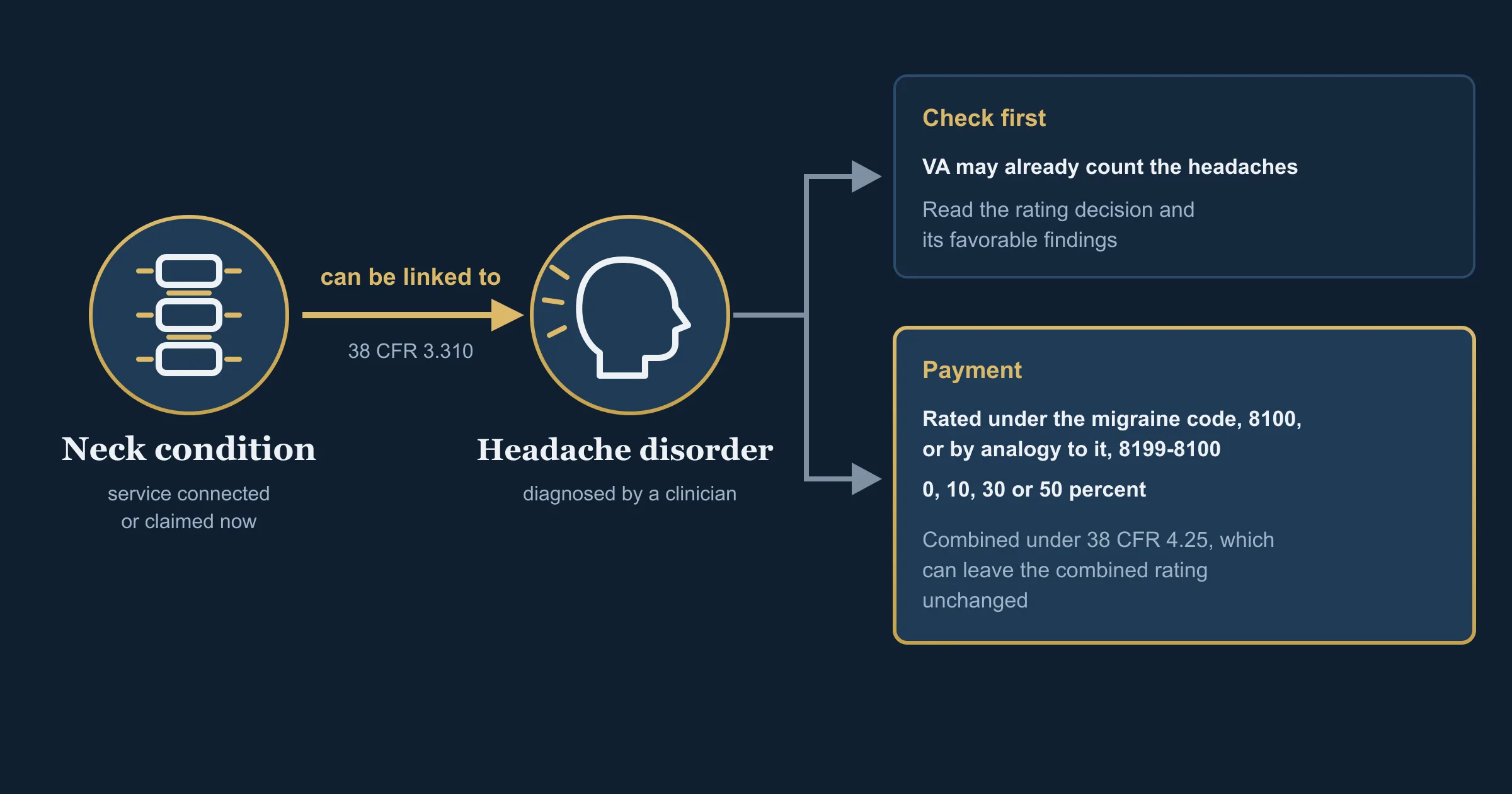
Start Here: VA May Already Count Your Headaches
Before anyone writes about the link, read what VA has already decided. A veteran can be service connected for headaches without knowing it, when VA has folded the headaches into the neck grant instead of listing them as a separate rating.
What one 1985 rating decision did
In 18150820 (2018) the Board found that a June 1985 rating decision had granted service connection for "residuals, injury, cervical spine with associated headaches," and that it said: "Headaches are considered part and parcel of the spinal injury and will be included in the veteran's diagnosis." The Board held that "VA expressly service connected the headaches, albeit without an explicit separate noncompensable rating", effective October 12, 1984.
Then VA lost track of its own grant. When the veteran claimed "compensation benefits for headaches" in 2014, VA, in the Board's words, "incorrectly construed this statement as a service connection claim instead of as an increased rating claim", and denied it. The Board dismissed the service-connection appeal, because there was nothing left to grant, and ordered VA's records updated to show the 1984 date, saying the correction "confers no new benefit". It sent back for a VA examination the question VA should have decided: "Entitlement to a compensable rating for a headache disorder" (non-precedential, 38 CFR 20.1303).
The wording to look for varies
Do not search only for the phrase "associated headaches". In 1442004 (2014) the neck disability on appeal had been identified as "degenerative disc disease, C3-4 and C4-5 with headaches." Inside that neck appeal the Board found the headaches to be "a separate neurological manifestation of the service-connected cervical spine disorder" and ordered: "A separate rating for headaches as secondary to a cervical spine disorder is granted" (non-precedential, 38 CFR 20.1303).
So read every description of a service-connected disability on your codesheet and in the rating narrative for any headache wording, whatever form it takes. Then read the decision notice.
The list of favorable findings
Every decision notice issued since February 19, 2019 must include "A listing of any findings made by the adjudicator that are favorable to the claimant under § 3.104(c)" (38 CFR 3.103(f)(4)). A favorable finding "is binding on all subsequent agency of original jurisdiction and Board of Veterans' Appeals adjudicators, unless rebutted by evidence that identifies a clear and unmistakable error in the favorable finding" (38 CFR 3.104(c)).
That rule carried the headaches in A21018795 (2021). The Board wrote: "In the October 2019 rating decision, the AOJ made a favorable finding that the Veteran's headaches are secondary to his neck condition." The neck itself was not service connected at the time. Once the Board granted the neck, on a private opinion about the neck, it granted the headaches "Based on this favorable finding", with no separate headache opinion discussed (non-precedential, 38 CFR 20.1303).
If VA already counts them, you are not done
If your headaches are already service connected, on their own or as part of the neck, you do not need a nexus letter for the link. You can still ask VA to rate them separately through a claim for an increase (38 CFR 3.1(p)(1)(ii)), the question the Board sent back in 18150820 and the separate rating it granted in 1442004. If the decision that folded them into the neck was issued less than a year ago, you can instead ask for a review of it: a supplemental claim with new and relevant evidence, a higher-level review, or a Board appeal. An issue pursued that way without a break can keep the date of the claim that decision decided (38 CFR 3.2500(h)(1)), where a claim for an increase can reach back up to a year before the claim (38 CFR 3.400(o)(2)).
Name the earlier decision by date and quote its wording in your claim, because VA has misread its own grant before. Bring severity evidence too, because a separate rating pays only when the attacks meet the rating criteria (see what a headache rating can pay, below). That evidence comes from your records, a headache journal and the people who see the attacks, not from a nexus letter.
If Your Neck Is Not Service Connected Yet, Claim Both Now
A headache claimed as secondary to the neck needs a service-connected neck. That is a reason to claim the neck now, not a reason to wait for it.
Why the neck has to be part of the claim
In 18160361 (2018) VA treating physicians had attributed the veteran's headaches to his neck, one recording an impression of chronic headaches thought to be cervicogenic. The Board still declined to reopen the headache claim for lack of new and material evidence, holding that those opinions did not raise a reasonable possibility of substantiating it because the neck was not service connected and "service connection cannot be granted secondary to a nonservice-connected disability", citing Allen v. Brown, 7 Vet. App. 439 (1995) (en banc), and 38 CFR 3.310(a). The neck's own request to reopen failed in the same decision. That was a failed request to reopen a finally denied claim, not a ruling on the medical link (non-precedential, 38 CFR 20.1303).
Why waiting costs money
VA's manual dates a secondary grant from the claim it was awarded on: "The effective date of secondary SC must be based on the date that the application upon which SC was eventually awarded was filed." It adds: "The effective date assigned for a secondary SC disability cannot be earlier than the effective date assigned for the causal or primary SC disability" (M21-1 Part V, Subpart ii, Chapter 4, Section A, Blocks 3.f and 3.g). A headache claim filed a year after the neck claim cannot reach back to the neck's date on that rule.
If you are not ready to file a complete claim, file an intent to file now. Under 38 CFR 3.155(b), if VA receives a complete application "within 1 year of receipt of the intent to file a claim, VA will consider the complete claim filed as of the date the intent to file a claim was received."
The Board has granted both in one decision
Five decisions we read granted the neck and the headaches in the same decision: A21018795 (2021), 21072900 (2021), 18160149 (2018), 18157013 (2018) and 18146722 (2018). In 21072900 the Board found the requirements met "because the Veteran's cervical spine condition is now service-connected as discussed above". Each is non-precedential under 38 CFR 20.1303.
Name both conditions on the claim. VA's manual says a pending claim can reach an unclaimed condition that caused the claimed one, if that condition is shown to be related to service ("the pending claim reasonably encompasses a claim for benefits for the causal disability", M21-1 Part V, Subpart ii, Chapter 3, Section A, Block 2.d), but naming both removes the question.
If a neck claim or appeal is already pending
Raise the headaches in it. VA's manual dates a disability found within the scope of a claim from that claim: the effective date "is governed by the date of receipt of the expressly claimed issue which resulted in sympathetic reading and/or finding a disability within scope" (M21-1 Part V, Subpart ii, Chapter 4, Section A, Block 1.g). It also says "A specific claim is not required to award a within-scope complication/residual" and lists "neurological disabilities related to the spine" among the examples (Part V, Subpart ii, Chapter 3, Section A, Block 2.c). It does not say whether a headache is one.
The Board has taken headaches up in pending appeals: in 1442004 it granted a separate headache rating inside an appeal for a higher neck rating, and in A25007432 it recorded that a 2022 Board decision, in a legacy appeal whose subject the 2025 decision does not state, had found a separate headache rating, secondary to the cervical spine, "reasonably raised", after which VA granted service connection for the headaches (both non-precedential, 38 CFR 20.1303).
If your headaches began in service
Say so, with the dates. Direct service connection does not depend on the neck at all. In 18146722 (2018) the Board found as fact that "The Veteran's headaches are related to service" and granted the neck and the headaches on a direct basis. In 18157013 (2018) service records showed that the veteran "reported neck pain and headaches following these MVAs", but the Board granted the headaches on a secondary basis, "as either secondary to the Veteran's service connected hepatitis C or as secondary to her neck disability" (both non-precedential, 38 CFR 20.1303).
The timeline cuts both ways, so give it as it happened. In 1314955 (2013) a VA examiner found the veteran's neck pains "could not have caused his headaches as the symptoms of both began at the same time", and the Board denied the claim (non-precedential, 38 CFR 20.1303). An opinion has to answer the theory your actual history supports, and no one should shape the history to fit a theory.
Inside the Neck Rating or Secondary to It: Two Routes With Different Dates
VA could treat a neck-linked headache as part of the neck disability or as a separate secondary condition. The two routes carry different effective-date rules, and nothing we found says which one VA uses for headaches. Ask VA to consider both.
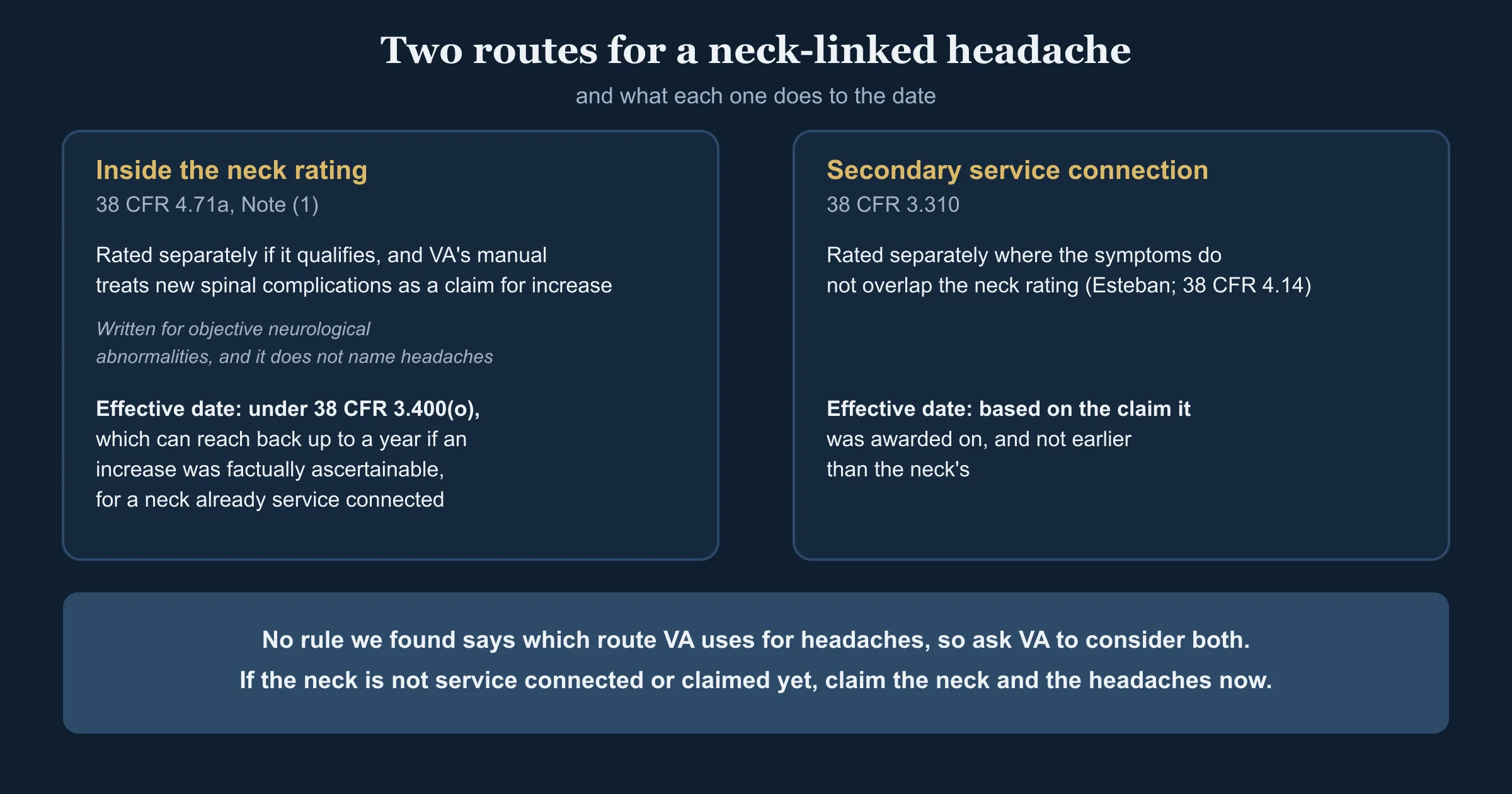
Route one: a complication counted with the neck
The spine formula in 38 CFR 4.71a rates the neck "With or without symptoms such as pain (whether or not it radiates), stiffness, or aching in the area of the spine affected by residuals of injury or disease". Its Note (1) adds: "Evaluate any associated objective neurologic abnormalities, including, but not limited to, bowel or bladder impairment, separately, under an appropriate diagnostic code."
VA's manual treats those abnormalities as a worsening of the spine rather than a new disability: "a claim asserting new complications of spinal disease is considered a claim for increase rather than a claim for secondary SC" (M21-1 Part V, Subpart iii, Chapter 1, Section B, Block 3.d). For the date, it says objective neurological abnormalities "establish a worsening of the spinal disability" and that 38 CFR 3.400(o) applies (Part V, Subpart ii, Chapter 4, Section A, Block 5.e, Example 2). Under 3.400(o)(2) the date can be the "Earliest date as of which it is factually ascertainable based on all evidence of record that an increase in disability had occurred if a complete claim or intent to file a claim is received within 1 year from such date". That can reach back up to a year before the claim, for a neck that is already service connected. Where the neck and a neurological complication are granted on one claim, the manual's example dates both from that claim (M21-1 Part V, Subpart iii, Chapter 1, Section B, Block 3.e, Example 2). It is a possibility, not a promise.
Route two: secondary service connection
38 CFR 3.310(a) service connects a disability "which is proximately due to or the result of a service-connected disease or injury". VA's manual says "A secondarily SC disability cannot be treated as an increased evaluation under 38 CFR 3.400(o) for effective date purposes", and the date follows the claim the grant was awarded on (same section, Block 3.f). The general rule in 38 CFR 3.400 is "the date of receipt of the claim or the date entitlement arose, whichever is later."
The Board has used both framings for the same kind of headache. It decided neck-linked headaches as secondary claims in 1507123, 1500511, 21067969 and 21072900, and it granted a separate headache rating under Note (1) inside a neck appeal in 1442004, whose order reads "as secondary to a cervical spine disorder" (all non-precedential, 38 CFR 20.1303). The word secondary on a decision does not settle the route or the date: VA's manual says its rating system requires that complications rated separately from a service-connected disability "be coded as secondary", and that this convention "does not impact assignment of an effective date" (M21-1 Part V, Subpart ii, Chapter 4, Section A, Block 5.e).
Why neither route is settled for headaches
The word headache does not appear in VA's manual section on the spine, and in 38 CFR 4.71a it appears once, in the fibromyalgia code. Nothing we read says whether a headache is one of the "associated objective neurologic abnormalities" in Note (1). One signal points away from it: a note under the codes for organic diseases of the central nervous system (DCs 8000 to 8025) in 38 CFR 4.124a describes "residuals not capable of objective verification, i.e., headaches, dizziness, fatigability". That note governs a different set of codes and is not a rule about the neck.
So plead both. Ask VA in writing to consider a separate rating for the headaches as part of the neck disability, secondary service connection under 38 CFR 3.310, and direct service connection if the headaches began in service. We have not verified how VA's application form handles more than one theory; whatever form you use, name each theory in writing.
If the neck made an existing headache disorder worse
If you had migraines or another headache disorder before the neck made it worse, the route for that worsening is aggravation under 38 CFR 3.310(b), and the regulation sets a gate: VA will not concede aggravation "unless the baseline level of severity of the nonservice-connected disease or injury is established by medical evidence created before the onset of aggravation or by the earliest medical evidence created at any time between the onset of aggravation and the receipt of medical evidence establishing the current level of severity of the nonservice-connected disease or injury."
In 23005147 (2023) an examiner who agreed the neck could "serve as triggers" for the veteran's migraines, yet found no aggravation without an adequate explanation, gave an inadequate opinion (non-precedential, 38 CFR 20.1303).
One deduction is gone, and the baseline deduction remains
3.310(b) still recites a deduction for natural progress. VA's manual, following Spicer v. McDonough, 61 F.4th 1360 (Fed. Cir. 2023), says VA "will apply the broader but-for standard and will no longer consider natural progress of the NSC disability when deciding a claim based on aggravation of an NSC disability by an SC disability" (M21-1 Part V, Subpart ii, Chapter 2, Section D, Block 1.a, in a note). That is VA's stated practice in its manual, not new regulation text. The same block applies the but-for test to secondary service connection as well, for disabilities that "would not have occurred but for" a service-connected one, and to aggravation, where a non-service-connected disability "would have been less severe but for the SC disability, including where the SC disability has interfered with or impeded treatment for the NSC disability".
The baseline deduction survives: "The evaluation assigned will reflect the difference between the current and baseline levels of severity" (Block 1.g). The baseline can rest on medical evidence or on "any other credible evidence, including lay evidence, that supports establishment of the baseline", though lay evidence on its own may not be enough (Block 1.c). And the manual cuts against the veteran here: "Do not assume a baseline of 0 percent when a baseline cannot be established by the available evidence" (Block 1.f). The same block says an aggravation claim should be denied for lack of a baseline only after VA's duty to assist is fulfilled, and that the duty includes developing evidence of the baseline, which may include an examination or medical opinion when warranted.
If VA service connected a TBI
Check the TBI rating before claiming anything here. VA's manual evaluates subjective complaints of headaches "as part of the TBI evaluation under 38 CFR 4.124a, DC 8045 rather than under a separate DC", and rates a distinct headache disorder separately "as long as the manifestations do not overlap with those used to assign the evaluation of TBI" (M21-1 Part V, Subpart iii, Chapter 12, Section B, Block 2.d). The same headache cannot be paid twice (38 CFR 4.14). That manual rule is written for TBI, not for the neck.
For the TBI side of the question, see our guide to headaches secondary to TBI.
Can a Neck Condition Cause Headaches? What the Medicine Supports
The medical question in this claim is about now: whether your current neck disorder is the source of your current headache, or makes it worse. Doctors recognize headache that comes from the neck, they disagree about how to diagnose it, and the research does not answer the question for any one veteran. Each finding below is labelled for what it measured and in whom.
A recognized diagnosis with written criteria
The International Classification of Headache Disorders (ICHD-3, entry 11.2.1) recognizes cervicogenic headache as a headache caused by a disorder of the cervical spine, its bone, discs or soft tissues. Paraphrasing its criteria: there must be clinical or imaging evidence of a disorder or lesion in the cervical spine or neck soft tissues of a kind known to be able to cause headache; at least two of four signs of causation (the headache began around the time the neck disorder began; it significantly improved or resolved as the neck disorder improved or resolved; neck motion is reduced and provocative maneuvers make the headache significantly worse; or a diagnostic block of a neck structure or its nerve supply abolishes it); and no other ICHD-3 diagnosis that accounts for it better. ICHD-3 adds that cervical spondylosis may or may not qualify, depending on the individual case.
Doctors disagree about how to diagnose it
A 2009 review in The Lancet Neurology (Bogduk and Govind) noted that some clinicians remain skeptical of the diagnosis, that the clinical diagnostic criteria it assessed had not been shown to be valid, and that a neck source can be established with fluoroscopically guided, controlled diagnostic nerve blocks (PMID 19747657). In a 1999 study in which physicians examined 24 headache patients in person, agreement on the diagnosis was a kappa of 0.83 between two expert headache neurologists but 0.43 to 0.62 among other physicians; the authors concluded that, with Sjaastad's criteria applied strictly, cervicogenic headache was diagnosed about as reliably as migraine and tension-type headache under the International Headache Society's criteria (PMID 10595292). In a 2022 review of 11 diagnostic studies, one bedside test, the cervical flexion-rotation test, had a pooled sensitivity and specificity of 83.0 percent each across 4 studies and 182 participants in telling cervicogenic headache apart from migraine, other headaches or no headache, which shifts the probability modestly; the review supported taking a headache history and examining the neck to make the diagnosis, and judged the value of findings other than this test unclear (PMID 36088782). A 2021 meta-analysis found less rotation on that test (by 17.67 degrees) and weaker neck flexion in cervicogenic headache than in migraine, each pooled from 2 studies (75 and 80 patients), and its authors called for more high-quality studies and wrote that physical findings alone cannot settle the diagnosis between cervicogenic headache and migraine (PMID 34479514). ICHD-3 itself says the features that tend to set cervicogenic headache apart are not unique to it and do not necessarily establish causation.
Controlled nerve blocks are the reference test
In a 2022 study of 166 consecutive patients with probable cervicogenic headache, controlled diagnostic blocks found the painful joint in 75 percent of those whose main complaint was headache (the C2-3 joint in 62 percent) and in 67 percent of those whose neck pain was worse than their headache (PMID 33484154). In 100 consecutive patients with neck pain for more than three months after whiplash, double-blind controlled blocks of the third occipital nerve confirmed that nerve's headache in 27 percent (95 percent CI 18 to 36), and no feature of the history or examination settled the diagnosis before the blocks, although patients who had it were more likely to be tender over the C2-3 joint (PMID 7931379). Neither study was of veterans.
One block, or an occipital block, does not settle it
Against controlled blocks, a single uncontrolled neck-joint block gave a false-positive result for 16 of 60 joints that had responded to a first block, 27 percent (95 percent CI 15 to 38), in 55 patients with neck pain for more than three months after a motor vehicle accident (PMID 8358135). The same research group recommended placebo-controlled blocks where diagnostic certainty is critical, naming a medicolegal context (PMID 8535040). Greater occipital nerve injections also helped after 26 of 57 injections in migraine and 13 of 22 in cluster headache in a London clinic audit (PMID 16527404), so relief after an occipital nerve block does not by itself place the source in the neck.
An MRI cannot settle it
Cervical MRI showed disc bulging in 87.6 percent of 1,211 volunteers with no symptoms (PMID 25584950). In a small comparison, disc bulging appeared in 10 of 22 patients with cervicogenic headache (45.4 percent) and 9 of 20 controls (45.0 percent) (PMID 14510932). ICHD-3 treats upper-cervical imaging findings as a hint of causation, not firm proof, and its chapter introduction says degenerative neck changes appear in nearly everyone over 40 and are as widespread in people without headache as in people with it.
Neck pain comes with other headaches too
Pooled clinic studies found neck pain in 77.0 percent of people with migraine (95 percent CI 69.0 to 86.4) against 23.2 percent of people without headache (PMID 35166137). In a population sample of 797 people studied by researchers at the Danish Headache Center, past-year neck pain was reported by 76.2 percent with migraine alone and 88.4 percent with tension-type headache alone, against 56.7 percent without headache (PMID 24853166). ICHD-3 leans toward classing headache from neck muscle pain as tension-type headache.
After a neck injury, the long-term evidence runs both ways
In Lithuania, 210 people in police-recorded rear-end collisions, 28 percent of whom reported neck pain at first (lasting no more than 17 days), and 210 matched people without a collision showed no significant difference in neck pain or headache after one year (PMID 10084524). In another Lithuanian group of 202 people in police-recorded rear-end collisions, 53 percent reported headache 1 to 3 years later against 50 percent of controls, and 10 of the 12 with daily headache had it before the crash (PMID 8622449). A Swedish insurance cohort found more headache and other complaints 7 years later in 232 drivers who reported a whiplash injury than in 3,688 unexposed people (relative risks 1.6 to 3.7 across complaints), and no increase in exposed drivers without a reported injury (PMID 11470396). A Japanese study that re-examined 75 of its original 508 whiplash patients and 181 of its 497 comparison volunteers 20 years later found headache in 24.0 percent against 12.2 percent (odds ratio 2.39), while neck MRI findings were similar in both groups and did not track symptoms (PMID 33394988). None of these diagnosed cervicogenic headache by ICHD criteria or by blocks, and none studied service members.
Military figures are context, not causation
Among 985 service members evacuated from Iraq and Afghanistan for headache between 2004 and 2009, 33.6 percent returned to duty overall, against 29.7 percent of those diagnosed with cervicogenic headache and 23.1 percent with occipital neuralgia (PMID 21994113). Among 38,426 Iraq and Afghanistan veterans who first received VA care in 2008 and received care in each year from 2009 to 2011, a 2008 headache diagnosis went with a coded neck-pain diagnosis (adjusted odds ratio 2.44, 95 percent CI 2.14 to 2.77) and more strongly with TBI plus PTSD (10.16) (PMID 26688427). We found no study that followed a neck injury sustained in military service to a headache that began years later. Neither study above shows that a neck injury caused a later headache.
What this means for a claim
Put together: a neck disorder can be the source of a headache, a cervical source can be shown in selected patients with controlled blocks, and examination findings can help separate it from migraine. The research does not show that headache plus neck pain plus an imaging finding means the neck is the source, and it gives no rate for veterans.
That makes the question a fair one for a physician to weigh in one veteran's file, against the ICHD-3 criteria and the record, and not one that the science settles in general. An opinion that says the science settles it overstates the science, and a VA examiner can say so.
Occipital neuralgia is a different diagnosis
ICHD-3 lists occipital neuralgia separately (entry 13.4): shooting or stabbing pain at the back of the scalp in the territory of the occipital nerves, which, under its criteria, a local anesthetic block of the nerve relieves for a time, and which has to be told apart from pain referred from the upper neck joints. VA's rating schedule has no entry that names the occipital nerve. If your records name occipital neuralgia, the analysis on this page does not carry over directly; ask the clinician who made the diagnosis how it was confirmed.
It Does Not Have to Be Called Cervicogenic, and Every Symptom Counts
The Board has granted neck-linked headaches under several labels. Nothing in the rating rules asks for one name, and nothing on this page should push you toward a label or away from a symptom.
Headache labels in Board orders on neck-linked headaches (non-precedential, 38 CFR 20.1303)
| Decision | Label in the Board's words |
|---|---|
| 1500511 (2015) | chronic headaches |
| 1507123 (2015) | occipital headaches secondary to cervical spine DDD |
| 1524862 (2015) | secondary service connection for migraine headaches |
| 18160149 (2018) | tension headaches, including as secondary to a neck disorder |
| A21018795 (2021) | cervicogenic headaches secondary to degenerative arthritis, cervical spine |
| 21072900 (2021) | headaches, as secondary to a cervical spine condition |
| 21067969 (2021) | headaches as secondary to a service-connected cervical spine disability |
Each label is quoted from the decision's order granting service connection.
A migraine diagnosis did not stop a neck-secondary grant
In 1524862 (2015) the Board found as fact: "The Veteran's migraine headaches are the result of his service-connected cervical degenerative disc disease." A private physician's 2011 note said the neck pain was worst at the base of the skull and "sometimes associated with headaches", adding "I suspect that this comes from the C3-4 spondylosis", and VA treatment notes later tied the headaches to the neck pain (non-precedential, 38 CFR 20.1303).
A split diagnosis can connect one part and not another
In 1507123 (2015) the VA examiner "diagnosed migraine and tension headaches." Three VA opinions tied the veteran's occipital headaches to his cervical spine, and one found that "the headaches/pressure behind the eyes and in his temples, the photo/phonophobia, and visual disturbance is part of the migraine syndrome and is not related to his cervical spine DDD." The Board granted "occipital headaches secondary to cervical spine DDD" and not the migraine component (non-precedential, 38 CFR 20.1303).
When only one component is connected and the medical evidence separates its symptoms, the rating counts only that component: 38 CFR 4.14 bars "the use of manifestations not resulting from service-connected disease or injury in establishing the service-connected evaluation". If the symptoms cannot be separated, VA's manual says "all symptoms should be deemed related to the SC disability and rated accordingly", though the other condition does not become service connected, and it treats whether they can be separated as a medical determination (M21-1 Part V, Subpart ii, Chapter 3, Section D, Block 2.c). In 0919523 (2009), after a grant for cervicogenic headaches, later diagnoses of tension and migraine headaches led the Board to ask whether they were "separate and distinct entities unrelated to the cervicogenic headaches" (non-precedential, 38 CFR 20.1303).
Describe every symptom as it happens
Tell every clinician and examiner about every symptom as it happens, including nausea and sensitivity to light or sound. ICHD-3 notes that migraine-like features such as nausea, vomiting and light or sound sensitivity can occur with cervicogenic headache, generally to a lesser degree than in migraine. For migraine, VA's manual says DC 8100 requires VA to "consider all symptoms experienced as a result of migraine attacks" (M21-1 Part V, Subpart iii, Chapter 12, Section A, Block 3.a, citing Holmes v. Wilkie).
Neither the ICHD-3 features nor the rating levels are a script. A headache described as it is, and diagnosed by the clinician who examined you, is what an honest opinion can work from.
If the injury that hurt your neck also started the headaches
ICHD-3 classifies headache caused by neck trauma, including headache after whiplash, in its chapter on trauma rather than under cervicogenic headache, even though it grants that headache after whiplash may well come from pathology in the neck. Every type in that chapter requires the headache to begin within 7 days of the injury, of regaining consciousness, or of regaining the ability to sense and report pain; ICHD-3 itself calls the 7-day interval somewhat arbitrary but keeps it for lack of evidence to change it. Where the neck condition comes from an injury in service, the physician has to say which diagnosis fits and why. A headache that began with the injury in service points to direct service connection; one that began later, with a current neck disorder as its source, is the secondary question this page covers.
What a Headache Rating Can Pay, and When It Pays Nothing
The rating schedule has no code for cervicogenic headache. VA rates a neck-linked migraine under the migraine code, DC 8100, and other neck-linked headaches by analogy to that code; either way, the percentage turns on prostrating attacks, not on the link.
Rated by analogy to DC 8100
In 1525697 (2015) the Board wrote: "There is no diagnostic code corresponding to cervicogenic headache disability in VA's rating schedule." The regional office had "rated the Veteran's cervicogenic headaches by analogy under Diagnostic Code 8100", and the Board raised them from 30 to 50 percent. In 18155577 (2018) the headaches "have been rated in accordance with DC 8199-8100", and the Board granted 30 percent on the veteran's own testimony (both non-precedential, 38 CFR 20.1303).
The code number follows 38 CFR 4.27, under which for a condition the schedule does not list "the last 2 digits will be "99" for all unlisted conditions", so it reads 8199-8100. 38 CFR 4.20 allows the analogy and adds a caution: "Conjectural analogies will be avoided, as will the use of analogous ratings for conditions of doubtful diagnosis, or for those not fully supported by clinical and laboratory findings." That caution concerns the diagnosis in the individual case, which is one more reason documented findings matter. It did not stop the Board from rating neck-linked headaches by analogy in the decisions above. Our guide to headaches after a TBI walks through the same analogy in its section on headaches that are not migraines.
The levels, and the one that pays nothing
DC 8100 has four levels. The paying ones are 10 percent for characteristic prostrating attacks averaging one in 2 months, 30 percent for attacks averaging once a month, and 50 percent for very frequent completely prostrating and prolonged attacks productive of severe economic inadaptability, each measured over the last several months. The bottom row reads "With less frequent attacks" and pays 0 percent. The full table is on our migraines page, linked below.
VA's manual defines prostrating as "causing extreme exhaustion, powerlessness, debilitation or incapacitation with substantial inability to engage in ordinary activities" (M21-1 Part V, Subpart iii, Chapter 12, Section A, Block 3.b). The regulation does not define the 0 percent level; the manual reads the structure of the code to mean "Characteristic prostrating attacks, on average, are more than two months apart over the last several months" (Block 3.f).
Winning the link can pay nothing
In A25007432 (2025) VA granted service connection for cervicogenic headaches in October 2022 and "assigned a noncompensable disability rating, effective September 22, 2021, under diagnostic code 8199-8100." The examiner had described headaches about twice a week that came with neck pain, resolved in an hour or two and did not make the veteran leave work. The Board sent the rating back because the examiner had assumed each headache would be treated with medication, and because chiropractic records had not been requested (non-precedential, 38 CFR 20.1303). In 1801003 (2018) another veteran's headaches sat at 0 percent for about nine years before a later examination supported 50 percent; that decision does not state the basis of the grant (non-precedential, 38 CFR 20.1303).
A grant at 0 percent still puts the headaches on the record as service connected, and a favorable finding binds later decision makers unless clear and unmistakable error is shown (38 CFR 3.104(c)). It can matter in other ways, and we do not count any of them as a reason to buy a letter. The law directs VA to furnish the hospital care and medical services it finds needed for a service-connected disability, with no percentage threshold (38 U.S.C. 1710(a)(1)(A)), and hospital and outpatient care for a 0 percent service-connected disability is not subject to the copayments in 38 CFR 17.108 (paragraph (e)(1)). VA also charges no copayment for medication for a service-connected disability, at any percentage (38 CFR 17.110(c)(2)). If the headaches later worsen, a claim for an increase can be dated up to a year before the claim when the increase is factually ascertainable (38 CFR 3.400(o)(2)), where a new secondary claim is dated from the claim. A condition the headaches cause can itself be service connected (38 CFR 3.310(a)). And if none of your service-connected disabilities is rated above 0 percent, a single 10 percent rating may be assigned under 38 CFR 3.324 when two or more separate permanent ones clearly interfere with normal employability.
What proves the frequency
The percentage turns on how frequent and how prostrating the attacks are, and that evidence comes from you and the people around you. VA's manual, in guidance written for migraine under DC 8100, lists probative evidence of frequency: "medical progress notes", lay evidence of the symptoms "(as long as those symptoms have been competently identified as symptoms of migraine headaches)", "contemporaneous notes (a headache journal)", prescription refills and witness statements. It adds: "The absence of treatment reports is not necessarily probative on the question of headache frequency as a claimant may not seek treatment for headaches during every episode" (Block 3.g).
Journals "which routinely and relatively contemporaneously record headache episodes" may be accepted as credible lay testimony (Block 3.h), and "Headaches recorded on non-work days may be used to prove frequency and prostration. However, they will not generally be relevant to work availability, and performance or limitations, which are considerations in determining severe economic inadaptability." The manual also says "medical evidence is required to establish that the reported symptoms are due to the SC migraine headaches" (Block 3.c). Record every headache, the mild ones too, at the time it happens.
VA's examination guidance treats a headache examination report as insufficient "if it does not indicate the frequency of prostrating headaches and whether the headaches are migraine-type or non-migraine type" (M21-1 Part IV, Subpart i, Chapter 3, Section B, Block 1.b). In 18145348 (2018) an employer's report carried limited weight because it did not show a history of several months of prostrating attacks and "does not differentiate the Veteran's headache pain from his neck pain" (non-precedential, 38 CFR 20.1303). A nexus letter supplies none of this. It addresses the link, not the frequency of prostrating attacks.
Beside the neck rating, but not counted twice
A headache rating sits beside the neck rating only for what the neck rating does not already count. 38 CFR 4.14 says "the evaluation of the same manifestation under different diagnoses are to be avoided." VA's manual states the test in a note: "Separate evaluations are warranted where none of the symptomatology for any one condition duplicates or overlaps another" (M21-1 Part V, Subpart ii, Chapter 3, Section D, Block 2.b, citing Esteban v. Brown). Neck pain belongs to the neck rating; attacks of head pain rated on DC 8100's criteria are measured on different things. In the decisions we read, headache ratings stood beside neck ratings in 1442004, 1801003, 18145348 and 18155577.
The disc-disease exception is used only when it gives the higher combined rating
If your neck is rated for intervertebral disc syndrome on incapacitating episodes, VA's manual says "a separate evaluation may not be assigned for LOM, radiculopathy, or any other associated objective neurological abnormality as doing so would constitute pyramiding under 38 CFR 4.14" (M21-1 Part V, Subpart iii, Chapter 1, Section B, Block 3.a). Whether that reaches a headache is unverified: neither the regulation nor the manual names headaches. And VA uses that method only when it gives more: disc syndrome is rated under the general formula or the incapacitating-episode formula, "whichever method results in the higher evaluation when all disabilities are combined under § 4.25" (38 CFR 4.71a).
How a headache rating combines with the neck
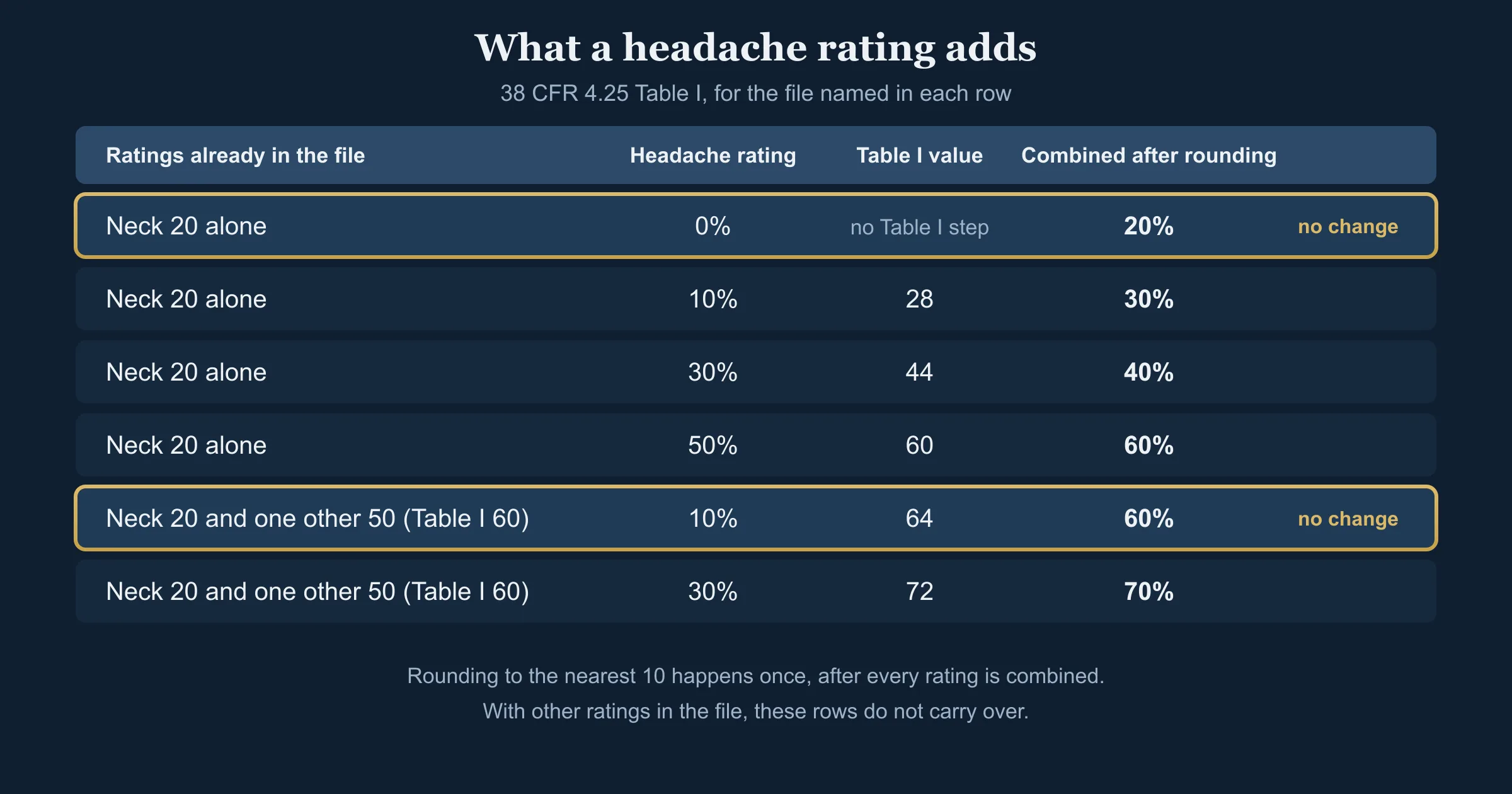
Ratings are not added. 38 CFR 4.25(a) combines them through Table I, largest first, and the combined value "will then be converted to the nearest number divisible by 10, and combined values ending in 5 will be adjusted upward." Under 4.25(b) that conversion "will be done only once per rating decision, will follow the combining of all disabilities, and will be the last procedure in determining the combined degree of disability."
Read the table below in both directions: the same 10 percent headache rating moves a lone 20 percent neck rating to 30, and leaves a file whose ratings combine to exactly 60 at 60. Each row is scoped to the file it names. With other ratings in your file, every rating is combined in order of severity using unrounded values, and these rows do not carry over.
Combined value under 38 CFR 4.25 Table I, for the file named in each row
| Ratings already in the file | Headache rating | Table I value | Combined rating after rounding |
|---|---|---|---|
| Neck 20 percent, nothing else | 0 percent | No Table I step | 20 percent (no change) |
| Neck 20 percent, nothing else | 10 percent | 28 | 30 percent |
| Neck 20 percent, nothing else | 30 percent | 44 | 40 percent |
| Neck 20 percent, nothing else | 50 percent | 60 | 60 percent |
| Neck 20 percent and one other rating of 50 percent (Table I value 60) | 10 percent | 64 | 60 percent (no change) |
| Neck 20 percent and one other rating of 50 percent (Table I value 60) | 30 percent | 72 | 70 percent |
Cells read from Table I in 38 CFR 4.25 as published in the eCFR issue of August 27, 2026. Three ratings are combined in order of severity: 50 and 20 give 60, and 60 and 10 give 64; 50 and 30 give 65, and 65 and 20 give 72.
The full DC 8100 table and the definitions of its terms are on our migraines and VA disability page.
What Board Decisions on Neck-Linked Headaches Show
We read 25 Board decision files for this page, each at its order or remand block and the reasoning behind it. On the link, 11 granted service connection or a separate rating, 1 denied, 1 declined to reopen, 1 dismissed because VA had already connected the headaches, and 4 sent the question back. Seven more concern the percentage or a diagnosis that changed after the grant. These decisions came from searches, not a random draw, so the counts are not grant rates and predict nothing.
38 CFR 20.1303 says "previously issued Board decisions will be considered binding only with regard to the specific case decided", that "Prior decisions in other appeals may be considered in a case to the extent that they reasonably relate to the case", and that "each case presented to the Board will be decided on the basis of the individual facts of the case in light of applicable procedure and substantive law." We describe each decision for the issue it decided and for no more.
What carried the headache link in the 11 grants: VA's own evidence in 6 (1507123, 18157013, 18160149, 21067969, 21072900, 1442004); an earlier VA favorable finding, whose evidence the decision does not describe, in 1 (A21018795); VA evidence together with treating clinicians' notes in 2 (1500511, 1524862); a private chiropractor's opinion, with a June 2018 VA examiner reaching the same conclusion, in 1 (21024692); and an examiner whose status the decision does not state in 1 (18146722). In two of the grants a private opinion went to the neck, not the headaches (A21018795, and 18160149, which cites a June 2013 private opinion on the neck). Two private headache opinions failed: in 1314955 the Board found one "deserves little probative value", and in 23064169 it called one "speculative in nature".
Service connection or a separate rating granted
Citation Nr 1507123 (decided February 18, 2015)
Granted: "Service connection for occipital headaches secondary to cervical spine DDD is granted." The migraine component was not connected.
The Board relied on "the December 2009, June 2012, and August 2014 VA opinions", which tied the occipital part of the headaches to the cervical spine and found the migraine features unrelated to it.
Why it matters. VA's own examiners carried the grant, and a mixed headache picture was split.
Non-precedential: binds only this case (38 CFR 20.1303).
Citation Nr 1500511 (decided January 7, 2015)
Granted: "Service-connection for chronic headaches is granted."
A January 2010 VA opinion, given before the neck was service connected, and a February 2013 treating opinion by Dr. J. A., whose status the decision does not state, were given "greater weight than other VA opinions as the other VA opinions only address service-connection on a direct basis."
Why it matters. Opinions on the secondary question outweighed opinions that answered a different one.
Non-precedential: binds only this case (38 CFR 20.1303).
Citation Nr A21018795 (decided November 24, 2021)
Granted in one decision: the cervical spine, as secondary to the thoracolumbar spine, and "cervicogenic headaches secondary to degenerative arthritis, cervical spine".
A July 2021 private opinion won the neck. No headache opinion is discussed; the headaches followed VA's October 2019 favorable finding once the neck was granted.
Why it matters. The private opinion went to the neck; VA's own favorable finding settled the headache link.
Non-precedential: binds only this case (38 CFR 20.1303).
Citation Nr 18157013 (decided December 11, 2018)
Granted in one decision: a neck disability, and headaches.
The Board found that "no examiner addressed the likelihood that the Veteran's headaches are caused or aggravated by her neck disability" and relied on a Veterans Health Administration expert opinion it had requested in 2017 that linked the headaches to the now service-connected neck, and granted them as secondary to either the neck or hepatitis C.
Why it matters. When VA's examiners skipped the neck theory, an expert opinion the Board requested from the Veterans Health Administration filled the gap.
Non-precedential: binds only this case (38 CFR 20.1303).
Citation Nr 18146722 (decided November 1, 2018)
Granted on a direct basis: degenerative arthritis of the cervical spine, and headaches.
A January 2007 examiner of unstated status linked the in-service injury to the neck "with headaches of a cervicogenic origin". A medical expert opinion the Board requested in 2010 was negative, and the Board still found relative equipoise.
Why it matters. The in-service injury explained both the neck and the headaches.
Non-precedential: binds only this case (38 CFR 20.1303).
Citation Nr 21072900 (decided December 6, 2021)
Granted in one decision: the cervical spine, and "headaches, as secondary to a cervical spine condition".
A VA examiner, examining by telephone, found the headaches "felt to be secondary to the chronic neck pain as well as the noted muscle spasms in this region of the cervical spine noted on imaging". A second VA examiner's negative opinions, on the neck, were "conclusory and inadequate"; the decision discusses no negative headache opinion.
Why it matters. VA's own examiner carried the headaches.
Non-precedential: binds only this case (38 CFR 20.1303).
Citation Nr 18160149 (decided December 26, 2018)
Granted in one decision: the cervical spine, "tension headaches, including as secondary to a neck disorder", and radiculopathy in both arms.
A June 2014 VA medical opinion by the veteran's primary care provider described the cervical changes as having "precipitated a headache disorder". A June 2013 private opinion is cited on the neck.
Why it matters. A VA treating clinician carried the headaches; the private opinion went to the neck.
Non-precedential: binds only this case (38 CFR 20.1303).
Citation Nr 21067969 (decided November 8, 2021)
Granted: headaches "as secondary to a service-connected cervical spine disability".
An earlier Board denial had addressed only direct service connection, and a joint motion limited the remand to the secondary theory. "The December 2017 VA examiner specifically found that the Veteran's headaches were secondary to neck pain."
Why it matters. The answer was already in a VA examination in the file.
Non-precedential: binds only this case (38 CFR 20.1303).
Citation Nr 21024692 (decided April 23, 2021)
Reopened and granted: headaches "claimed as secondary to service-connected neck and shoulder disabilities".
A private chiropractor's report "provided a clear conclusion with supporting data, and reasoned medical explanations connecting the two" and was given "great probative value"; a June 2018 VA examiner had found "headaches secondary to chronic cervical problems."
Why it matters. A private opinion earned its weight by its reasoning, and a VA examiner reached the same conclusion.
Non-precedential: binds only this case (38 CFR 20.1303).
Citation Nr 1524862 (decided June 10, 2015)
Granted: "Entitlement to secondary service connection for migraine headaches is granted."
Private and VA treatment notes tied the headaches to the neck; the February 2013 VA examination against the claim rested on "an inaccurate factual premise".
Why it matters. Treating notes outweighed a flawed examination, and the migraine label did not bar the grant.
Non-precedential: binds only this case (38 CFR 20.1303).
Citation Nr 1442004 (decided September 19, 2014)
Granted inside a neck appeal: "A separate rating for headaches as secondary to a cervical spine disorder is granted."
The neck had been identified as "degenerative disc disease, C3-4 and C4-5 with headaches"; VA examinations tied the headaches to the neck, and the Board cited Note (1) of the spine formula. Its order set no percentage.
Why it matters. Headaches already named in the neck's description were rated separately, on VA evidence.
Non-precedential: binds only this case (38 CFR 20.1303).
Denied, not reopened, or already granted
Citation Nr 1314955 (decided May 6, 2013)
Denied: headaches, "to include as secondary to service-connected cervical and lumbar spine disabilities".
A VA examiner found the neck pains "could not have caused his headaches as the symptoms of both began at the same time"; a private chiropractor's opinion on the direct theory appeared to "rely solely on the Veteran's lay statements regarding his symptoms", which the medical evidence did not support, and the Board found that it "deserves little probative value".
Why it matters. A private opinion resting on an account the record did not support got little weight, and the shared onset worked against the secondary claim.
Non-precedential: binds only this case (38 CFR 20.1303).
Citation Nr 18160361 (decided December 26, 2018)
Not reopened: both the headache claim and the cervical spine claim.
Favorable VA treating opinions on the link did not help, because "service connection cannot be granted secondary to a nonservice-connected disability".
Why it matters. A failed request to reopen, not a ruling on the medical link.
Non-precedential: binds only this case (38 CFR 20.1303).
Citation Nr 18150820 (decided November 16, 2018)
Dismissed: the service-connection appeal, because VA had service connected the headaches in 1985. Remanded: a compensable rating.
VA had "incorrectly construed" a 2014 claim as a new service-connection claim; the records update "confers no new benefit upon the Veteran".
Why it matters. Read the old rating decision first.
Non-precedential: binds only this case (38 CFR 20.1303).
Sent back for a VA opinion, or a better one
Citation Nr 23064169 (decided December 5, 2023)
Remanded: migraine headaches, to include cervicogenic headaches, secondary to the cervical spine.
The Board wrote that "correlation is not causation" and that "the opinion is speculative in nature", found the VA opinions inadequate too, and ordered a new opinion that addresses the private one.
Why it matters. Causal words need causal reasoning.
Non-precedential: binds only this case (38 CFR 20.1303).
Citation Nr 23005147 (decided January 26, 2023)
Remanded: migraine headaches, to include as secondary to the cervical spine or PTSD.
The examiner agreed the service-connected conditions "can serve as triggers for the Veteran's migraine headaches" yet found no aggravation, without an adequate explanation.
Why it matters. A conceded trigger needs an answer on aggravation.
Non-precedential: binds only this case (38 CFR 20.1303).
Citation Nr 21075140 (decided December 17, 2021)
Remanded: right-sided head pain, to include as secondary to the cervical spine.
The July 2020 VA examiner "did not provide an opinion on aggravation".
Why it matters. Causation needs reasons, and aggravation needs its own answer.
Non-precedential: binds only this case (38 CFR 20.1303).
Citation Nr 1603845 (decided February 3, 2016)
Remanded: a separate rating for headaches associated with cervical disc disease.
A VA examiner's statement about the literature came with no rationale, and the new opinion had to address an August 2011 private assessment of "cervicogenic headaches."
Why it matters. An unexplained conclusion with no answer on aggravation was sent back, and the new opinion had to be reconciled with a private assessment in the file.
Non-precedential: binds only this case (38 CFR 20.1303).
The percentage: decisions on what the headaches are rated
Citation Nr 1525697 (decided June 16, 2015)
Raised from 30 to 50 percent for cervicogenic headaches, for the whole appeal period.
Rated by analogy to DC 8100; a VA examiner found "very frequent prostrating and prolonged attacks of non-migraine headache pain lasting one to two days".
Why it matters. A neck-secondary headache reached the top level on the frequency and severity of the attacks.
Non-precedential: binds only this case (38 CFR 20.1303).
Citation Nr 18155577 (decided December 4, 2018)
An initial 30 percent for "tension headaches associated with mild degenerative changes of the cervical spine"; 50 percent denied.
Rated under DC 8199-8100. Two VA examiners found no prostrating attacks, but on the veteran's testimony the Board resolved reasonable doubt in his favor; steady employment with no reported missed work defeated 50 percent.
Why it matters. Credible testimony about frequency counts.
Non-precedential: binds only this case (38 CFR 20.1303).
Citation Nr 1801003 (decided January 9, 2018)
0 percent before June 8, 2017, and 50 percent from that date, for chronic headaches.
Before June 2017 the Board found "no evidence of characteristic prostrating attacks". The decision does not state the basis of the original grant.
Why it matters. Used here for the 0 percent shape only.
Non-precedential: binds only this case (38 CFR 20.1303).
Citation Nr A25007432 (decided January 28, 2025)
Remanded: the 0 percent rating for cervicogenic headaches under 8199-8100.
The examiner had assumed medication relief, and chiropractic headache records had not been requested.
Why it matters. Winning the link paid nothing at first; the severity evidence sets the number.
Non-precedential: binds only this case (38 CFR 20.1303).
Citation Nr 18145348 (decided October 26, 2018)
Held at 10 percent for "musculoskeletal headaches", beside a 10 percent neck rating.
An employer's report of lost work days "does not differentiate the Veteran's headache pain from his neck pain".
Why it matters. A report that did not separate headache from neck pain, or show months of prostrating attacks, carried limited weight.
Non-precedential: binds only this case (38 CFR 20.1303).
Citation Nr 0801007 (decided January 10, 2008)
Remanded: cervical headaches rated 10 percent under 8199-8100.
The Board asked whether the headaches "are prostrating in nature" and how frequent the attacks were.
Why it matters. An examination that skips prostrating attacks cannot support the rating.
Non-precedential: binds only this case (38 CFR 20.1303).
Citation Nr 0919523 (decided May 26, 2009)
Remanded: cervicogenic headaches, rated 0 and then 10 percent.
Later tension and migraine diagnoses raised whether they were "separate and distinct entities unrelated to the cervicogenic headaches".
Why it matters. A shifting diagnosis can move symptoms in or out of the grant.
Non-precedential: binds only this case (38 CFR 20.1303).
VA's own evidence or a VA favorable finding carried 7 of the 11 grants, and a private opinion, with a VA examiner reaching the same conclusion, carried 1. The percentage was decided apart from the link, on the frequency and severity of prostrating attacks.
Does a Private Opinion Help? What It Has to Cover, and What It Cannot Do
VA must give you an examination or medical opinion when the record lacks enough medical evidence to decide the claim but holds competent evidence of a current disability or of persistent or recurrent symptoms, and "Indicates that the claimed disability or symptoms may be associated with the established event, injury, or disease in service or with another service-connected disability" (38 CFR 3.159(c)(4)(i)). VA's manual says that on secondary claims "the threshold for ordering an examination is low", although "A generalized statement merely asserting a conclusion that a condition is secondary to an SC disability is not sufficient" (M21-1 Part IV, Subpart i, Chapter 1, Section B, Block 1.e). So a letter is not the first step. It can help a narrower group.
Who a private opinion can help
- Your neck is service connected, or claimed now.
- Your records hold a diagnosed headache disorder.
- Your headaches are not already part of a neck or TBI rating, and no favorable finding has settled the link.
- VA's evidence on causation or aggravation is negative, silent or inadequate. A silent or inadequate VA opinion can be sent back for a new one, but in two of the three files we cite the Board first denied the claim relying, at least in part, on that opinion, and sent it back only after the Court of Appeals for Veterans Claims vacated the denial (21075140, 23005147); in 1603845 the Board sent one back itself.
- Your records hold the clinical facts a reviewing physician needs: the diagnosis, examination findings, the timeline and any nerve block results.
What the opinion has to cover
- The question, in the present tenseWhether your current neck disorder is the source of your current headache, or makes it worse. The question is not whether an old injury caused headaches in general.
- A named diagnosis, and whyWhich diagnosis fits (cervicogenic headache, tension-type headache, migraine made worse by the neck, or another), mapped to its criteria from your records. Where the neck condition came from an injury in service, why ICHD-3's trauma chapter, with its 7-day onset rule, does or does not apply.
- The neck disorder itselfWhat it is and how it was shown, with ICHD-3's caution that imaging hints at causation without proving it, and that spondylosis qualifies only case by case.
- At least two causation signs from the recordOnset in step with the neck disorder; significant improvement or resolution in step with improvement or resolution of the neck disorder; reduced neck motion with the headache made significantly worse by provocative maneuvers; or a headache abolished after a diagnostic block of a neck structure or its nerve supply, naming the structure blocked and whether the block was controlled.
- The differentialMigraine with neck pain, tension-type headache, occipital neuralgia, headache after a head injury and medication-overuse headache, each excluded or explained. In 1507123 one component was connected and another was not.
- Causation and aggravation, answered separatelyAn opinion that skipped aggravation and did not fully explain its answer on causation fell short in 21075140, and an examiner who conceded the neck as a trigger but denied aggravation without an adequate explanation fell short in 23005147. For aggravation, the baseline from the earliest records.
- The record, read and appliedThe Board weighed reasons, not titles: compare 21024692 with 23064169 and 1314955 in the Board decisions above.
The conclusion is conventionally written as a probability, "at least as likely as not", the form the January 2010 VA examiner used in 1500511. Those words are not in 38 CFR 3.102, which speaks of "an approximate balance of positive and negative evidence which does not satisfactorily prove or disprove the claim". The reasons are what the Board weighs.
What a records review cannot do
A nexus letter is a records-based medical opinion for your claim, not a doctor's visit. A records review cannot add an examination finding, a range-of-motion test or a nerve-block result your records do not contain, and two of ICHD-3's four signs of causation depend on exactly those. It does not change the frequency of your prostrating attacks, on which the percentage turns. It is not a guarantee your claim gets approved. The VA makes that call, not us. A physician on our team will not sign an opinion your file does not support. We write medical evidence; filing claims and representing veterans are not part of our work.
The elements VA looks for in any medical opinion are in our guide to what a nexus letter must include.
Is There a Headache Claim Here, and Does It Need a Letter?
Check your file
Tick each statement your records support today. The first three ask whether VA has already settled part of this. The next two ask whether the neck and the diagnosis are in place. The rest carry no points; each names something a rater or a physician will look for in the file.
Tick only what your records show right now. Nothing here adds up to a score.
When You May Not Need a Letter, and When We Cannot Help
We write nexus letters. Here is where buying one does not make sense, or cannot work.
- VA already counts your headachesIf your rating decision lists the headaches as service connected, on their own or with the neck, the link is settled. The next step is a claim for an increase or, if that decision is less than a year old, a review of it, which can keep the date of the claim it decided (38 CFR 3.2500(h)(1)).
- Your neck is not service connected and not claimedA headache claimed as secondary to the neck needs a service-connected neck. Claim both now, or file an intent to file now; a letter cannot replace the neck claim.
- No VA examiner has looked yetVA must provide an examination or opinion when the record lacks enough medical evidence to decide the claim but shows a current disability and an indication of a link (38 CFR 3.159(c)(4)). VA's own evidence or a VA favorable finding decided the link in 7 of the 11 grants we read.
- Your file already holds a favorable opinion or findingA favorable VA opinion, a treating clinician's note or a favorable finding on the decision notice may already carry the link. A favorable finding binds later decision makers unless clear and unmistakable error is shown (38 CFR 3.104(c)).
- The open question is the percentageThe rating turns on the frequency of prostrating attacks, shown by your records, a journal and witness statements. A nexus letter addresses the link, not the frequency of your attacks.
- The combined rating may not moveA grant can come at 0 percent, and a new 10 percent rating can leave a combined 60 where it is. Whether the link is worth paying to establish now is your call, and we will say so plainly on the consultation.
- Your TBI rating already counts the headachesThe same headache cannot be paid twice (38 CFR 4.14). That question belongs to the TBI rules.
- The records lack the clinical factsWithout a recorded diagnosis, examination findings and a timeline, a records review has nothing to build on. A clinician who can examine you comes first.
Questions and Answers
Can headaches be service connected secondary to a neck condition?
Yes, they can be, under 38 CFR 3.310(a) when a service-connected neck condition causes them, or 3.310(b) when it makes an existing headache disorder worse, which needs a baseline. Of the Board decisions we read, 11 granted service connection or a separate rating for neck-linked headaches, under several labels; one of the 11 (18146722) granted them on a direct basis. Each is "binding only with regard to the specific case decided" under 38 CFR 20.1303.
My neck rating decision lists headaches. Do I need a nexus letter?
Not for the link, if the decision lists the headaches as part of a service-connected disability. In 18150820 the Board found that a 1985 grant "with associated headaches" had service connected them, and in 1442004 it granted a separate headache rating inside a neck appeal; each decision is "binding only with regard to the specific case decided" (38 CFR 20.1303). The next step is a claim for an increase with severity evidence, naming the earlier decision, or, if that decision is less than a year old, a review of it (a supplemental claim with new and relevant evidence, a higher-level review or a Board appeal), which can keep the date of the claim it decided under 38 CFR 3.2500(h)(1). A mention in the evidence summary alone is not a grant.
Should I wait until my neck is service connected before claiming headaches?
No. VA's manual dates a secondary grant from the claim it was awarded on and not earlier than the neck's effective date (M21-1 Part V, Subpart ii, Chapter 4, Section A, Blocks 3.f and 3.g). Claim both now, or file an intent to file, which holds your date for a year under 38 CFR 3.155(b). The Board granted the neck and the headaches together in five decisions we read.
Is a neck-linked headache a claim for an increase or a secondary claim?
Nothing we found says which one VA uses for headaches. VA's manual treats new neurological complications of spinal disease as a claim for increase, dated under 38 CFR 3.400(o), which can reach back up to a year when the neck is already service connected; secondary service connection is dated from the claim. Ask VA to consider both, and direct service connection if the headaches began in service.
Do my headaches have to be diagnosed as cervicogenic headache?
No. The Board has granted neck-linked headaches labelled chronic, occipital, tension, migraine and cervicogenic headaches. ICHD-3 leans toward coding headache from neck muscle pain as tension-type headache, and places headache caused by neck trauma in its trauma chapter. The diagnosis should be whatever your clinician finds, from your symptoms described as they are.
Can an MRI or a nerve block prove my headaches come from my neck?
An MRI cannot settle it: disc bulging appeared in 87.6 percent of 1,211 volunteers with no symptoms. Controlled diagnostic nerve blocks are the reference test researchers use, but a single uncontrolled block gave false-positive results for 27 percent of the joints that had responded to it in one study, and occipital nerve injections can also relieve migraine and cluster headache. A block result counts for what was blocked and how.
What is the VA rating for headaches secondary to a neck condition?
There is no code for cervicogenic headache, so VA rates neck-linked headaches other than migraine by analogy to the migraine code, written 8199-8100; a migraine is rated under DC 8100 itself. The levels are 0, 10, 30 and 50 percent, set by the frequency of characteristic prostrating attacks over the last several months, and 50 percent also needs completely prostrating and prolonged attacks productive of severe economic inadaptability. If the neck made an existing headache disorder worse, VA deducts the baseline level from the current one (M21-1 Part V, Subpart ii, Chapter 2, Section D, Block 1.g), so 30 percent now over a 10 percent baseline is rated 20. In the decisions we read, results ran from 0 percent (A25007432) to 50 percent (1525697); each decision is "binding only with regard to the specific case decided" (38 CFR 20.1303).
Will a headache rating raise my combined rating?
It may or may not. Ratings combine through Table I of 38 CFR 4.25, and rounding happens once at the end. With a neck at 20 percent as your only rating, a 10 percent headache rating gives 28, which rounds to 30. With a neck at 20 and another rating at 50, a 10 percent headache rating gives 64, which rounds back to 60. A grant at 0 percent has no Table I step, so beside any rating of 10 percent or more it leaves the combined rating where it is. If none of your service-connected disabilities is rated above 0 percent, a single 10 percent rating may be assigned under 38 CFR 3.324 when two or more separate permanent ones clearly interfere with normal employability.
I have a service-connected TBI. Can I also claim headaches secondary to my neck?
Check the TBI rating first. VA evaluates subjective headache complaints inside the TBI rating, and rates a distinct headache disorder separately only where the manifestations do not overlap with the TBI's (M21-1 Part V, Subpart iii, Chapter 12, Section B, Block 2.d). The same headache cannot be paid twice under 38 CFR 4.14. Our guide to headaches after a TBI covers those rules.
Do I need a nexus letter for headaches secondary to a neck condition?
Not in every case. VA must provide an examination or opinion when the record lacks enough medical evidence to decide the claim but shows a current disability and an indication of a link (38 CFR 3.159(c)(4)). In 7 of the 11 grants we read (found by searching, so not a rate), VA's own evidence or a VA favorable finding decided the link. A letter does real work when a VA opinion or decision has gone against the link and your records hold the diagnosis, examination findings and timeline a reviewer needs.
How much does a nexus letter for headaches secondary to a neck condition cost?
Our pricing page lists the fee for a physician-authored nexus letter, and the consultation is free. The fee is due before your letter is drafted, and if our clinician reviews your file and concludes an honest nexus opinion cannot be supported, you get your money back before drafting starts. The section on when you may not need a letter is worth reading first.
Related guides
- Neck conditions and VA disabilityHow VA rates the neck under the spine formula, the claim a headache secondary to it depends on.
- Migraines and VA disabilityThe full DC 8100 table and the definitions behind each level.
- Headaches after a TBIWhen a head injury is service connected, and how VA separates a headache disorder from the TBI rating.
- Nexus letter for migrainesThe direct route, for headaches that began in service.
- Migraines secondary to tinnitusAnother secondary route to a headache claim.
- Depression secondary to chronic painAnother condition claimed as secondary to a painful service-connected neck.
- What a nexus letter must includeThe elements a rater looks for in any medical opinion.
- Can a chiropractor write a nexus letterWho can give an opinion VA weighs, including the kind of chiropractor's opinion in 21024692.
Bring the Rating Decision Before Anything Else
Before you pay anyone for a letter, have your neck rating decision and codesheet, the decision notice with its favorable findings, any VA headache or neck examination, your treatment records and a headache journal at hand. They answer the first questions on this page: whether VA already counts the headaches, whether the neck is service connected or claimed, and whether anything in the file disputes the link. Where a VA opinion or decision has gone against the link, the check above shows whether a physician's opinion is worth discussing.
Go back to the readiness check.
The fee and the refund terms are on our pricing page.
Citations & References
- 38 U.S.C. 1710(a)(1), eligibility for hospital care and medical services (Cornell LII) https://www.law.cornell.edu/uscode/text/38/1710
- 38 CFR 3.1(p), definitions of claim, initial claim and claim for increase (eCFR, issue date 2026-08-27) https://www.ecfr.gov/current/title-38/section-3.1
- 38 CFR 3.102, Reasonable doubt (eCFR, issue date 2026-08-27) https://www.ecfr.gov/current/title-38/section-3.102
- 38 CFR 3.103(f)(4), notice of favorable findings (eCFR, issue date 2026-08-27) https://www.ecfr.gov/current/title-38/section-3.103
- 38 CFR 3.104(c), favorable findings (eCFR, issue date 2026-08-27) https://www.ecfr.gov/current/title-38/section-3.104
- 38 CFR 3.155(b), intent to file a claim (eCFR, issue date 2026-08-27) https://www.ecfr.gov/current/title-38/section-3.155
- 38 CFR 3.159(c)(4), duty to provide a medical examination or opinion (eCFR, issue date 2026-08-27) https://www.ecfr.gov/current/title-38/section-3.159
- 38 CFR 3.310, secondary service connection and aggravation, paragraphs (a) and (b) (eCFR, issue date 2026-08-27) https://www.ecfr.gov/current/title-38/section-3.310
- 38 CFR 3.324, Multiple noncompensable service-connected disabilities (eCFR, issue date 2026-08-27) https://www.ecfr.gov/current/title-38/section-3.324
- 38 CFR 3.400, effective dates, the general rule and paragraph (o) (eCFR, issue date 2026-08-27) https://www.ecfr.gov/current/title-38/section-3.400
- 38 CFR 3.2500(h), effective dates for continuously pursued issues (eCFR, issue date 2026-08-27) https://www.ecfr.gov/current/title-38/section-3.2500
- 38 CFR 3.2501, Supplemental claims (eCFR, issue date 2026-08-27) https://www.ecfr.gov/current/title-38/section-3.2501
- 38 CFR 4.14, Avoidance of pyramiding (eCFR, issue date 2026-08-27) https://www.ecfr.gov/current/title-38/section-4.14
- 38 CFR 4.20, Analogous ratings (eCFR, issue date 2026-08-27) https://www.ecfr.gov/current/title-38/section-4.20
- 38 CFR 4.25, Combined ratings table (eCFR, issue date 2026-08-27) https://www.ecfr.gov/current/title-38/section-4.25
- 38 CFR 4.27, Use of diagnostic code numbers (eCFR, issue date 2026-08-27) https://www.ecfr.gov/current/title-38/section-4.27
- 38 CFR 4.71a, the spine formula, Note (1) and intervertebral disc syndrome (eCFR, issue date 2026-08-27) https://www.ecfr.gov/current/title-38/section-4.71a
- 38 CFR 4.124a, including DC 8100 and the note under DCs 8000 to 8025 (eCFR, issue date 2026-08-27) https://www.ecfr.gov/current/title-38/section-4.124a
- 38 CFR 17.108(e), care not subject to the inpatient and outpatient copayments (eCFR, issue date 2026-08-27) https://www.ecfr.gov/current/title-38/section-17.108
- 38 CFR 17.110(c)(2), no copayment for medication for a service-connected disability (eCFR, issue date 2026-08-27) https://www.ecfr.gov/current/title-38/section-17.110
- 38 CFR 20.1303, Nonprecedential nature of Board decisions (eCFR, issue date 2026-08-27) https://www.ecfr.gov/current/title-38/section-20.1303
- M21-1, Part V, Subpart iii, Chapter 1, Section B, Blocks 3.a, 3.d and 3.e, the spine and its neurological complications (VA KnowVA, article 554400000014410) https://www.knowva.ebenefits.va.gov/system/templates/selfservice/va_ssnew/help/customer/locale/en-US/portal/554400000001018/content/554400000014410/M21-1-Part-V-Subpart-iii-Chapter-1-Section-B-Musculoskeletal-Disabilities-of-the-Extremities-and-Spine
- M21-1, Part V, Subpart iii, Chapter 12, Section A, Blocks 3.a to 3.h, migraine headaches (VA KnowVA, article 554400000180519) https://www.knowva.ebenefits.va.gov/system/templates/selfservice/va_ssnew/help/customer/locale/en-US/portal/554400000001018/content/554400000180519/M21-1-Part-V-Subpart-iii-Chapter-12-Section-A-Neurological-Conditions-and-Convulsive-Disorders
- M21-1, Part V, Subpart iii, Chapter 12, Section B, Block 2.d, TBI and comorbid headaches (VA KnowVA, article 554400000180832) https://www.knowva.ebenefits.va.gov/system/templates/selfservice/va_ssnew/help/customer/locale/en-US/portal/554400000001018/content/554400000180832/M21-1-Part-V-Subpart-iii-Chapter-12-Section-B-Traumatic-Brain-Injury-TBI
- M21-1, Part V, Subpart ii, Chapter 2, Section D, Blocks 1.a, 1.c, 1.f and 1.g, secondary service connection, aggravation and the baseline (VA KnowVA, article 554400000180484) https://www.knowva.ebenefits.va.gov/system/templates/selfservice/va_ssnew/help/customer/locale/en-US/portal/554400000001018/content/554400000180484/M21-1-Part-V-Subpart-ii-Chapter-2-Section-D-Secondary-Service-Connection-SC-and-Aggravation-of-Non-Service-Connected-NSC-Disabilities
- M21-1, Part V, Subpart ii, Chapter 3, Section D, Blocks 2.b and 2.c, the Esteban note on when separate evaluations are warranted and the rule for symptoms that cannot be separated (VA KnowVA, article 554400000180489) https://www.knowva.ebenefits.va.gov/system/templates/selfservice/va_ssnew/help/customer/locale/en-US/portal/554400000001018/content/554400000180489/M21-1-Part-V-Subpart-ii-Chapter-3-Section-D-Evaluating-Disabilities
- M21-1, Part V, Subpart ii, Chapter 4, Section A, Blocks 1.g, 3.f, 3.g and 5.e, effective dates (VA KnowVA, article 554400000180492) https://www.knowva.ebenefits.va.gov/system/templates/selfservice/va_ssnew/help/customer/locale/en-US/portal/554400000001018/content/554400000180492/M21-1-Part-V-Subpart-ii-Chapter-4-Section-A-Effective-Dates
- M21-1, Part V, Subpart ii, Chapter 3, Section A, Blocks 2.c and 2.d, issues within the scope of a claim (VA KnowVA, article 554400000180486) https://www.knowva.ebenefits.va.gov/system/templates/selfservice/va_ssnew/help/customer/locale/en-US/portal/554400000001018/content/554400000180486/M21-1-Part-V-Subpart-ii-Chapter-3-Section-A-Determining-the-Issues
- M21-1, Part IV, Subpart i, Chapter 1, Section B, Block 1.e, examinations on secondary claims (VA KnowVA, article 554400000180495) https://www.knowva.ebenefits.va.gov/system/templates/selfservice/va_ssnew/help/customer/locale/en-US/portal/554400000001018/content/554400000180495/M21-1-Part-IV-Subpart-i-Chapter-1-Section-B-Evidentiary-Standards-for-Finding-an-Examination-or-Opinion-Necessary
- M21-1, Part IV, Subpart i, Chapter 3, Section B, Block 1.b, headache examination report review (VA KnowVA, article 554400000180516) https://www.knowva.ebenefits.va.gov/system/templates/selfservice/va_ssnew/help/customer/locale/en-US/portal/554400000001018/content/554400000180516/M21-1-Part-IV-Subpart-i-Chapter-3-Section-B-Examination-Sufficiency-for-Specific-Disabilities
- ICHD-3, 11.2.1 Cervicogenic headache (International Headache Society) https://ichd-3.org/11-headache-or-facial-pain-attributed-to-disorder-of-the-cranium-neck-eyes-ears-nose-sinuses-teeth-mouth-or-other-facial-or-cervical-structure/11-2-headache-attributed-to-disorder-of-the-neck/11-2-1-cervicogenic-headache/
- ICHD-3, 11.2 Headache attributed to disorder of the neck (International Headache Society) https://ichd-3.org/11-headache-or-facial-pain-attributed-to-disorder-of-the-cranium-neck-eyes-ears-nose-sinuses-teeth-mouth-or-other-facial-or-cervical-structure/11-2-headache-attributed-to-disorder-of-the-neck/
- ICHD-3, chapter 11 introduction and its coded-elsewhere note on post-whiplash headache (International Headache Society) https://ichd-3.org/11-headache-or-facial-pain-attributed-to-disorder-of-the-cranium-neck-eyes-ears-nose-sinuses-teeth-mouth-or-other-facial-or-cervical-structure/
- ICHD-3, chapter 5, Headache attributed to trauma or injury to the head and/or neck (International Headache Society) https://ichd-3.org/5-headache-attributed-to-trauma-or-injury-to-the-head-andor-neck/
- ICHD-3, 13.4 Occipital neuralgia (International Headache Society) https://ichd-3.org/13-painful-cranial-neuropathies-and-other-facial-pains/13-4-occipital-neuralgia/
- Bogduk N, Govind J. Cervicogenic headache: an assessment of the evidence on clinical diagnosis, invasive tests, and treatment. Lancet Neurol. 2009 (PubMed) https://pubmed.ncbi.nlm.nih.gov/19747657/
- Govind J, Bogduk N. Sources of Cervicogenic Headache Among the Upper Cervical Synovial Joints. Pain Med. 2022 (PubMed) https://pubmed.ncbi.nlm.nih.gov/33484154/
- Anarte-Lazo E, et al. Differentiating migraine, cervicogenic headache and asymptomatic individuals based on physical examination findings: a systematic review and meta-analysis. BMC Musculoskelet Disord. 2021 (PubMed) https://pubmed.ncbi.nlm.nih.gov/34479514/
- van Suijlekom JA, et al. Interobserver reliability of diagnostic criteria for cervicogenic headache. Cephalalgia. 1999 (PubMed) https://pubmed.ncbi.nlm.nih.gov/10595292/
- Demont A, et al. Cervicogenic headache, an easy diagnosis? A systematic review and meta-analysis of diagnostic studies. Musculoskelet Sci Pract. 2022 (PubMed) https://pubmed.ncbi.nlm.nih.gov/36088782/
- Lord SM, et al. Third occipital nerve headache: a prevalence study. J Neurol Neurosurg Psychiatry. 1994 (PubMed) https://pubmed.ncbi.nlm.nih.gov/7931379/
- Barnsley L, et al. False-positive rates of cervical zygapophysial joint blocks. Clin J Pain. 1993 (PubMed) https://pubmed.ncbi.nlm.nih.gov/8358135/
- Lord SM, et al. The utility of comparative local anesthetic blocks versus placebo-controlled blocks for the diagnosis of cervical zygapophysial joint pain. Clin J Pain. 1995 (PubMed) https://pubmed.ncbi.nlm.nih.gov/8535040/
- Afridi SK, et al. Greater occipital nerve injection in primary headache syndromes, prolonged effects from a single injection. Pain. 2006 (PubMed) https://pubmed.ncbi.nlm.nih.gov/16527404/
- Nakashima H, et al. Abnormal findings on magnetic resonance images of the cervical spines in 1211 asymptomatic subjects. Spine. 2015 (PubMed) https://pubmed.ncbi.nlm.nih.gov/25584950/
- Coskun O, et al. Magnetic resonance imaging of patients with cervicogenic headache. Cephalalgia. 2003 (PubMed) https://pubmed.ncbi.nlm.nih.gov/14510932/
- Al-Khazali HM, et al. Prevalence of neck pain in migraine: A systematic review and meta-analysis. Cephalalgia. 2022 (PubMed) https://pubmed.ncbi.nlm.nih.gov/35166137/
- Ashina S, et al. Prevalence of neck pain in migraine and tension-type headache: a population study. Cephalalgia. 2015 (PubMed) https://pubmed.ncbi.nlm.nih.gov/24853166/
- Obelieniene D, et al. Pain after whiplash: a prospective controlled inception cohort study. J Neurol Neurosurg Psychiatry. 1999 (PubMed) https://pubmed.ncbi.nlm.nih.gov/10084524/
- Schrader H, et al. Natural evolution of late whiplash syndrome outside the medicolegal context. Lancet. 1996 (PubMed) https://pubmed.ncbi.nlm.nih.gov/8622449/
- Berglund A, et al. The association between exposure to a rear-end collision and future health complaints. J Clin Epidemiol. 2001 (PubMed) https://pubmed.ncbi.nlm.nih.gov/11470396/
- Watanabe K, et al. The Long-term Impact of Whiplash Injuries on Patient Symptoms and the Associated Degenerative Changes Detected Using MRI. Spine. 2021 (PubMed) https://pubmed.ncbi.nlm.nih.gov/33394988/
- Cohen SP, et al. Headaches during war: analysis of presentation, treatment, and factors associated with outcome. Cephalalgia. 2012 (PubMed) https://pubmed.ncbi.nlm.nih.gov/21994113/
- Jaramillo CA, et al. A cohort study examining headaches among veterans of Iraq and Afghanistan wars: Associations with traumatic brain injury, PTSD, and depression. Headache. 2016 (PubMed) https://pubmed.ncbi.nlm.nih.gov/26688427/
- Board of Veterans' Appeals, Citation Nr 18150820 (2018) https://www.va.gov/vetapp18/Files11/18150820.txt
- Board of Veterans' Appeals, Citation Nr 1442004 (2014) https://www.va.gov/vetapp14/Files5/1442004.txt
- Board of Veterans' Appeals, Citation Nr A21018795 (2021) https://www.va.gov/vetapp21/Files11/A21018795.txt
- Board of Veterans' Appeals, Citation Nr 18160361 (2018) https://www.va.gov/vetapp18/Files12/18160361.txt
- Board of Veterans' Appeals, Citation Nr 21072900 (2021) https://www.va.gov/vetapp21/Files12/21072900.txt
- Board of Veterans' Appeals, Citation Nr 18160149 (2018) https://www.va.gov/vetapp18/Files12/18160149.txt
- Board of Veterans' Appeals, Citation Nr 18157013 (2018) https://www.va.gov/vetapp18/Files12/18157013.txt
- Board of Veterans' Appeals, Citation Nr 18146722 (2018) https://www.va.gov/vetapp18/Files11/18146722.txt
- Board of Veterans' Appeals, Citation Nr 1314955 (2013) https://www.va.gov/vetapp13/Files2/1314955.txt
- Board of Veterans' Appeals, Citation Nr 1507123 (2015) https://www.va.gov/vetapp15/Files1/1507123.txt
- Board of Veterans' Appeals, Citation Nr 1500511 (2015) https://www.va.gov/vetapp15/Files1/1500511.txt
- Board of Veterans' Appeals, Citation Nr 21067969 (2021) https://www.va.gov/vetapp21/Files11/21067969.txt
- Board of Veterans' Appeals, Citation Nr 21024692 (2021) https://www.va.gov/vetapp21/Files4/21024692.txt
- Board of Veterans' Appeals, Citation Nr 1524862 (2015) https://www.va.gov/vetapp15/Files3/1524862.txt
- Board of Veterans' Appeals, Citation Nr 23064169 (2023) https://www.va.gov/vetapp23/Files12/23064169.txt
- Board of Veterans' Appeals, Citation Nr 23005147 (2023) https://www.va.gov/vetapp23/Files1/23005147.txt
- Board of Veterans' Appeals, Citation Nr 21075140 (2021) https://www.va.gov/vetapp21/Files12/21075140.txt
- Board of Veterans' Appeals, Citation Nr 1603845 (2016) https://www.va.gov/vetapp16/Files1/1603845.txt
- Board of Veterans' Appeals, Citation Nr 1525697 (2015) https://www.va.gov/vetapp15/Files3/1525697.txt
- Board of Veterans' Appeals, Citation Nr 18155577 (2018) https://www.va.gov/vetapp18/Files12/18155577.txt
- Board of Veterans' Appeals, Citation Nr 1801003 (2018) https://www.va.gov/vetapp18/Files1/1801003.txt
- Board of Veterans' Appeals, Citation Nr A25007432 (2025) https://www.va.gov/vetapp25/Files1/A25007432.txt
- Board of Veterans' Appeals, Citation Nr 18145348 (2018) https://www.va.gov/vetapp18/Files10/18145348.txt
- Board of Veterans' Appeals, Citation Nr 0801007 (2008) https://www.va.gov/vetapp08/files1/0801007.txt
- Board of Veterans' Appeals, Citation Nr 0919523 (2009) https://www.va.gov/vetapp09/files2/0919523.txt
M21-1 citations give the part, subpart, chapter, section and block. KnowVA loads the manual's text with JavaScript, so a link can show a blank page for a moment before the text appears. We read the manual text quoted here on November 7, 2026, and the CFR text comes from the eCFR issue dated August 27, 2026. Study figures come from each PubMed abstract. The ICHD-3 criteria are paraphrased; the exact wording is at the ichd-3.org links.