
Secondary claim guide
Nexus Letter for Tinnitus Secondary to a Service-Connected TBI
Medically reviewed by the Patriot Path Medical Team
Licensed MD reviewers • Last updated:
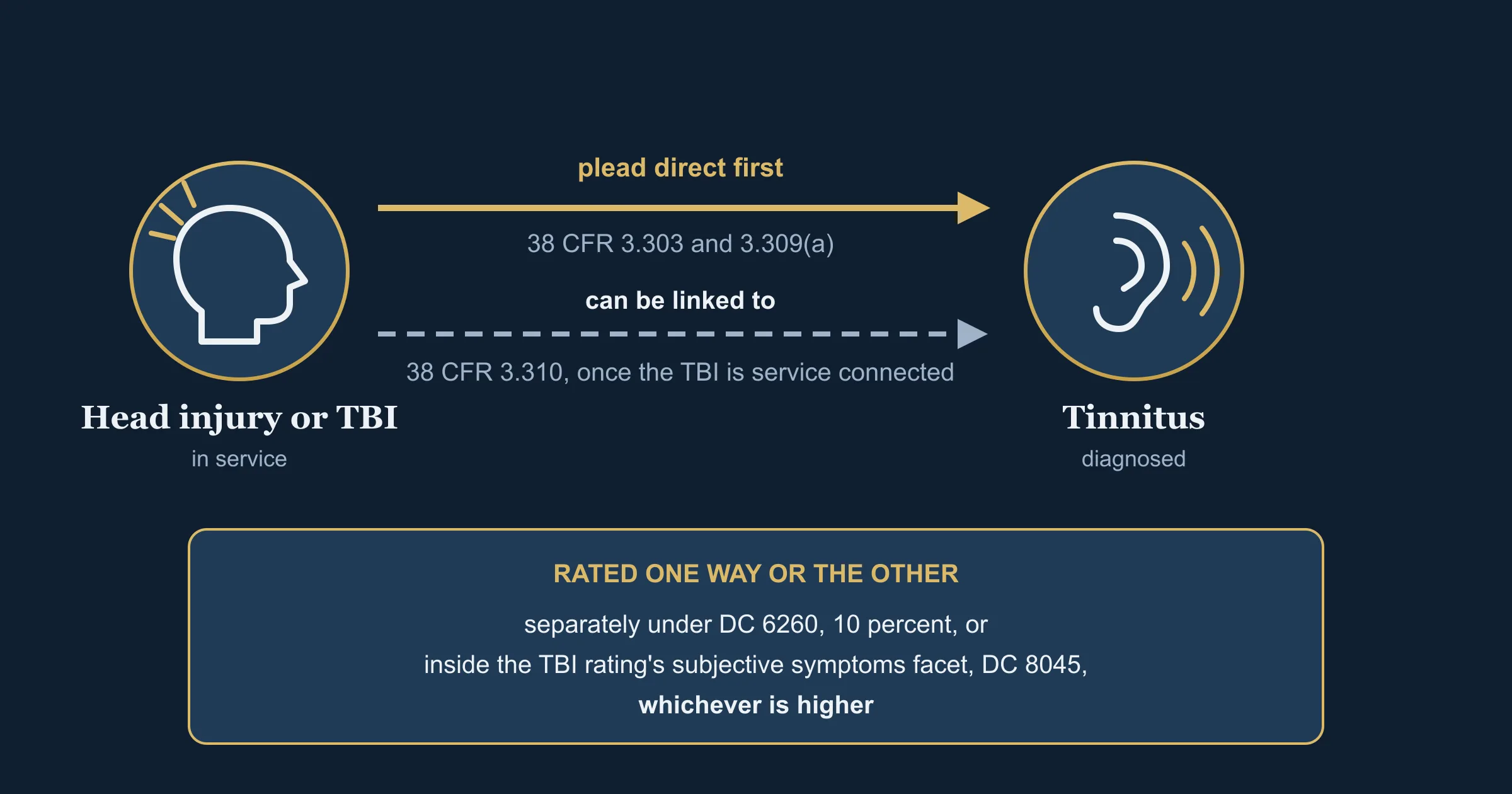
Tinnitus can be service connected as secondary to a service-connected TBI under 38 CFR 3.310(a) when medical evidence links them, but plead direct service connection first: the head injury itself is an in-service event VA's manual treats as a potential cause of tinnitus. VA then rates the tinnitus separately or inside the TBI rating, whichever is higher.
Four more things belong up front. A separate 10 percent for tinnitus can leave your combined rating where it is, and asking VA to use the higher of the two rating methods needs no nexus letter. The research shows an association between TBI and tinnitus, not proof that the brain injury caused yours, in part because a blast that injures the brain can also damage the ear. A diagnosis of tinnitus has to be in the record before a records-based letter can link it, but your own report of recurrent ringing can help you get a VA examination. And no Board decision we read granted tinnitus on a finding that it is secondary to a TBI, though one recites a regional office grant on that basis and another granted tinnitus on a direct basis as related to an in-service head injury; each decision cited here is "binding only with regard to the specific case decided" under 38 CFR 20.1303.
An illustrative example
A veteran was treated for a concussion after a vehicle rollover in service in 2009. VA service connected his TBI at 10 percent on the subjective symptoms facet, for daily headaches, intermittent dizziness and frequent insomnia. About two years after he left the service he noticed a constant ringing, and his doctor recorded it as tinnitus. His records show no combat and no noise exposure VA has conceded, and no ringing during service. A VA audiologist wrote that the tinnitus was less likely than not caused by noise in service and said nothing about the head injury.
On those facts the direct routes are thin, and the open question is whether the brain injury explains the ringing: a question VA's manual puts outside the audiologist's scope. If VA grants the link, the rater compares two methods. With the headaches, dizziness and insomnia still supporting level 1 of the TBI facet, a separate 10 percent for tinnitus combines with the TBI's 10 to 19, which rounds to 20. Counted inside the facet instead, the TBI stays at 10, unless the four symptoms together moderately interfere, which is level 2 of the facet and 40 percent. VA's manual says to use whichever gives the higher evaluation.
We put this example together from the rating rules and the M21-1 provisions on this page to show the order of the checks. It is not a client and not a case result, and it predicts nothing for any claim.
Plead Direct Service Connection First
A secondary claim needs a service-connected TBI and a medical link from the brain injury to the tinnitus. A direct claim needs neither. Where the same event in service could have injured both the brain and the ear, the direct routes are shorter, and one claim can name more than one theory.
The head injury is itself an in-service event
VA's manual says a tinnitus examination may be necessary when service treatment records do not document tinnitus "but there is evidence establishing noise exposure or another in-service event, injury, or disease (for example ear infections, use of ototoxic medication, head injury, barotrauma, or other tympanic trauma) that is medically accepted as a potential cause of tinnitus, and there is a competent diagnosis or competent report of current tinnitus" (M21-1 Part V, Subpart iii, Chapter 2, Section B, Block 3.b). On a direct claim the question is whether your tinnitus is related to the injury in service, and the TBI does not need to be service connected first.
That is how the Board granted tinnitus in 21029040 (2021). In a 2011 statement the veteran said that in service she slipped, hit her head and "was informed she had a slight concussion". Her service treatment records were silent on the fall, but the Board found that their record of severe headaches that month supported her account that she hit her head. A private audiological examiner opined that her tinnitus was as likely as not due to the in-service head injury, and the Board gave that opinion "great probative weight". The VA examiner had opined only on noise exposure and "did not opine if the Veteran's tinnitus was due to a head injury", and the Board found that examination inadequate. It granted service connection under 38 CFR 3.303, a direct basis, after the Court of Appeals for Veterans Claims had vacated an earlier denial (non-precedential, 38 CFR 20.1303).
Noise in service may already be conceded
VA's manual tells the rater to concede hazardous noise when your duty position has "a high, moderate, or low probability of hazardous noise exposure" on VA's Duty MOS Noise Exposure Listing, and adds: "If the evidence establishes that the Veteran was engaged in combat, concede exposure to hazardous noise for the purposes of establishing an event in service" (Block 1.b). The listing "is not an exclusive means of establishing a Veteran's in-service noise exposure". For combat veterans, 38 CFR 3.304(d) accepts "Satisfactory lay or other evidence" of an injury incurred in combat "if the evidence is consistent with the circumstances, conditions or hardships of such service even though there is no official record of such incurrence".
A blast that caused a TBI was also a noise and pressure event in service. Describe it as both: the explosion, how close you were, whether you wore hearing protection, and when the ringing started.
Tinnitus can be presumed service connected, within a window
VA's manual says: "Sensorineural hearing loss and tinnitus are considered organic diseases of the nervous system and are subject to presumptive SC under 38 CFR 3.309(a)" (Block 1.a), citing Fountain v. McDonald, 27 Vet.App. 258 (2015). The Court's holding there is narrower: it adopted the reading that 3.309(a) "includes tinnitus, at a minimum where there is evidence of acoustic trauma". The manual's own list of other organic diseases of the nervous system names tinnitus without that limit (M21-1 Part V, Subpart iii, Chapter 12, Section A, Block 1.d). The regulation itself does not name tinnitus; it lists "Other organic diseases of the nervous system". The presumption has a service requirement and a time limit. Under 38 CFR 3.307(a)(1), "The veteran must have served 90 days or more during a war period or after December 31, 1946", and under 38 CFR 3.307(a)(3) a chronic disease "must have become manifest to a degree of 10 percent or more within 1 year" from separation. DC 6260's only level is 10 percent, for recurrent tinnitus, so in practice the question is whether recurrent tinnitus is shown within a year of leaving service.
The manual also says no medical opinion is required for direct service connection where service records document tinnitus, you have it now, and continuity since service is claimed or shown, with one exception printed right beneath that rule: "An opinion may be necessary in the fact pattern above if evidence suggests a superseding post-service cause of current tinnitus" (Block 3.b).
A TBI claim is read for everything the injury left behind
The manual says a claim mentioning a head injury, concussion or TBI "must be sympathetically read and understood as a claim for all identifiable TBI residuals that can be attributed to one or more TBI events", and that "An explosion, for example, may cause burns, muscle injuries, orthopedic injuries including amputations, and PTSD in addition to a brain injury" (M21-1 Part V, Subpart iii, Chapter 12, Section B, Block 1.f). Name the tinnitus anyway. The manual's own list of example TBI residuals does not mention tinnitus (Block 1.e), so do not count on a rater reading it in.
When the Secondary Theory Does the Work
Under 38 CFR 3.310(a), a "disability which is proximately due to or the result of a service-connected disease or injury shall be service connected". For tinnitus after a TBI, that route matters where the direct routes come up short.
Three situations where a medical opinion on the brain injury does the work
First, tinnitus that started after service, after a documented TBI, with no noise VA has conceded and no ringing recorded in service. VA's manual says "TBI residuals can manifest years after the initial injury" and "A medical opinion is necessary when the medical evidence of record does not show a clear-cut etiology for a sign or symptom claimed as a delayed effect" (M21-1 Part V, Subpart iii, Chapter 12, Section B, Block 2.a, Notes).
Second, a reevaluation of a service-connected TBI. The manual tells raters to "not automatically concede that a new sign, symptom, or diagnosis is a residual of TBI simply because it is listed in" the manual's residual list "or in the evaluation criteria", and to obtain medical clarification where there is not competent evidence of the association (Block 2.g). Tinnitus appearing in the DC 8045 criteria does not make yours a residual.
Third, a VA opinion that answered the noise question and not the head injury. VA's manual, in its table on interpreting medical opinions involving tinnitus, gives an example for the case where the examiner says the tinnitus is not related to hearing loss or cannot determine its cause with reasonable certainty, or there is no hearing loss: if a veteran claims tinnitus "due to another condition (such as head injury, hypertension, and so on, which would be outside the scope of the audiologist), it might be appropriate to request a general medical, ears/nose/throat (ENT), or other examination, and an opinion as to the causation of tinnitus" (M21-1 Part V, Subpart iii, Chapter 2, Section B, Block 3.c). In 18145956 (2018) the Board sent a tinnitus claim back because the VA examiner "did not, however, comment on whether the tinnitus was etiologically related to the Veteran's in-service MVA", the 1975 accident in which the veteran injured his head; the claim was on a direct theory, and the same decision denied service connection for the TBI itself (non-precedential, 38 CFR 20.1303).
Tinnitus is not on the TBI presumption list
38 CFR 3.310(d)(1) names five conditions VA holds to be the result of a service-connected TBI: Parkinsonism, unprovoked seizures, three dementias, depression and diseases of hormone deficiency, each with its own severity or time condition. Tinnitus is not one of them; the word does not appear in 3.310 at all. Paragraph (d)(2) adds: "Neither the severity levels nor the time limits in paragraph (d)(1) of this section preclude a finding of service connection for conditions shown by evidence to be proximately due to service-connected TBI." So a tinnitus claim secondary to a TBI is decided on the evidence, under 3.310(a), and the evidence on the link is medical.
The Board has sent the secondary question back; we found no Board grant on it
In 18145267 (2018) the Board granted service connection for residuals of a mild TBI and, in the same decision, remanded "service connection for tinnitus, as secondary to residuals, mild TBI", a theory the veteran had raised in her appeal form. It ordered an examiner to answer whether the tinnitus was "proximately caused by, or aggravated by residuals, mild traumatic brain injury" (non-precedential, 38 CFR 20.1303).
The route has worked at the regional office: in 18148464 (2018) the Board recited that in an April 2016 rating decision "The RO stated that both were granted as secondary to the Veteran's service-connected TBI", meaning migraines and tinnitus. That is the regional office's decision as the Board described it, not a Board finding. Among the Board decisions we read and screened for this page, none granted tinnitus on a finding that it is secondary to a service-connected TBI.
If the TBI made existing tinnitus worse
38 CFR 3.310(b) service connects an increase in severity of a nonservice-connected condition caused by a service-connected one, but VA will not concede it "unless the baseline level of severity of the nonservice-connected disease or injury is established by medical evidence created before the onset of aggravation or by the earliest medical evidence created at any time between the onset of aggravation and the receipt of medical evidence establishing the current level of severity". VA's manual adds a third kind of evidence for the baseline, "any other credible evidence, including lay evidence, that supports establishment of the baseline", while noting that lay evidence "on its own, may not be sufficient to establish the baseline level of severity" (M21-1 Part V, Subpart ii, Chapter 2, Section D, Block 1.c). It also records that, after Spicer v. McDonough, 61 F.4th 1360 (Fed. Cir. 2023), VA "will no longer consider natural progress" in an aggravation claim, and that permanent worsening is not required (M21-1 Part V, Subpart ii, Chapter 2, Section D, Block 1.a). The baseline deduction survives: the rater determines "the percentage evaluations that would be warranted for both the baseline and current levels of severity" and deducts the baseline (Block 1.g).
For tinnitus that has a hard consequence. DC 6260 has one level, 10 percent, for recurrent tinnitus. If your tinnitus was already recurrent at the baseline, the baseline and the current level both sit at the only level DC 6260 has, so the deduction leaves no percentage to assign under that code however much louder it became. That is not a denial: where there is "competent and credible evidence of an increase in severity of the disability from the established baseline, but the current and baseline disability would be assigned the same level of evaluation under the rating schedule", VA's manual says to "grant SC and assign a noncompensable evaluation", that is, service connection at 0 percent (Block 1.h).
If an examiner called your tinnitus a symptom of hearing loss VA already connects, the manual's rule is different; our guide to tinnitus with service-connected hearing loss covers it.
How VA Rates Tinnitus Beside a TBI: One Method or the Other
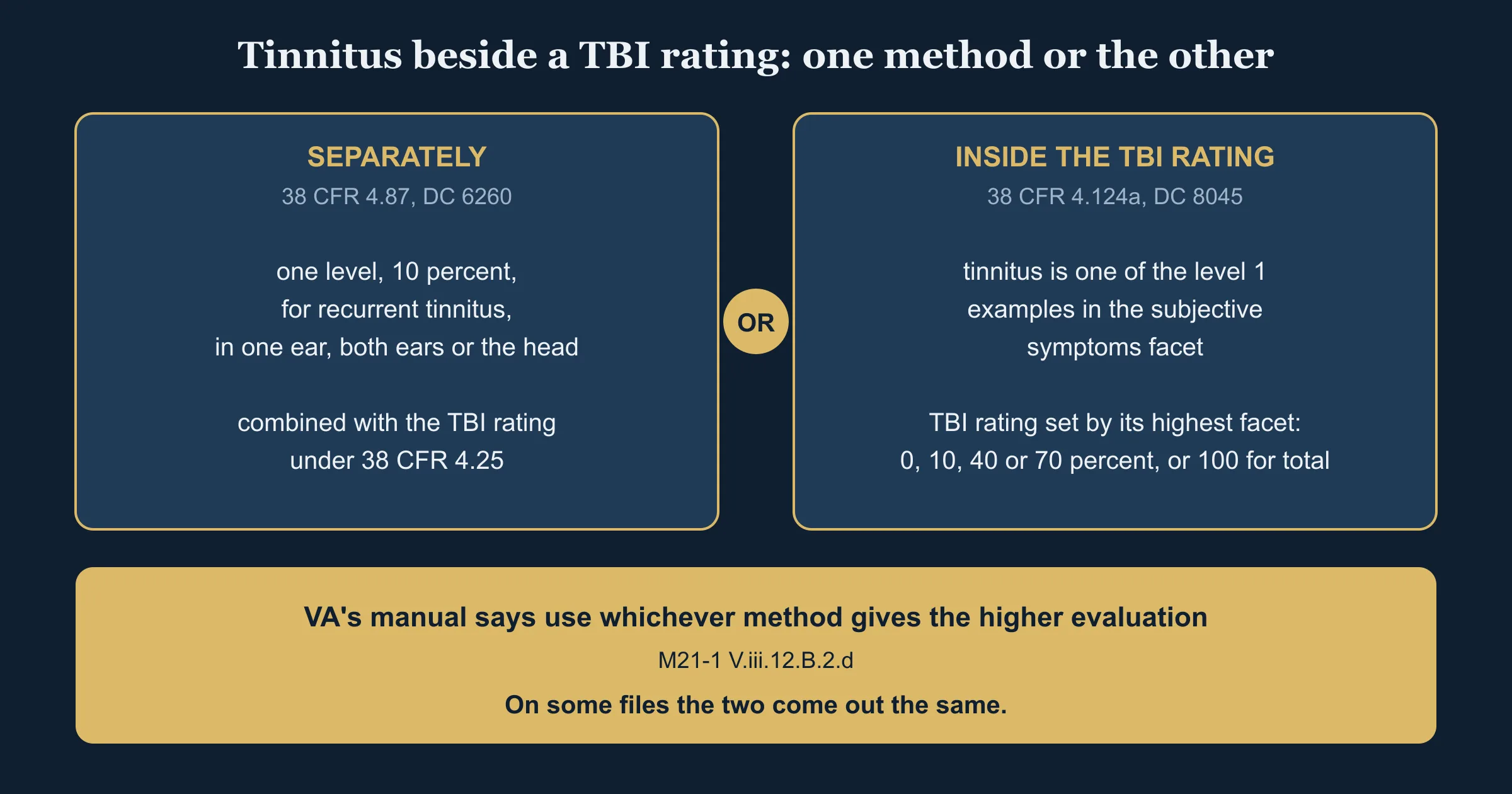
VA's manual tells the rater to rate tinnitus in a veteran with a TBI by whichever of two methods gives the higher evaluation, and the rule cuts both ways.
Method one: separately, under DC 6260
38 CFR 4.87 rates "Tinnitus, recurrent" at 10 percent under DC 6260, and nothing higher. Its notes say: "A separate evaluation for tinnitus may be combined with an evaluation under diagnostic codes 6100, 6200, 6204, or other diagnostic code, except when tinnitus supports an evaluation under one of those diagnostic codes", and "Assign only a single evaluation for recurrent tinnitus, whether the sound is perceived in one ear, both ears, or in the head." In 18148464 the Board held there was "no legal basis for the assignment of a schedular rating in excess of 10 percent for tinnitus" (non-precedential, 38 CFR 20.1303).
Method two: inside the TBI rating, under DC 8045
DC 8045 says both things. It tells the rater to "Evaluate physical (including neurological) dysfunction based on the following list, under an appropriate diagnostic code", and the list includes "hearing loss and tinnitus". It also names tinnitus as an example at level 1 of the subjective symptoms facet: "Three or more subjective symptoms that mildly interfere with work; instrumental activities of daily living; or work, family, or other close relationships. Examples of findings that might be seen at this level of impairment are: intermittent dizziness, daily mild to moderate headaches, tinnitus, frequent insomnia, hypersensitivity to sound, hypersensitivity to light."
The TBI rating is set by its highest facet: "0 = 0 percent; 1 = 10 percent; 2 = 40 percent; and 3 = 70 percent", or 100 percent if any facet is total (38 CFR 4.124a, DC 8045).
The manual's rule: whichever is higher
M21-1's table for a TBI with comorbid conditions says, for tinnitus: evaluate "tinnitus based on one of the following methods, depending on which method results in a higher evaluation: separately under 38 CFR 4.87, DC 6260, or in the subjective symptoms facet under 38 CFR 4.124a, DC 8045" (M21-1 Part V, Subpart iii, Chapter 12, Section B, Block 2.d).
Read in both directions, that rule rules out two claims you will see elsewhere. Tinnitus does not automatically get its own 10 percent on top of the TBI rating, because the rater uses one method, not both. And tinnitus does not simply fold into the TBI rating, because a separate DC 6260 rating is one of the two methods and the manual picks the higher. Where tinnitus is already service connected as part of your TBI, asking VA to apply the higher method is a rating question you can raise yourself; it does not need a nexus letter.
Do not count the same symptom twice: two different rules
38 CFR 4.14 is the general bar: "the evaluation of the same manifestation under different diagnoses are to be avoided." DC 8045 Note (1) is the TBI-specific rule for overlap with a comorbid disorder: "If the manifestations of two or more conditions cannot be clearly separated, assign a single evaluation under whichever set of diagnostic criteria allows the better assessment of overall impaired functioning due to both conditions. However, if the manifestations are clearly separable, assign a separate evaluation for each condition." The manual's tinnitus row applies the same bar to one symptom and chooses by its own test, the higher evaluation, not Note (1)'s better assessment: tinnitus rated under DC 6260 is not also counted toward the subjective symptoms facet.
What the choice does to the combined rating
Ratings are combined, not added. Under 38 CFR 4.25 each further rating is applied to the efficiency the earlier ones leave, so two 10 percent ratings combine to 19, and the combined value "will then be converted to the nearest number divisible by 10", a conversion that "will be done only once per rating decision, will follow the combining of all disabilities". The table below is scoped to the file named in each row; with other ratings in your file, the rows do not carry over. A separate 10 percent that leaves the combined rating where it is today is still combined with any rating added in a later decision: 70 and 10 give 73, which rounds to 70, but 70, 10 and 10 give 76, which rounds to 80.
The two methods compared, for the file named in each row
| TBI rating and its facets (assumed) | Tinnitus separately under DC 6260 | Tinnitus inside the TBI facet | Higher method |
|---|---|---|---|
| TBI 70 percent on the memory facet at level 3, nothing else in the file | 70 and 10 give 73 in Table I, which rounds to 70 | TBI stays 70 | No difference in the combined rating (70) |
| TBI 40 percent on a level 2 facet other than subjective symptoms, nothing else in the file | 40 and 10 give 46 in Table I, which rounds to 50 | TBI stays 40 | Separate (50) |
| TBI 10 percent on subjective symptoms at level 1, with three other qualifying symptoms besides tinnitus, the four together still mildly interfering (for moderate interference, see the note below), nothing else in the file | TBI still 10 on the other three symptoms; 10 and 10 combine to 19, which rounds to 20 | TBI stays 10 | Separate (20) |
| TBI 10 percent on subjective symptoms at level 1, where tinnitus is one of exactly three symptoms and no other facet is above level 0, nothing else in the file | If the two symptoms left no longer meet level 1, the TBI can fall to 0; tinnitus 10, combined 10 | TBI stays 10 | No difference in the combined rating (10) |
Table I values read from 38 CFR 4.25 in the eCFR issue of August 27, 2026. Table I's rows begin at 19, and its headnote reads "10 combined with 10 is 19", which matches the efficiency method that section describes: 90 percent of 90 percent leaves 81 percent, or 19 percent disabled. Facet levels are assumptions for the example; the rater assigns them from the examination. The inside method can also come out higher: with the TBI at 10 percent on three or more other subjective symptoms that mildly interfere, no other facet above level 1 and nothing else in the file, tinnitus counted with them can make the symptoms moderately interfere, which is level 2 of the facet and a TBI rating of 40 percent, against 10 and 10, which combine to 19 and round to 20, for the separate method.
Two codes that do not apply to a TBI
DC 8046, cerebral arteriosclerosis, says "Purely subjective complaints such as headache, dizziness, tinnitus, insomnia and irritability, recognized as symptomatic of a properly diagnosed cerebral arteriosclerosis, will be rated 10 percent and no more under diagnostic code 9305." That is a different disease. It is not a TBI rule, and its 10 percent cap does not apply to a TBI rating. Separately, DC 6260 Note (3) says objective tinnitus, a sound other people can hear, is not rated under DC 6260 but "as part of any underlying condition causing it".
A proposal to change the tinnitus code, not yet law
In February 2022 VA published a proposed rule saying: "VA proposes to evaluate tinnitus only as part of its underlying pathology and to delete DC 6260 entirely. In other words, tinnitus will be compensated through application of DCs 6100, 6204, 6205, 8045, 8046, or 9305, depending on its service-connected cause" (87 FR 8474, 8480). For a veteran whose tinnitus comes from a TBI, that would leave only the DC 8045 method. The same notice says the proposal "will have no impact on veterans currently in receipt of service connection for tinnitus under DC 6260", citing 38 CFR 3.951(a).
It is a proposal, not the rule. The Federal Register lists no final rule for it, and the rating schedule current through November 19, 2026 still contains DC 6260 as quoted above. We make no prediction about whether or when it becomes final, and it is not a reason to rush a claim.
How DC 8045's ten facets are scored is on our TBI and VA disability page.
If Your Hearing Changed Too: Hearing Loss After a TBI
The same event can damage hearing, and DC 8045 lists "hearing loss and tinnitus" together among the physical problems VA evaluates "under an appropriate diagnostic code". This section covers what changes when hearing loss is part of the claim. The hearing tables themselves are on our hearing-loss page.
Claim it by name: do not count on a tinnitus claim to bring hearing loss with it
VA's manual says "a claim for SC that is phrased as being for "tinnitus" generally should not be interpreted as raising a claim for SC (or an increased evaluation) for hearing loss", because tinnitus "has a specific definition" (M21-1 Part V, Subpart iii, Chapter 2, Section B, Block 3.a). The reverse can happen: a hearing-loss claim can bring tinnitus within its scope when other lay or medical evidence raises tinnitus and establishes entitlement to service connection for it (Block 2.a). If your hearing has changed, claim both.
What counts as a hearing loss disability
Under 38 CFR 3.385, "impaired hearing will be considered to be a disability when the auditory threshold in any of the frequencies 500, 1000, 2000, 3000, 4000 Hertz is 40 decibels or greater; or when the auditory thresholds for at least three of the frequencies 500, 1000, 2000, 3000, or 4000 Hertz are 26 decibels or greater; or when speech recognition scores using the Maryland CNC Test are less than 94 percent." The examination "must be conducted by a state-licensed audiologist and must include a controlled speech discrimination test (Maryland CNC) and a puretone audiometry test", without hearing aids (38 CFR 4.85(a)).
The percentage comes from Table VII, which combines a numeral for each ear (38 CFR 4.85(e)); the table is headed diagnostic code 6100. It contains 0 percent cells, so a hearing loss that meets 3.385 can be service connected and still rated 0 percent. A nexus letter does not change your audiogram.
One blast, three routes
In 18147079 (2018) a combat veteran said his hearing was "never the same" after his armored personnel carrier hit a roadside bomb. Noise exposure was conceded, but the VA examiner "did not address the Veteran's in-service exposure to a roadside bomb", and a later VA TBI examiner "noted that the Veteran was injured in a blast explosion that caused hearing loss residuals". The Board sent the claim back for an audiologist to answer whether the hearing loss was related to the in-service noise and the roadside bomb, caused by the service-connected TBI, or aggravated by it (non-precedential, 38 CFR 20.1303). Ask VA to consider all three.
If VA already connects your hearing loss and an examiner calls your tinnitus a symptom of it, VA's manual says to grant the tinnitus "on a direct, not secondary, basis" (Block 3.c). That route does not depend on the TBI at all.
The audiology exam and the hearing tables are on our hearing loss and VA disability page.
The Diagnosis Comes Before the Link
A nexus opinion links a diagnosed condition to its cause. It cannot supply the diagnosis.
What VA's manual says about who can diagnose tinnitus
The manual says: "A diagnosis of tinnitus is a medical determination; a layperson is not competent to render a diagnosis without appropriate medical training and/or background." It also says a layperson can testify to "the perception of sounds in his/her own ear(s) or head", but that this lay testimony "is NOT sufficient, in and of itself, to establish a medically-confirmed diagnosis of tinnitus for the purposes of awarding SC". Your own competent and credible report of current tinnitus still counts when VA decides whether a direct claim needs a medical opinion or an examination (M21-1 Part V, Subpart iii, Chapter 2, Section B, Block 3.b). The same block notes that tinnitus "is sometimes acute and transitory".
Board decisions have not all put it the same way. In 18152388 (2018) the Board wrote that "tinnitus is capable of lay diagnosis". In 18157588 (2018) a VA examiner found that ringing "lasting between 10 and 60 seconds at a time" was too brief to diagnose as tinnitus, and the Board wrote that the veteran "is not competent to provide a diagnosis in this case" and denied the claim (both non-precedential, 38 CFR 20.1303). The safest course is a diagnosis recorded by a clinician or an audiologist, with your own account of when the ringing started and how it has recurred since.
What the Research Shows, and Why a Blast Complicates It
A blast or a blow to the head can injure the inner ear, the hearing nerve and the brain at the same moment, and noise in service can add its own damage. Those are the confounders in this research: a study that finds more tinnitus after a TBI has to show whether the brain injury, an injury to the ear itself, or the sound of a blast or other noise did it. The studies below show an association. None proves that a brain injury caused any one veteran's tinnitus.
A very large VA cohort: an association that remains beside combat noise
In a Million Veteran Program study of 758,005 participants, an adjusted analysis of the 142,078 with complete data gave traumatic brain injury a relative risk of 1.73 for tinnitus, in a model that also included combat noise (1.17 for daily exposure), blast exposure and hearing loss; the authors wrote that blast itself "did not appreciably increase the risk of tinnitus". Two limits apply. The study counted a participant as having a TBI on a head-injury diagnosis or on symptoms reported after head trauma, and those symptoms included ringing in the ears, the outcome being measured. And the model did not test whether the head injury came before the ringing. The authors concluded that the evidence suggests tinnitus in the military is more closely related to environmental exposures than to aging (Clifford and Ryan, Ear and Hearing, 2022).
A prospective study of Marines before and after deployment
Among 1,647 Marine and Navy servicemen assessed before and after deploying to Iraq or Afghanistan, a TBI before deployment was associated with new tinnitus after it (odds ratio 1.86), and a TBI during deployment with tinnitus after deployment (2.65). The highest odds of new tinnitus were among the blast-exposed (2.93), those with moderate to severe TBI symptoms and those with multiple TBIs (Yurgil and colleagues, Journal of Head Trauma Rehabilitation, 2016). The abstract reports accounting for PTSD; it does not mention noise exposure.
Blast against non-blast, among people who all had a TBI
In a retrospective review of the health records of 456 service members with a deployment-related mild TBI, 59 percent of the blast-injured and 40 percent of the non-blast-injured developed tinnitus, and unprotected noise exposure was associated with tinnitus (Karch and colleagues, US Army Medical Department Journal, 2016). In a review of the medical records of 252 patients on a VA TBI inpatient unit, tinnitus was reported by 11 percent before the Iraq war, 18 percent with a non-blast TBI after it began, and 38 percent with a blast-related TBI (Lew and colleagues, Journal of Rehabilitation Research and Development, 2007). Both compare mechanisms of injury, not TBI with no TBI.
Head injuries with no blast at all
A 2024 systematic review of tinnitus after non-blast TBI found it reported in adults with and without hearing loss. It also graded the evidence: the best studies reached only level 2b on the Oxford scale, methods varied widely, and the authors called for prospective research (Le and colleagues, Brain Injury, 2024).
Severity, not cause
In a 2018 national survey of VA patients already diagnosed with tinnitus, those with a TBI diagnosis were 3.6 times as likely to rate their tinnitus-related impairment as very severe rather than none or mild (Coco and colleagues, Journal of Head Trauma Rehabilitation, 2024). That concerns how bad tinnitus is, not what started it.
What this means for an opinion on your claim
The research supports a plausible association between TBI and tinnitus, and tinnitus is reported after head injuries with no blast. In the studies that compare injuries, a blast-related TBI went with more tinnitus than a TBI from other causes, but those comparisons cannot separate the sound of the blast from the brain injury. The one prospective study here measured tinnitus three months after deployment, so it does not cover ringing that first appears later, such as years after leaving service. None of it lets anyone say a brain injury caused your tinnitus because studies say so. VA's manual puts it this way: "In most cases, the cause of tinnitus is unknown. Tinnitus can be associated with hearing loss, exposure to loud noise, ear disease, head injury (traumatic brain injury), cerebrovascular disease, tumors, certain medications, and many other medical conditions" (M21-1 Part V, Subpart iii, Chapter 2, Section B, Block 3.b).
A useful opinion therefore works from your record: how the injury happened, whether there was a blast and how close it was, your noise history and hearing protection, when the ringing began relative to the injury, your audiograms, and the other causes it has to rule in or out.
What Board Decisions on Head Injuries and Tinnitus Show
We read nine Board decisions closely for this page, at their order or remand block and the reasoning on tinnitus or hearing loss, and screened 54 more at the order block, reading the reasoning in each tinnitus decision among them that mentions a TBI or head injury. Of the nine, on a head-injury or TBI link for tinnitus or hearing loss: 1 granted, on a direct basis; 3 sent the question back for an opinion that addresses it; 1 denied it on the evidence; and 1 decided only the noise theory the veteran raised. Of the other three, one was denied for want of a diagnosis; one granted tinnitus on noise in service, citing the hearing loss it service connected and the veteran's report of onset in service, and not on the TBI it granted in the same decision; and one is a rating case. The 54 screened decisions are not in these counts: none of them granted tinnitus on a head-injury or TBI link, and two (1014258 and 18149913) denied tinnitus where a VA opinion in the record went against a head-injury or TBI link. These decisions came from searches, not a random draw, so the counts are not grant rates and predict nothing.
38 CFR 20.1303 says "previously issued Board decisions will be considered binding only with regard to the specific case decided", that "Prior decisions in other appeals may be considered in a case to the extent that they reasonably relate to the case", and that "each case presented to the Board will be decided on the basis of the individual facts of the case in light of applicable procedure and substantive law." We describe each decision for the issue it decided and for no more.
None of the decisions we read or screened granted tinnitus on a finding that it is secondary to a service-connected TBI. The one grant on a head-injury link (21029040) was direct, under 38 CFR 3.303, and it rested on a private audiological opinion after the VA examiner had opined on noise only. In two of the three remands (18145956 and 18147079) the VA opinion on file had not addressed the head injury or the blast.
Service connection granted on a head-injury link
Citation Nr 21029040 (decided May 12, 2021)
Granted: "Service connection for tinnitus is granted." Direct basis, 38 CFR 3.303.
Resolving reasonable doubt in the veteran's favor, the Board found the tinnitus "at least as likely as not related to an in-service head injury", on evidence it found "in relative equipoise". It gave "great probative weight" to a September 2013 private audiological opinion, and called the November 2015 VA examination inadequate because the examiner "did not opine if the Veteran's tinnitus was due to a head injury". The Board had denied the claim in 2019; the Court of Appeals for Veterans Claims vacated that denial in 2020.
Why it matters. A private opinion on the head injury filled the gap the VA examiner left, on the direct route, and it took an appeal to the Court to get there.
Non-precedential: binds only this case (38 CFR 20.1303).
Sent back for an opinion that addresses the TBI or head injury
Citation Nr 18145267 (decided October 26, 2018)
TBI granted; "Entitlement to service connection for tinnitus, as secondary to residuals, mild TBI, is remanded."
With the TBI now service connected, the Board ordered a VA examination on whether the tinnitus was "proximately caused by, or aggravated by residuals, mild traumatic brain injury", noting that the third element of the test for ordering an examination is "a low threshold".
Why it matters. A secondary theory raised in the appeal was sent back for VA's own opinion: with the TBI granted and the veteran's treatment for the claimed disorders in the record, the Board wrote that new VA examinations "are required".
Non-precedential: binds only this case (38 CFR 20.1303).
Citation Nr 18145956 (decided October 30, 2018)
"Entitlement to service connection for tinnitus is remanded." Direct theory: an in-service vehicle accident with a head injury. In the same decision the Board denied service connection for the TBI itself, finding no current residuals.
The VA examiner had found the tinnitus less likely than not caused by service, reasoning about noise and hearing, but "did not, however, comment on whether the tinnitus was etiologically related to the Veteran's in-service MVA". The Board ordered a supplemental opinion on the head injury.
Why it matters. An opinion that answers the noise question does not answer the head-injury question.
Non-precedential: binds only this case (38 CFR 20.1303).
Citation Nr 18147079 (decided November 2, 2018)
"Entitlement to service connection for bilateral hearing loss is remanded." Hearing loss, not tinnitus.
Combat noise was conceded, but the VA examiner "did not address the Veteran's in-service exposure to a roadside bomb". The Board asked an audiologist whether the hearing loss was related to the noise and the roadside bomb, caused by the service-connected TBI, or aggravated by it.
Why it matters. One blast can be the direct event and the secondary theory at once, and the Board asked for both.
Non-precedential: binds only this case (38 CFR 20.1303).
Denied, or decided on another theory
Citation Nr 25003496 (decided March 12, 2025)
"Entitlement to service connection for tinnitus is denied." The TBI was service connected.
The August 2024 examiner related the tinnitus to an acoustic neuroma and hearing loss that were not service connected, and found it "less likely than not" associated with the TBI or noise because it began more than 50 years after service. The Board noted that the veteran "specifically denied tinnitus in 2011 and 2012", and found his own statements "do not constitute competent evidence to establish a relationship" with the TBI.
Why it matters. Here the examiner named another cause, and the claim was denied even though a January 2015 statement the Board quoted said the veteran's hearing loss, tinnitus and balance issues "may be related to TBI". An opinion has to deal with the other causes, and the record may not let it.
Non-precedential: binds only this case (38 CFR 20.1303).
Citation Nr 18157588 (decided December 13, 2018)
Tinnitus and TBI both denied.
The examiner found ringing "lasting between 10 and 60 seconds at a time" too brief to diagnose as tinnitus, and the Board wrote that the veteran was "not competent to provide a diagnosis in this case".
Why it matters. Without a diagnosis there is nothing to link.
Non-precedential: binds only this case (38 CFR 20.1303).
Citation Nr 18150591 (decided November 15, 2018)
"Entitlement to service connection for tinnitus is denied." The TBI was already service connected.
The veteran argued artillery noise. The Board decided that theory against him, relying on a VA opinion based on onset in about 2008, years after service. Its tinnitus analysis does not discuss the TBI as a cause.
Why it matters. Name every theory your evidence supports, including the TBI, in the claim itself.
Non-precedential: binds only this case (38 CFR 20.1303).
A rating case: the separate 10 percent beside a 70 percent TBI
Citation Nr 18148464 (decided November 7, 2018)
TBI raised to 70 percent; migraine above 30 percent and tinnitus above 10 percent denied.
The TBI's 70 percent rested on level 3 of the memory, attention, concentration and executive functions facet. The Board recited that the regional office had granted migraines and tinnitus in 2016 "as secondary to the Veteran's service-connected TBI", and noted the veteran had "separate compensable ratings for his migraine headaches and tinnitus".
Why it matters. A separate tinnitus rating can stand beside a TBI rating that rests on a different facet. On a schedular basis it cannot go above 10 percent.
Non-precedential: binds only this case (38 CFR 20.1303).
On this record, the decisions turned on whether any opinion addressed the head injury at all, and on whether the record held a diagnosis and a timeline. The schedular tinnitus percentage could not go above 10 in any of them: DC 6260 has one level.
Does a Private Opinion Help? What It Has to Cover, and What It Cannot Do
VA must give you an examination or medical opinion when the record lacks enough medical evidence to decide the claim but holds competent evidence of a current disability or of persistent or recurrent symptoms, establishes an event, injury or disease in service (or a disease VA presumes service connected, within its presumptive period), and "Indicates that the claimed disability or symptoms may be associated with the established event, injury, or disease in service or with another service-connected disability" (38 CFR 3.159(c)(4)(i)). VA's manual says that on secondary claims evidence of the service-connected primary disability "substitutes for the in-service event, injury, or disease" and "the threshold for ordering an examination is low", although "A generalized statement merely asserting a conclusion that a condition is secondary to an SC disability is not sufficient" to trigger one (M21-1 Part IV, Subpart i, Chapter 1, Section B, Block 1.e). So a letter is not the first step. It can help a narrower group.
Who a private opinion can help
- Your TBI is service connected, or your claim or appeal for it is filed and not yet decided.
- Your tinnitus is diagnosed in your treatment records or a VA examination.
- Your tinnitus is not already service connected, on its own or as part of the TBI rating.
- The direct routes are thin: no ringing recorded in service, no noise VA has conceded, and no continuity since service.
- VA's opinion on file answered noise or hearing loss and said nothing about the head injury, or it went against the link.
What the opinion has to cover
- The diagnosis, from the recordThat the tinnitus is diagnosed, subjective rather than objective, and recurrent, with when and where it was first recorded.
- The injury, as documentedThe TBI event, its mechanism (a blast, a fall, a vehicle accident, a blow), and its classification at the time, from service records and the TBI examination.
- The timelineWhen the ringing began relative to the injury, and what the records say in between. In 25003496 the VA examiner relied on earlier records in which the veteran had denied tinnitus.
- The noise and the blast, separatedNoise exposure and hearing protection, and for a blast, why the brain injury rather than the sound alone explains the tinnitus, or why both contributed. The research cannot make that call for an individual; the opinion has to reason it from the record.
- The other causesHearing loss, ear disease, medications, vascular causes and tumors, each considered. In 25003496 the examiner attributed the tinnitus to an acoustic neuroma and hearing loss that were not service connected, and nothing in the file answered that.
- Causation and aggravation, answered separatelyWhether the TBI caused the tinnitus, and whether it made existing tinnitus worse, with the baseline the regulation requires for the second.
- Reasons, not a conclusionVA's manual says a bare conclusion that a condition is secondary does not even trigger an examination. The Board weighs the reasoning.
The conclusion is conventionally written as a probability, "at least as likely as not", the wording the Board used in its finding in 21029040. Those words are not in 38 CFR 3.102, which speaks of "an approximate balance of positive and negative evidence which does not satisfactorily prove or disprove the claim". The reasons are what the Board weighs.
What a records review cannot do
A nexus letter is a records-based medical opinion for your claim, not a doctor's visit. A records review cannot add an audiogram, a diagnosis or a record of when the ringing started that your file does not contain. It cannot raise the schedular rating for tinnitus above 10 percent; DC 6260 has one level. It cannot choose between the two rating methods; the rater does, and you can ask for the higher one yourself. It is not a guarantee your claim gets approved. The VA makes that call, not us. A physician on our team will not sign an opinion your file does not support. We write medical evidence; filing claims and representing veterans are not part of our work.
The elements VA looks for in any medical opinion are in our guide to what a nexus letter must include.
Is There a Tinnitus Claim Here, and Does It Need a Letter?
Check your file
Check each statement against your records today. The first two ask whether VA has already settled the link or offers a route that does not need the TBI. The next two ask whether the TBI and the diagnosis are in place. The last two ask whether a VA opinion or decision left the head-injury link unanswered or went against it. None of them adds up to a score; each names something a rater or a physician will look for in the file.
Tick only what your records show right now. Nothing here adds up to a score.
When You May Not Need a Letter, and When We Cannot Help
We write nexus letters. Here is where buying one does not make sense, or cannot work.
- The direct routes may cover youCombat, a noisy duty position or a documented head injury in service can each supply the in-service event of a direct claim, and the link to your tinnitus still has to be shown. VA's manual says no medical opinion is required where service records document tinnitus, you have it now, and continuity since service is claimed or shown, unless evidence suggests a superseding later cause. Plead the direct routes first, and name the TBI as well.
- VA already connects your tinnitusThe link is settled. If the other rating method would give more, that is a rating argument you can make yourself.
- No VA examiner has looked yetVA must provide an examination or opinion when the record lacks enough medical evidence to decide the claim but shows a current diagnosed disability or persistent or recurrent symptoms, an event, injury or disease in service, and an indication that the disability or symptoms may be associated with that event or with a service-connected disability (38 CFR 3.159(c)(4)). Name the head injury in the claim so the examiner is asked about it.
- Your tinnitus comes with service-connected hearing lossIf an examiner calls it a symptom of that hearing loss, VA's manual says to grant it on a direct basis. The TBI is beside the point.
- The combined rating may not moveA separate 10 percent can leave a combined 70 where it is or move it to 80, depending on the exact values before rounding, and on some TBI ratings the two methods come out the same. Whether the link is worth paying to establish now is your call. On the free consultation we give you a straight answer on whether a nexus letter can actually help, before you pay.
- There is no diagnosis yetWithout tinnitus recorded by a clinician or an audiologist, a records review has nothing to build on. A hearing evaluation comes first.
- Another cause is documented and unansweredIf your records point to a cause such as an acoustic neuroma or a medication, and nothing in them answers it, an honest opinion may not be possible. If our clinician reviews your file and concludes an honest nexus opinion cannot be supported, you get your money back before drafting starts.
Questions and Answers
Can tinnitus be service connected secondary to a TBI?
Yes, under 38 CFR 3.310(a), when medical evidence shows the tinnitus is proximately due to or the result of the service-connected TBI. Tinnitus is not one of the five conditions 38 CFR 3.310(d) presumes to follow a TBI, so the link turns on the evidence. Plead direct service connection too: the head injury in service is itself an event VA's manual accepts as a potential cause of tinnitus.
Should I claim tinnitus as direct or as secondary to my TBI?
Both, if your evidence supports both. A direct claim needs no service-connected TBI: the head injury, a blast or noise in service can be the event, and VA's manual treats tinnitus as an organic disease of the nervous system for the 38 CFR 3.309(a) presumption, within one year of separation, if you served 90 days or more during a war period or after December 31, 1946 (38 CFR 3.307(a)(1)). The secondary theory matters where the tinnitus began after service and the direct routes are thin. The one Board grant on a head-injury link we found, 21029040, was direct; it binds only that case (38 CFR 20.1303).
Does tinnitus get its own 10 percent on top of my TBI rating?
Not automatically. VA's manual says to rate tinnitus in a veteran with a TBI either separately under DC 6260 or inside the subjective symptoms facet of DC 8045, whichever gives the higher evaluation (M21-1 Part V, Subpart iii, Chapter 12, Section B, Block 2.d). A separate 10 percent beside a TBI rated on another facet can move the combined rating, as from 40 to 50 where those are the only two ratings, or leave it where it is, as beside a TBI rated 70 with nothing else in the file.
Is tinnitus just part of my TBI rating?
It can be counted there, but that is one of two methods, not the rule. DC 8045 lists tinnitus as an example at level 1 of the subjective symptoms facet and also lists hearing loss and tinnitus among physical problems evaluated under an appropriate diagnostic code. VA's manual picks whichever method gives the higher evaluation. If your decision used the lower one, you can raise that yourself; it needs no nexus letter.
What if VA's audiologist only talked about noise?
Then the head-injury question may be unanswered. VA's manual says a claim for tinnitus due to a head injury may be outside the audiologist's scope and may call for a general medical, ENT or other examination. The Board sent a tinnitus claim back in 18145956 because the VA examiner had not commented on the in-service accident in which the veteran injured his head, ordering a supplemental opinion from "an appropriate clinician", and granted one in 21029040 on a private audiological opinion about a head injury; each binds only its own case (38 CFR 20.1303).
Does research show a TBI causes tinnitus?
It shows an association, not proof for any one veteran. A Million Veteran Program study found TBI associated with tinnitus in a model that also included combat noise, blast exposure and hearing loss, though it counted ringing reported after head trauma as one sign of a TBI. A prospective study of Marines found a TBI before deployment associated with new tinnitus after it, with the highest odds among the blast-exposed. A blast that injures the brain can also damage the ear, so an opinion has to separate the two from your record.
Can I claim hearing loss after a TBI too?
Yes, and claim it by name: VA's manual says a tinnitus claim "generally should not be interpreted as raising a claim" for hearing loss (M21-1 Part V, Subpart iii, Chapter 2, Section B, Block 3.a). Hearing counts as a disability only when it meets the thresholds in 38 CFR 3.385, and the percentage comes from Table VII of 38 CFR 4.85, which includes 0 percent. In 18147079 the Board asked an audiologist whether a veteran's hearing loss came from a roadside bomb in service, was caused by the service-connected TBI, or was aggravated by it; that decision is "binding only with regard to the specific case decided" (38 CFR 20.1303).
Can tinnitus be rated higher than 10 percent with a TBI?
Not under DC 6260, which has one level, 10 percent, whether the sound is in one ear, both or the head. Inside DC 8045, tinnitus is one symptom among others in the subjective symptoms facet, which reaches level 2, 40 percent, where three or more subjective symptoms moderately interfere; DC 8045 Note (2) says the symptoms listed at each level are "only examples". The TBI rating is set by its highest facet. In 18148464 the Board held there was no legal basis for a schedular tinnitus rating above 10 percent; it binds only that case (38 CFR 20.1303).
Is VA getting rid of the tinnitus rating?
VA proposed in February 2022 to delete DC 6260 and rate tinnitus only as part of its cause, which for a TBI would mean DC 8045 (87 FR 8474). It is a proposal, not the rule: the Federal Register lists no final rule for it, and the rating schedule current through November 19, 2026 still contains DC 6260. VA wrote that the proposal would have no impact on veterans already service connected for tinnitus under DC 6260.
How much does a nexus letter for tinnitus secondary to a TBI cost?
The consultation is free, and the fee for a physician-authored letter is on our pricing page. It is paid before drafting, and if our clinician reviews your file and concludes an honest nexus opinion cannot be supported, you get your money back before drafting starts. Read the direct-first section and the section on when you may not need a letter before you book.
Related guides
- Tinnitus and VA disabilityDC 6260, the direct route, and the evidence for a tinnitus claim of any cause.
- TBI and VA disabilityHow DC 8045 rates a brain injury across its ten facets.
- Hearing loss and VA disabilityThe audiology exam, the hearing tables and the hearing-loss claim itself.
- Tinnitus with service-connected hearing lossWhen an examiner calls the tinnitus a symptom of hearing loss VA already connects.
- Headaches after a TBIThe TBI rule for headaches, which differs from the one for tinnitus.
- Depression secondary to TBIOne of the five conditions 38 CFR 3.310(d) does list, and what happens outside its time limits.
- Seizures secondary to TBIUnprovoked seizures after a moderate or severe injury, another 3.310(d) condition.
- What a nexus letter must includeThe elements a rater looks for in any medical opinion.
Bring Your Service Records and Your Rating Decision First
Before you pay anyone for a letter, have your service treatment records and personnel records, any record of the head injury or blast, your TBI rating decision and codesheet, any VA hearing or TBI examination, your audiograms and your treatment records at hand. They answer the first questions on this page: whether a direct route already covers you, whether VA already counts the tinnitus and by which method, and whether any VA opinion left the head injury unanswered. Where one did, the check above shows whether a physician's opinion is worth discussing.
Go back to the readiness check.
The fee and the refund terms are on our pricing page.
Citations & References
- 38 CFR 3.102, Reasonable doubt (eCFR, issue date 2026-08-27) https://www.ecfr.gov/current/title-38/section-3.102
- 38 CFR 3.155(b), intent to file a claim (eCFR, issue date 2026-08-27) https://www.ecfr.gov/current/title-38/section-3.155
- 38 CFR 3.159(c)(4), duty to provide a medical examination or opinion (eCFR, issue date 2026-08-27) https://www.ecfr.gov/current/title-38/section-3.159
- 38 CFR 3.303, principles relating to service connection (eCFR, issue date 2026-08-27) https://www.ecfr.gov/current/title-38/section-3.303
- 38 CFR 3.304(d), combat (eCFR, issue date 2026-08-27) https://www.ecfr.gov/current/title-38/section-3.304
- 38 CFR 3.307(a)(1) and (a)(3), chronic diseases, service length and the one-year period (eCFR, issue date 2026-08-27) https://www.ecfr.gov/current/title-38/section-3.307
- 38 CFR 3.309(a), chronic diseases, other organic diseases of the nervous system (eCFR, issue date 2026-08-27) https://www.ecfr.gov/current/title-38/section-3.309
- 38 CFR 3.310, secondary service connection, aggravation and the TBI paragraph (d) (eCFR, issue date 2026-08-27) https://www.ecfr.gov/current/title-38/section-3.310
- 38 CFR 3.385, Disability due to impaired hearing (eCFR, issue date 2026-08-27) https://www.ecfr.gov/current/title-38/section-3.385
- 38 CFR 3.2501, Supplemental claims (eCFR, issue date 2026-08-27) https://www.ecfr.gov/current/title-38/section-3.2501
- 38 CFR 4.14, Avoidance of pyramiding (eCFR, issue date 2026-08-27) https://www.ecfr.gov/current/title-38/section-4.14
- 38 CFR 4.25, Combined ratings table (eCFR, issue date 2026-08-27) https://www.ecfr.gov/current/title-38/section-4.25
- 38 CFR 4.85, Evaluation of hearing impairment, including Table VII (eCFR, issue date 2026-08-27) https://www.ecfr.gov/current/title-38/section-4.85
- 38 CFR 4.87, Schedule of ratings, ear, DC 6260 (eCFR, issue date 2026-08-27) https://www.ecfr.gov/current/title-38/section-4.87
- 38 CFR 4.124a, DC 8045 and DC 8046 (eCFR, issue date 2026-08-27) https://www.ecfr.gov/current/title-38/section-4.124a
- 38 CFR 20.1303, Nonprecedential nature of Board decisions (eCFR, issue date 2026-08-27) https://www.ecfr.gov/current/title-38/section-20.1303
- Proposed rule, Schedule for Rating Disabilities, Ear, Nose, Throat, and Audiology Disabilities, 87 FR 8474 (February 15, 2022) https://www.federalregister.gov/documents/2022/02/15/2022-02049/schedule-for-rating-disabilities-ear-nose-throat-and-audiology-disabilities-special-provisions
- M21-1, Part V, Subpart iii, Chapter 12, Section B, Blocks 1.e, 1.f, 2.a, 2.d and 2.g, traumatic brain injury (VA KnowVA, article 554400000180832) https://www.knowva.ebenefits.va.gov/system/templates/selfservice/va_ssnew/help/customer/locale/en-US/portal/554400000001018/content/554400000180832/M21-1-Part-V-Subpart-iii-Chapter-12-Section-B-Traumatic-Brain-Injury-TBI
- M21-1, Part V, Subpart iii, Chapter 2, Section B, Blocks 1.a, 1.b, 2.a, 3.a, 3.b and 3.c, conditions of the auditory system (VA KnowVA, article 554400000014464) https://www.knowva.ebenefits.va.gov/system/templates/selfservice/va_ssnew/help/customer/locale/en-US/portal/554400000001018/content/554400000014464/M21-1-Part-V-Subpart-iii-Chapter-2-Section-B-Conditions-of-the-Auditory-System
- M21-1, Part V, Subpart iii, Chapter 12, Section A, Block 1.d, other organic diseases of the nervous system (VA KnowVA, article 554400000180519) https://www.knowva.ebenefits.va.gov/system/templates/selfservice/va_ssnew/help/customer/locale/en-US/portal/554400000001018/content/554400000180519/M21-1-Part-V-Subpart-iii-Chapter-12-Section-A-Neurological-Conditions-and-Convulsive-Disorders
- M21-1, Part V, Subpart ii, Chapter 2, Section D, Blocks 1.a, 1.c, 1.g and 1.h, secondary service connection, aggravation and the baseline (VA KnowVA, article 554400000180484) https://www.knowva.ebenefits.va.gov/system/templates/selfservice/va_ssnew/help/customer/locale/en-US/portal/554400000001018/content/554400000180484/M21-1-Part-V-Subpart-ii-Chapter-2-Section-D-Secondary-Service-Connection-SC-and-Aggravation-of-Non-Service-Connected-NSC-Disabilities
- M21-1, Part IV, Subpart i, Chapter 1, Section B, Block 1.e, the examination threshold on secondary and aggravation claims (VA KnowVA, article 554400000180495) https://www.knowva.ebenefits.va.gov/system/templates/selfservice/va_ssnew/help/customer/locale/en-US/portal/554400000001018/content/554400000180495/M21-1-Part-IV-Subpart-i-Chapter-1-Section-B-Evidentiary-Standards-for-Finding-an-Examination-or-Opinion-Necessary
- Fountain v. McDonald, 27 Vet.App. 258 (2015), U.S. Court of Appeals for Veterans Claims, No. 13-0540 https://www.uscourts.cavc.gov/documents/Fountain13-0540.pdf
- Clifford RE, Ryan AF. The Interrelationship of Tinnitus and Hearing Loss Secondary to Age, Noise Exposure, and Traumatic Brain Injury. Ear Hear. 2022 (PubMed) https://pubmed.ncbi.nlm.nih.gov/35612496/
- Yurgil KA, et al. Prospective Associations Between Traumatic Brain Injury and Postdeployment Tinnitus in Active-Duty Marines. J Head Trauma Rehabil. 2016 (PubMed) https://pubmed.ncbi.nlm.nih.gov/25699623/
- Karch SJ, et al. Hearing Loss and Tinnitus in Military Personnel with Deployment-Related Mild Traumatic Brain Injury. US Army Med Dep J. 2016 (PubMed) https://pubmed.ncbi.nlm.nih.gov/27613210/
- Lew HL, et al. Auditory dysfunction in traumatic brain injury. J Rehabil Res Dev. 2007 (PubMed) https://pubmed.ncbi.nlm.nih.gov/18075949/
- Le M, et al. Prevalence of tinnitus following non-blast related traumatic brain injury: a systematic review of literature. Brain Inj. 2024 (PubMed) https://pubmed.ncbi.nlm.nih.gov/38775672/
- Coco L, et al. Associations Between Traumatic Brain Injury and Severity of Tinnitus-Related Functional Impairment Among US Military Veterans. J Head Trauma Rehabil. 2024 (PubMed) https://pubmed.ncbi.nlm.nih.gov/38709830/
- Board of Veterans' Appeals, Citation Nr 21029040 (2021) https://www.va.gov/vetapp21/Files5/21029040.txt
- Board of Veterans' Appeals, Citation Nr 18145267 (2018) https://www.va.gov/vetapp18/Files10/18145267.txt
- Board of Veterans' Appeals, Citation Nr 18145956 (2018) https://www.va.gov/vetapp18/Files10/18145956.txt
- Board of Veterans' Appeals, Citation Nr 18147079 (2018) https://www.va.gov/vetapp18/Files11/18147079.txt
- Board of Veterans' Appeals, Citation Nr 25003496 (2025) https://www.va.gov/vetapp25/Files3/25003496.txt
- Board of Veterans' Appeals, Citation Nr 18157588 (2018) https://www.va.gov/vetapp18/Files12/18157588.txt
- Board of Veterans' Appeals, Citation Nr 18150591 (2018) https://www.va.gov/vetapp18/Files11/18150591.txt
- Board of Veterans' Appeals, Citation Nr 18148464 (2018) https://www.va.gov/vetapp18/Files11/18148464.txt
- Board of Veterans' Appeals, Citation Nr 18152388 (2018) https://www.va.gov/vetapp18/Files11/18152388.txt
- Board of Veterans' Appeals, Citation Nr 1014258 (2010) https://www.va.gov/vetapp10/Files2/1014258.txt
- Board of Veterans' Appeals, Citation Nr 18149913 (2018) https://www.va.gov/vetapp18/Files11/18149913.txt
M21-1 citations give the part, subpart, chapter, section and block. KnowVA loads the manual's text with JavaScript, so a link can show a blank page for a moment before the text appears. We read the manual text quoted here on November 20, 2026, and the CFR text comes from the eCFR issue dated August 27, 2026. Study figures come from each PubMed abstract, and for the Million Veteran Program study also from its full text in PubMed Central (PMC11193335).