
Secondary claims: sleep apnea and tinnitus
Nexus Letter for Obstructive Sleep Apnea Secondary to Service-Connected Tinnitus
Medically reviewed by the Patriot Path Medical Team
Licensed MD reviewers • Last updated:
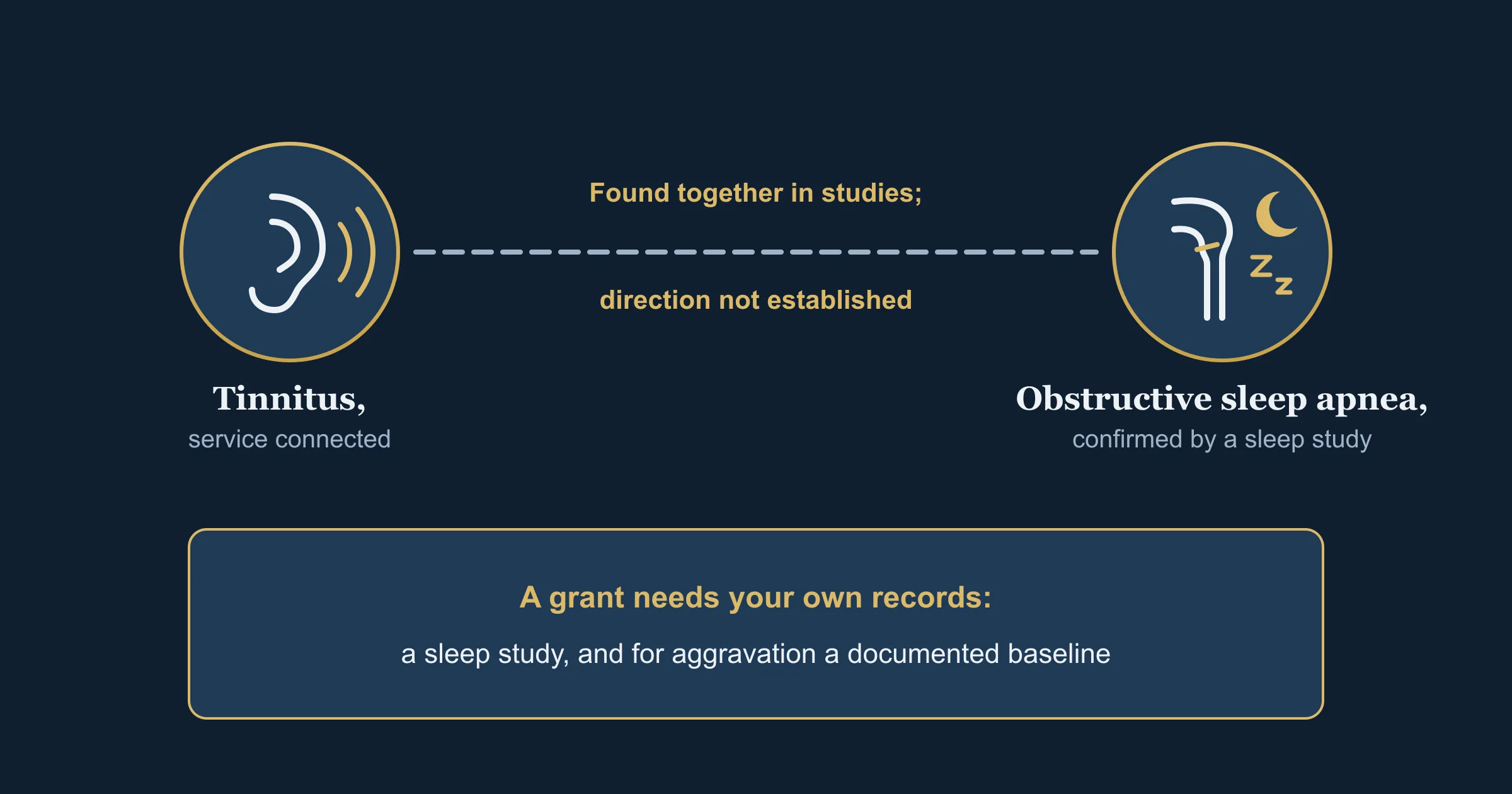
Research finds tinnitus and obstructive sleep apnea together more than chance would predict, but no study we read shows tinnitus causes or worsens apnea. That makes this a hard claim. VA requires a sleep study first, Board decisions have gone both ways, and an honest physician opinion must rest on your own records.
This page is for a veteran with service-connected tinnitus and sleep-study-confirmed obstructive sleep apnea weighing a claim linking the two.
For the wider question, see how a nexus opinion for sleep apnea is built and weighed.
Who Should Not Start Here
Three groups belong on a different page.
- Your sleep apnea is already service connected on another basisWhether VA granted it directly, as secondary to PTSD, rhinitis or sinusitis, or through obesity as an intermediate step (three requirements, all needed, M21-1 V.ii.3.C.3.b), adding tinnitus does not change the rating, which follows the apnea's severity; an aggravation grant is the exception, rated as current minus baseline severity (M21-1 V.ii.2.D.1.g).See our guides to sleep apnea secondary to PTSD and sleep apnea secondary to rhinitis.
- You have no sleep studyVA's manual says: "Do not establish SC for sleep apnea that has not been confirmed by a sleep study." No opinion on a link can stand in for the study.See the sleep-study section.
- What keeps you up is the ringingLying awake from the ringing is not sleep apnea. VA's manual says that where insomnia is "shown to be secondary to, or a symptom of, another underlying SC disability", its symptoms go into the rating for that underlying disability (M21-1 V.iii.13.1.k); our insomnia page explains the exception.Separate claims: insomnia secondary to tinnitus, depression secondary to tinnitus and anxiety secondary to tinnitus.
What the Research Shows About Tinnitus and Sleep Apnea
No study we read shows tinnitus causing apnea or making it worse, and none follows people with tinnitus forward in time.
An association of modest size
Four analyses put the odds at roughly 1.3 to 1.7: 1.34 in the Hamburg City Health Study of 14,355 adults, from self-reports adjusted only for age and sex (Becker 2026, PMID 42806132); 1.36 from insurance diagnosis codes in Taiwan (Koo 2017, PMID 27666578); 1.43 in a United States survey that estimated apnea from questionnaire answers, not a sleep study (Wang 2025, PMID 39841314); and 1.65 pooled across eight case-control or cross-sectional studies, though among severity groups only severe apnea reached significance (Gao, published online 2024, PMID 38321723). None can say which came first.
Time order: what two studies can and cannot show
Koo 2017 looked only for apnea diagnoses recorded before the tinnitus diagnosis, by insurance-claim dates rather than true onset, so it could not find the reverse order. In Hua 2026 (PMID 42485887), 31 people with moderate to severe apnea had airway surgery and their average Tinnitus Handicap Inventory score fell slightly, from 7.61 to 5.55; with no control group it settles nothing.
One study points to hearing loss as the shared factor
Lee 2025 (PMID 41226889), a cross-sectional Korean survey analysis despite cohort in its title, scored apnea risk by questionnaire, not a sleep study. Tinnitus was reported by 11.7 percent at high risk against 7.9 percent at low risk, a difference that was not statistically significant; tinnitus lasting over six months (10.7 against 6.9 percent) was. Matched on high-frequency hearing loss alone, both groups were at 11.7 percent, and the authors concluded that "tinnitus is unaffected by OSA itself but by the hearing loss that accompanies OSA".
What the sleep studies add
In 2,847 overnight sleep studies, once apnea severity was in the model, chronic tinnitus was not associated with loss of deep sleep (Tseng 2022, PMID 36042632). Among 51 people with sleep-study-confirmed apnea and similar hearing, apnea severity did not differ with or without tinnitus (Choi 2025, PMID 40633516). In 39 tinnitus patients with no comparison group, tinnitus duration was correlated with apnea severity, which shows no direction (Hildebrandt 2024, PMID 37473777). A survey linked chronic tinnitus to witnessed apnea, not apnea measured in a sleep study (Han 2025, PMID 40423717). We found no study we could read that tested whether CPAP eases tinnitus, or whether tinnitus affects CPAP use.
What this means for a claim
The research supports an association, which shared hearing loss may explain, not an argument that tinnitus caused or worsened anyone's apnea.
How VA Rates Sleep Apnea Next to Tinnitus
Both codes below are under a proposed rule that is not final.
DC 6847 today (38 CFR 4.97, eCFR issue date 2026-08-27); a 2022 proposal, not final, would replace it.
| Criteria ("6847 Sleep Apnea Syndromes (Obstructive, Central, Mixed):") | Rating |
|---|---|
| Chronic respiratory failure with carbon dioxide retention or cor pulmonale, or; requires tracheostomy | 100 percent |
| Requires use of breathing assistance device such as continuous airway pressure (CPAP) machine | 50 percent |
| Persistent day-time hypersomnolence | 30 percent |
| Asymptomatic but with documented sleep disorder breathing | 0 percent |
Tinnitus, and a proposed rule for both codes
38 CFR 4.87 rates "6260 Tinnitus, recurrent" at 10 percent, its only level. In February 2022 VA proposed rating sleep apnea by whether treatment works, and "to evaluate tinnitus only as part of its underlying pathology and to delete DC 6260 entirely." The same notice says "this proposal will have no impact on veterans currently in receipt of service connection for tinnitus under DC 6260" (87 FR 8474, RIN 2900-AQ72). A 2024 supplemental notice (89 FR 74162), whose only proposal is a new code for constrictive bronchiolitis, is also still proposed; on November 23, 2026 there was no final rule.
The two ratings can stand together
38 CFR 4.96(a) says "Ratings under diagnostic codes 6600 through 6817 and 6822 through 6847 will not be combined with each other." DC 6260 is outside every range named. The check is 38 CFR 4.14, against evaluating "the same manifestation under different diagnoses". On the face of the criteria there is no overlap: DC 6847 rates breathing-device need, daytime sleepiness and respiratory failure; DC 6260 rates a perceived sound. Both are the current text, which the pending proposal would change.
A combined rating, as an example
As an example only: apnea granted on a proximate-cause basis (38 CFR 3.310(a)) at 50 percent, with tinnitus at 10 percent, gives 55 in Table I of 38 CFR 4.25, which rounds up to 60, if those are the only two ratings; and the pending proposal would replace the criteria for the 50 percent level. An aggravation grant is rated as the difference between current and baseline levels (M21-1 V.ii.2.D.1.g), so the example does not apply to it.
For rating questions alone, see our main guide to sleep apnea claims.
The Sleep Study Comes First, Then the Device Question
First, VA needs proof the apnea exists.
VA's sleep-study rule
VA's manual says: "Do not establish SC for sleep apnea that has not been confirmed by a sleep study." A home study counts on a condition: "Accept a home sleep study only if it has been clinically determined that the Veteran can be appropriately evaluated by a home sleep study, and a competent medical provider has evaluated the results." (M21-1 V.iii.4.A.2.a.)
The same block adds that, without a sleep study, a diagnosis still "is sufficient to trigger the duty to assist for scheduling an examination if the other provisions of 38 CFR 3.159(c)(4) have been satisfied."
When the device sets the rating
Under the current DC 6847, which the pending 2022 proposal would replace, the 50 percent level turns on whether a qualifying breathing device, such as CPAP, an oral appliance or an implanted nerve stimulator, is required by the severity of the sleep apnea (Blocks 2.b and 2.c). "The regulation requires that the device be necessary, and this is a medical question." (Block 2.d.)
If the ringing hinders the device
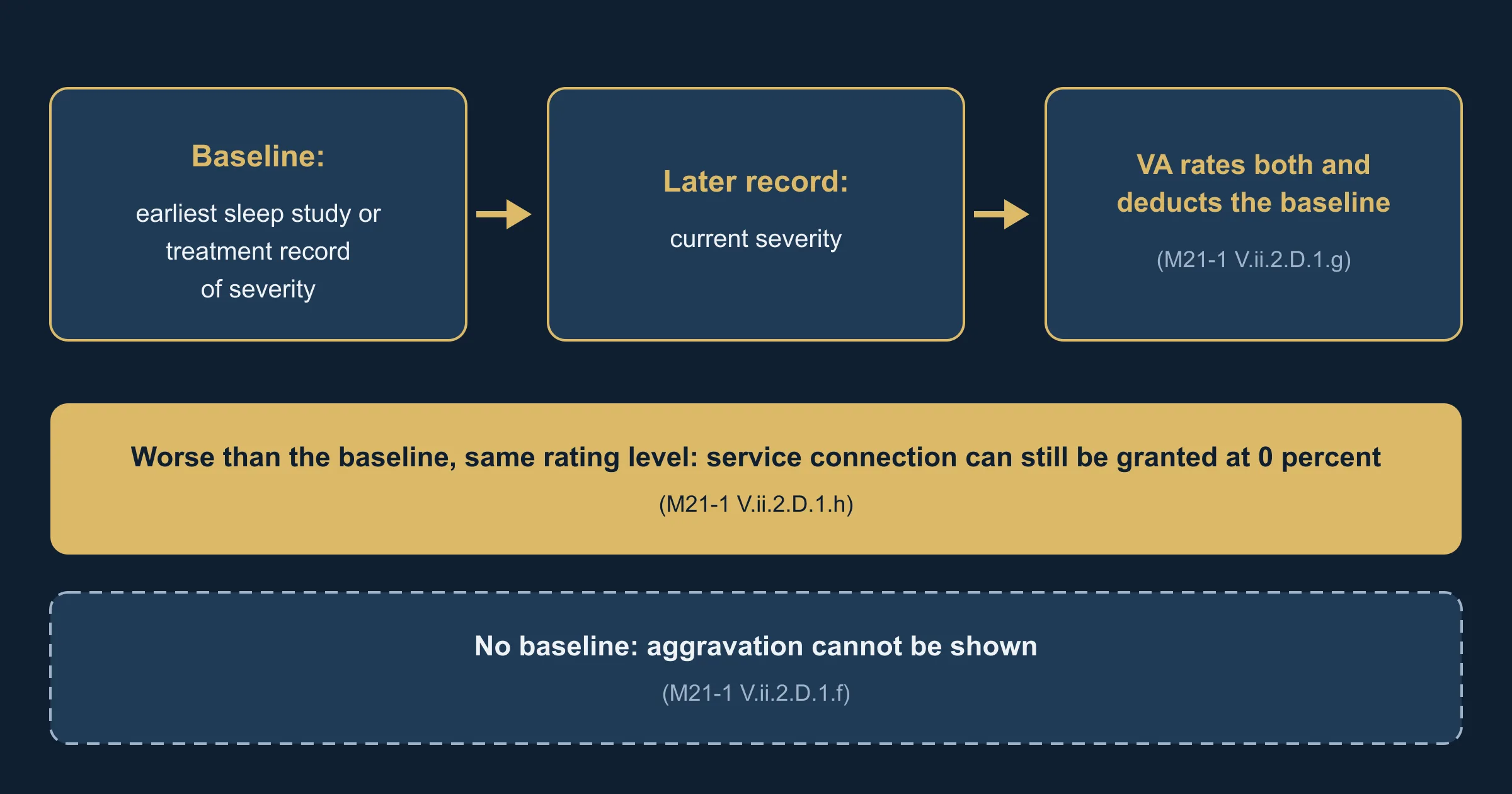
VA's manual counts as aggravation an increase in severity "including where the SC disability has interfered with or impeded treatment for the NSC disability" (M21-1 V.ii.2.D.1.a), without mentioning tinnitus. If you already need the device, an aggravation grant can be service connection at 0 percent (M21-1 V.ii.2.D.1.h). The 2022 proposal's comorbidity Note gives only physical examples, does not mention tinnitus, and is not final. Whether the ringing interferes with your device use is a physician's question on your records; this page does not say the theory works, or that it gains nothing.
What the Board Decisions Show
We found 14 Board of Veterans' Appeals decisions on obstructive sleep apnea secondary to tinnitus: 5 granted service connection (two of them on tinnitus together with a psychiatric condition), 5 denied it and 4 sent it back. That is a convenience sample found by general web search (the Board's own search returned HTTP 403 on November 23, 2026), not a census and not a grant rate. Under 38 CFR 20.1303, previously issued Board decisions "will be considered binding only with regard to the specific case decided." None of the grants assigned a percentage for the apnea.
Service connection granted
22057353 (October 12, 2022)
Granted: "Service connection for obstructive sleep apnea, as secondary to service-connected tinnitus, is granted."
The Board discussed one opinion, a private one from July 2022, which, as the Board recited it, concluded at least as likely as not that the apnea was "the direct result of" the tinnitus "on the basis that he was diagnosed with obstructive sleep apnea subsequent to the onset of his tinnitus." The Board recited no contrary evidence: "Absent probative evidence to the contrary, the Board is not in a position to further question the opinion."
Why it matters. A private, unrebutted causation opinion. Its conclusion rested, as recited, on the apnea being diagnosed after the tinnitus began, and no probative contrary evidence tested that reasoning.
It also granted hypertension, which our guide to hypertension secondary to sleep apnea covers.
A23033748 (November 29, 2023)
Granted: "Entitlement to service connection for sleep apnea secondary to tinnitus is granted."
A private August 2020 opinion concluded, as recited, that the apnea was "more likely than not caused by and/or aggravated by" the tinnitus. On the March 2021 VA opinion the Board wrote: "The examiner failed to address the aggravation element."
A25035209 (April 16, 2025)
Granted: "Service connection on a secondary basis for obstructive sleep apnea (OSA) is granted."
Tinnitus together with generalized anxiety disorder. A private opinion, as recited, concluded on causation only. The Board found the VA examination inadequate for skipping aggravation, citing El-Amin, and resolved the approximate balance for the veteran (38 CFR 3.102).
A25105376 (December 8, 2025)
Granted: "Service connection for sleep apnea, to include as secondary to service-connected tinnitus is granted."
Private opinions concluded caused or aggravated, in the alternative. Three VA examiners were negative; the Board found they "did not adequately address aggravation".
18142617 (October 16, 2018)
Granted: "Entitlement to service connection for sleep apnea is granted."
A private opinion addressed aggravation only, by tinnitus together with depression and a limb movement disorder. A VA opinion the Board found probative addressed direct causation only. The Board found the evidence "at least in relative equipoise".
Service connection denied
25009182 (July 14, 2025)
Denied, on every theory the Board considered, including toxic exposure; that is not a presumption.
Two VA examiners (June and December 2023) addressed causation and aggravation and were negative. The December 2023 examiner's reasoning, as the Board recorded it: "Although there is high incidence of sleep impairment and sleep apnea in patients with tinnitus, there is no documentation that tinnitus causes the pathological changes in the larynx that cause sleep apnea. The medical literature simply provides evidence of coincidence and not causation." The examiner also reasoned, as recorded, that CPAP would be highly unlikely to relieve tinnitus-related apnea. The record noted a BMI over 38, and the only private opinion addressed direct service.
Why it matters. The strongest argument against this claim.
A25034143 (April 14, 2025)
Denied.
Three VA opinions were negative and, as recited, skipped aggravation, but the Board found "no competent nexus opinion" for the veteran.
20052058 (August 5, 2020)
Denied.
Two VA opinions, one on aggravation, were negative. Four opinions linked "a sleep disorder or insomnia" to the tinnitus; the Board said they "do not address the separately diagnosed sleep apnea in any way", and two, the veteran's own, said the apnea was "not in any way related".
20059945 (September 11, 2020)
Denied.
A VA examiner found, as the Board recorded it, no medical evidence of tinnitus contributing to apnea or its worsening. No private opinion.
1800416 (January 4, 2018)
Denied.
VA opinions on causation and aggravation were negative. The veteran's articles were "of limited probative value" because none discussed his own symptoms.
Sent back for an examination or a new opinion
25005035 (April 14, 2025)
Remanded, after an earlier Board denial was vacated.
The VA opinions were inadequate; "a lack of documented treatment alone is not a sufficient basis for a negative opinion". On aggravation, the Board said "the clinician must attempt to establish a baseline level of severity of the diagnosed disability prior to aggravation by the primary service-connected disability".
A25006591 (January 24, 2025)
Remanded.
The VA opinion "did not address the Veteran's specific contentions that his OSA is due to his tinnitus".
25000654 (January 16, 2025)
Remanded.
No VA examination yet. In its instructions to the examiner, the Board wrote that, under a 2019 Court decision, secondary service connection "does not require permanent worsening to qualify for service connection based on aggravation".
What this sample shows, and what it does not
Every grant had a private opinion favourable on the apnea (in two, on tinnitus together with a psychiatric condition), and no denial recites one; in 20052058 the Board said the opinions submitted "do not address the separately diagnosed sleep apnea in any way". A VA opinion that skipped aggravation was discounted in three grants, was found probative in 18142617, which was granted anyway, and stood in A25034143, where no favourable opinion existed. Fourteen decisions cannot show that a private opinion produces a grant.
No grant made or recited a baseline finding. We found no decision weighing a reasoned private opinion against a VA opinion that addressed both causation and aggravation, so that outcome is unknown.
Found by web search, these 14 decisions are not a census or a rate, and predict nothing for any claim.
What an Honest Physician Opinion Can and Cannot Say
A physician's opinion is evidence about your records, not a summary of the literature.
The answer to the examiner in 25009182
That examiner was right that the literature shows coincidence, not causation; an honest opinion concedes it, and a causation opinion leaning on the literature will meet the same reply. The examiner's sentence does not reach aggravation argued from one veteran's measured records against a documented baseline, a separate question that, in A25035209, the Board said an adequate secondary opinion must discuss. No grant in our sample was won that way, and we found no decision testing it against a VA opinion that addressed both questions. That examiner also named obesity, a very small oropharynx and age as likelier causes; an opinion on your records has to address any such factors they show.
What it can say
- That a sleep study confirmed your obstructive sleep apnea, and when your tinnitus began.
- That the two occur together in population studies, as an association only.
- A conclusion on causation and a separate one on aggravation, each reasoned from your records. The 25005035 remand frames them: would you have sleep apnea, and would it be less severe, but for the tinnitus.
- For aggravation, the earliest record of the apnea's severity set against a later one, and how weight, age or other risk factors in your records bear on that change.
What it cannot say
- That the literature shows tinnitus caused your apnea; it does not.
- That tinnitus beginning first, by itself, shows a link.
- Anything your records do not contain.
VA's rule for aggravation
Under 38 CFR 3.310(b), VA will not concede aggravation "unless the baseline level of severity of the nonservice-connected disease or injury is established by medical evidence created before the onset of aggravation or by the earliest medical evidence created at any time between the onset of aggravation and the receipt of medical evidence establishing the current level of severity". VA's manual adds "any other credible evidence, including lay evidence, that supports establishment of the baseline", though lay evidence alone may not be enough (M21-1 V.ii.2.D.1.c). If no baseline can be established, "no aggravation can be demonstrated", and VA must not "assume a baseline of 0 percent" (Block 1.f). The same block says an aggravation claim should be denied for lack of a baseline only after VA's duty to assist, which includes developing evidence of the baseline, has been fulfilled.
After Spicer v. McDonough (Fed. Cir. 2023), VA "will no longer consider natural progress", and permanent worsening is not required (Block 1.a). The baseline deduction remains (Block 1.g). The text of 38 CFR 3.310(b) still refers to natural progress; the manual's instruction applies the Spicer holding. This is VA's rule, not how the grants above were won.
Whether a physician can support an opinion on your records is a decision made after review; it may be no.
For the general format of a nexus letter, see our nexus letter example. We publish no sample for this pairing.
Readiness Check: Is There Anything for a Physician to Review?
Check your file
This check looks at your file. The second and third statements are requirements no letter can supply.
Tick only what your records show today. Nothing here adds up to a score.
Questions and Answers
Can tinnitus cause obstructive sleep apnea?
No study we read shows that it does. Population studies find the two together more than chance predicts, odds of roughly 1.3 to 1.7, and no study we read establishes which came first. An opinion has to reason from one veteran's records, not the literature.
Can sleep apnea cause tinnitus?
No study we read shows that either. One insurance database was searched, by design, only for apnea recorded before tinnitus, and in 31 people with no control group tinnitus scores fell slightly after airway surgery. This page does not cover a claim for tinnitus secondary to sleep apnea.
Has the Board of Veterans' Appeals granted sleep apnea as secondary to tinnitus?
Some Board decisions have granted it and others have denied it; the ones we found by web search are a convenience sample, not a rate. Each decision is "binding only with regard to the specific case decided" (38 CFR 20.1303).
If the ringing keeps me awake, is that sleep apnea?
Not by itself. Sleep apnea is a breathing disorder a sleep study confirms; lying awake from the ringing is a different claim, covered by our insomnia, depression and anxiety guides.
Do I need a sleep study before filing?
To be granted, yes: VA's manual says "Do not establish SC for sleep apnea that has not been confirmed by a sleep study." A home study counts only on the manual's conditions. VA's manual adds that a diagnosis without a sleep study can still trigger the duty to assist for scheduling an examination, if the other provisions of 38 CFR 3.159(c)(4) have been satisfied (M21-1 V.iii.4.A.2.a).
Would a sleep apnea rating combine with my tinnitus rating?
It could: 38 CFR 4.96(a) does not bar the pair, and 38 CFR 4.14 bars evaluating "the same manifestation under different diagnoses", which on the face of the current criteria the two codes do not share. This page's rating section works an example for a proximate-cause grant; an aggravation grant is rated as the difference from the baseline. DC 6847 and DC 6260 are both the subject of a 2022 proposed rule (87 FR 8474) that is not final.
What if the ringing makes it hard to use my CPAP?
Three passages in VA's manual bear on it, and none mentions tinnitus. On the device level, under the current DC 6847, which a pending 2022 proposal (87 FR 8474) would replace: "Use of a device absent a medical determination that the device is necessary does not qualify. The regulation requires that the device be necessary, and this is a medical question. If the competent medical evidence of record shows that use of a qualifying breathing assistance device is medically required, the fact that the claimant is not actually using it as prescribed is not relevant." On aggravation, the manual counts an increase in severity "including where the SC disability has interfered with or impeded treatment for the NSC disability." And: "Whenever there is competent and credible evidence of an increase in severity of the disability from the established baseline, but the current and baseline disability would be assigned the same level of evaluation under the rating schedule, grant SC and assign a noncompensable evaluation." Whether the ringing interferes with your device use, and whether that changed the apnea's severity from a documented baseline, is a medical question for a physician with your records. The manual does not address this pairing or say whether such a claim succeeds or fails.
Is obstructive sleep apnea a PACT Act presumptive condition?
No. The presumptive lists in 38 CFR 3.309, 38 CFR 3.320 and 38 U.S.C. 1120 do not mention sleep apnea. When VA finalized its 2021 presumptions for fine particulate matter in 2023 (88 FR 60336), it recorded that "Another commenter questioned why obstructive sleep apnea was not added as a presumptive condition" and answered: "For the reasons provided below, VA makes no changes based on these comments." Its reasoning included: "Unlike asthma, sinusitis, and rhinitis, obstructive sleep apnea can be related to anatomic risk factors, such as craniofacial profile, structural abnormalities (e.g., pharyngeal wall instability) and neck circumference." That was a 2023 response to comments; the rule also notes the PACT Act process for adding presumptions later.
What does a physician opinion for sleep apnea and tinnitus cost?
The consultation is free, and the fee is $1,500, flat. The fee is due before your letter is drafted. If our clinician reviews your file and concludes an honest nexus opinion cannot be supported, you get your money back. Once we begin drafting your letter, the fee covers that work.
Related guides
- Sleep apnea claims: the full guideClaims on any basis.
- Sleep apnea secondary to PTSDA different primary condition.
- Sleep apnea secondary to rhinitisThe nasal airway route.
- Hypertension secondary to sleep apneaA claim built on service-connected apnea, including Board decision 22057353.
- Insomnia secondary to tinnitusSleep lost to the ringing itself: a different claim.
- Tinnitus and VA disabilityThe tinnitus claim itself.
Gather Your Sleep Records First
Before paying anyone for an opinion, gather every sleep study, sleep-medicine note and device prescription, your tinnitus rating decision, any VA apnea examination, and notes mentioning the ringing and your sleep.
For claims on any basis, read how VA weighs the evidence in sleep apnea claims.
The fee and the refund terms are on our pricing page.
Citations & References
- 38 CFR 3.102, Reasonable doubt (eCFR, issue date 2026-08-27) https://www.ecfr.gov/current/title-38/section-3.102
- 38 CFR 3.159(c)(4), duty to provide a medical examination or opinion (eCFR, issue date 2026-08-27) https://www.ecfr.gov/current/title-38/section-3.159
- 38 CFR 3.309, Disease subject to presumptive service connection (eCFR, issue date 2026-08-27) https://www.ecfr.gov/current/title-38/section-3.309
- 38 CFR 3.310, secondary service connection and aggravation (eCFR, issue date 2026-08-27) https://www.ecfr.gov/current/title-38/section-3.310
- 38 CFR 3.320, Claims based on exposure to fine particulate matter (eCFR, issue date 2026-08-27) https://www.ecfr.gov/current/title-38/section-3.320
- 38 CFR 4.14, Avoidance of pyramiding (eCFR, issue date 2026-08-27) https://www.ecfr.gov/current/title-38/section-4.14
- 38 CFR 4.25, Combined ratings table (eCFR, issue date 2026-08-27) https://www.ecfr.gov/current/title-38/section-4.25
- 38 CFR 4.87, Schedule of ratings, ear, DC 6260 (eCFR, issue date 2026-08-27) https://www.ecfr.gov/current/title-38/section-4.87
- 38 CFR 4.96(a), Rating coexisting respiratory conditions (eCFR, issue date 2026-08-27) https://www.ecfr.gov/current/title-38/section-4.96
- 38 CFR 4.97, Schedule of ratings, respiratory system, DC 6847 (eCFR, issue date 2026-08-27) https://www.ecfr.gov/current/title-38/section-4.97
- 38 CFR 20.1303, Nonprecedential nature of Board decisions (eCFR, issue date 2026-08-27) https://www.ecfr.gov/current/title-38/section-20.1303
- 38 U.S.C. 1120, Presumption of service connection for certain diseases associated with exposure to burn pits and other toxins (govinfo, 2024 edition) https://www.govinfo.gov/content/pkg/USCODE-2024-title38/html/USCODE-2024-title38-partII-chap11-subchapII-sec1120.htm
- Proposed rule, Schedule for Rating Disabilities, Ear, Nose, Throat, and Audiology Disabilities; Special Provisions Regarding Evaluation of Respiratory Conditions, 87 FR 8474 (February 15, 2022), RIN 2900-AQ72 https://www.federalregister.gov/documents/2022/02/15/2022-02049/schedule-for-rating-disabilities-ear-nose-throat-and-audiology-disabilities-special-provisions
- Supplemental notice of proposed rulemaking, 89 FR 74162 (September 12, 2024), RIN 2900-AQ72 https://www.federalregister.gov/documents/2024/09/12/2024-20542/schedule-for-rating-disabilities-ear-nose-throat-and-audiology-disabilities-special-provisions
- Final rule, Presumptive Service Connection for Respiratory Conditions Due to Exposure to Fine Particulate Matter, 88 FR 60336 (September 1, 2023) https://www.federalregister.gov/documents/2023/09/01/2023-18979/presumptive-service-connection-for-respiratory-conditions-due-to-exposure-to-fine-particulate-matter
- M21-1, Part V, Subpart iii, Chapter 4, Section A, Blocks 2.a to 2.d, sleep apnea and sleep studies (VA KnowVA, article 554400000180967) https://www.knowva.ebenefits.va.gov/system/templates/selfservice/va_ssnew/help/customer/locale/en-US/portal/554400000001018/content/554400000180967/M21-1-Part-V-Subpart-iii-Chapter-4-Section-A-Respiratory-Conditions
- M21-1, Part V, Subpart iii, Chapter 13, Block 1.k, considering service connection for insomnia (VA KnowVA, article 554400000180520) https://www.knowva.ebenefits.va.gov/system/templates/selfservice/va_ssnew/help/customer/locale/en-US/portal/554400000001018/content/554400000180520/M21-1-Part-V-Subpart-iii-Chapter-13-Mental-Disorders
- M21-1, Part V, Subpart ii, Chapter 2, Section D (VA KnowVA, article 554400000180484): Blocks 1.a, 1.c, 1.f, 1.g and 1.h, on aggravation of sleep apnea by a service-connected condition and the baseline it is measured from https://www.knowva.ebenefits.va.gov/system/templates/selfservice/va_ssnew/help/customer/locale/en-US/portal/554400000001018/content/554400000180484/M21-1-Part-V-Subpart-ii-Chapter-2-Section-D-Secondary-Service-Connection-SC-and-Aggravation-of-Non-Service-Connected-NSC-Disabilities
- M21-1, Part V, Subpart ii, Chapter 3, Section C, Block 3.b, obesity as an intermediate step (VA KnowVA, article 554400000180488) https://www.knowva.ebenefits.va.gov/system/templates/selfservice/va_ssnew/help/customer/locale/en-US/portal/554400000001018/content/554400000180488/M21-1-Part-V-Subpart-ii-Chapter-3-Section-C-Reviewing-Diagnoses
- Board of Veterans' Appeals, Citation Nr 18142617 (2018) https://www.va.gov/vetapp18/Files10/18142617.txt
- Board of Veterans' Appeals, Citation Nr 22057353 (2022) https://www.va.gov/vetapp22/Files10/22057353.txt
- Board of Veterans' Appeals, Citation Nr A23033748 (2023) https://www.va.gov/vetapp23/Files11/A23033748.txt
- Board of Veterans' Appeals, Citation Nr A25035209 (2025) https://www.va.gov/vetapp25/Files4/A25035209.txt
- Board of Veterans' Appeals, Citation Nr A25105376 (2025) https://www.va.gov/vetapp25/Files12/A25105376.txt
- Board of Veterans' Appeals, Citation Nr 1800416 (2018) https://www.va.gov/vetapp18/Files1/1800416.txt
- Board of Veterans' Appeals, Citation Nr 20052058 (2020) https://www.va.gov/vetapp20/Files8/20052058.txt
- Board of Veterans' Appeals, Citation Nr 20059945 (2020) https://www.va.gov/vetapp20/Files9/20059945.txt
- Board of Veterans' Appeals, Citation Nr 25009182 (2025) https://www.va.gov/vetapp25/Files7/25009182.txt
- Board of Veterans' Appeals, Citation Nr A25034143 (2025) https://www.va.gov/vetapp25/Files4/A25034143.txt
- Board of Veterans' Appeals, Citation Nr 20051189 (2020) https://www.va.gov/vetapp20/Files8/20051189.txt
- Board of Veterans' Appeals, Citation Nr A25006591 (2025) https://www.va.gov/vetapp25/Files1/A25006591.txt
- Board of Veterans' Appeals, Citation Nr 25000654 (2025) https://www.va.gov/vetapp25/Files1/25000654.txt
- Board of Veterans' Appeals, Citation Nr 25005035 (2025) https://www.va.gov/vetapp25/Files4/25005035.txt
- Koo M, et al. Risk of tinnitus in patients with sleep apnea: A nationwide, population-based, case-control study. Laryngoscope. 2017 (PubMed) https://pubmed.ncbi.nlm.nih.gov/27666578/
- Wang C, et al. Association between obstructive sleep apnea and Tinnitus in the United States: NHANES 2005-2020. Sleep Breath. 2025 (PubMed) https://pubmed.ncbi.nlm.nih.gov/39841314/
- Gao J, et al. Association Between Sleep Apnea and Tinnitus: A Meta-Analysis. Ear Nose Throat J. Published online 2024 (PubMed) https://pubmed.ncbi.nlm.nih.gov/38321723/
- Lee SJ, et al. Exploring a Possible Link Between Tinnitus and the Risk of Obstructive Sleep Apnea. J Clin Med. 2025 (PubMed) https://pubmed.ncbi.nlm.nih.gov/41226889/
- Choi S, et al. Association of tinnitus with obstructive sleep apnea and rapid eye movement-related obstructive sleep apnea in similar hearing threshold groups. Braz J Otorhinolaryngol. 2025 (PubMed) https://pubmed.ncbi.nlm.nih.gov/40633516/
- Hildebrandt J, et al. Sleep disorders in patients with chronic tinnitus. Laryngorhinootologie. 2024 (PubMed) https://pubmed.ncbi.nlm.nih.gov/37473777/
- Tseng HH, et al. Sleep apnea plays a more important role on sleep N3 stage than chronic tinnitus in adults. Medicine (Baltimore). 2022 (PubMed) https://pubmed.ncbi.nlm.nih.gov/36042632/
- Han SY, et al. Relationship Between Chronicity and Severity of Tinnitus and Sleep-Related Issues. Otol Neurotol. 2025 (PubMed) https://pubmed.ncbi.nlm.nih.gov/40423717/
- Becker B, et al. Tinnitus in urban settings: insights into lifestyle and medical factors from the Hamburg City Health Study. Eur Arch Otorhinolaryngol. 2026 (PubMed) https://pubmed.ncbi.nlm.nih.gov/42806132/
- Hua N, et al. Quality-of-life outcomes before and after multilevel pharyngeal surgery in moderate-to-severe obstructive sleep apnea. Braz J Otorhinolaryngol. 2026 (PubMed) https://pubmed.ncbi.nlm.nih.gov/42485887/
KnowVA can show a blank page for a moment while its text loads. We read the manual and the Federal Register status on November 23, 2026; CFR text is from the eCFR issue dated August 27, 2026. Study figures come from PubMed abstracts, and for three studies also from the full text.